











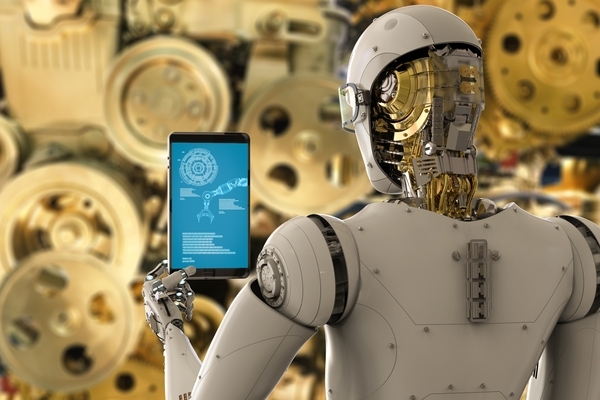
The digitalization surrounding us and artificial intelligence, which is taking over new areas of life, will change not only existing business models but, ultimately, the entire environment in which we live. Maybe not right away, but it will change. Especially since individual machines and groups of devices are already communicating or even “negotiating” with each other, and the interaction of platforms, cyber-physical and blockchain chains is becoming an everyday occurrence, it is hard to disagree with those who speak of a “Silicon Economy.” An economy whose driving force will be artificial intelligence, creating new models of business operation.
Which of these will turn the current world “upside down” and which will develop evolutionarily, without too many fireworks, are questions occupying businessmen, scientists, and especially logisticians, all over the world. However, thinking alone is not enough. You have to meet and simply talk about it with others, and something will surely come of it. An opportunity will be, among others, the 37th “Dortmund Talks” (Dortmunder Gespräche) organized in September, i.e., the Future of Logistics Congress, showing how others are implementing innovations in their companies to continue to function effectively on the market. The main thematic blocks will focus on issues such as: the digital sandbox (i.e., the latest solutions for the Social Networked Industry); digital CL logistics and the center of efficiency and IT (in the aspect of the interpenetration of science and practice); machine learning in logistics; how digitalization is changing the world of load carriers (i.e., “from cardboard to pallet”), as well as from basics to artificial intelligence (in the area of hospital logistics and healthcare). In Dortmund, it will be possible to learn about modern technologies and solutions in the field of: intralogistics, trade, production, maintenance, and transport, which can significantly increase efficiency and productivity in companies, which, as is well known, is currently in line with the mission of the Social Networked Industry.
But why would logisticians meet in a sandbox? Well, because as part of the first tour of the Digital Sandbox in Dortmund, they will receive the latest research results and practical implementation results in areas such as, for example, digital order processing for effective use in value chains, employee training with modular games (but played “for real”), natural communication between human and technology, including future-oriented human-machine cooperation in future production and logistics systems, as well as secure cooperation in the platform economy. And something for football fans: benchmarking algorithms on the example of football using robots…
In conclusion, I could – with a wink – ask whether, in the era of rapidly developing artificial intelligence and increasingly close collaboration of machines and devices, they will not unite enough to, for example, form their own trade unions, negotiating with the employees operating them for more frequent maintenance work, better quality lubricants, or more efficient room ventilation? One can laugh, as with the recent idea of the US President, who wants to buy Greenland from Denmark. Let us remember, however, that the United States has carried out similar transactions several times in history: in 1867, they bought Alaska from Russia, and earlier from France – Louisiana (covering at that time almost the entire “middle” of the current US territory between the Gulf of Mexico and the Great Lakes). In 1917, the Americans bought the Virgin Islands from Denmark for 15 million dollars in gold at the time, to propose another transaction to this country in 1946 – buying back Greenland for 100 million dollars in gold. The transaction did not take place then, just as it did not now, when the Danes laughed at this idea. But will they also resist a third time in the future? And will machines endowed with ever-developing artificial intelligence always be passive executors of human commands? For now, we can still laugh.