








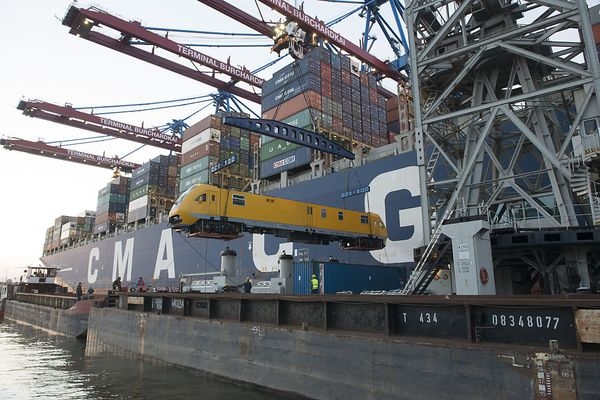
Dachser has completed the transport of locomotives manufactured by a German-Chinese consortium, which were assembled near Berlin, tested in the Czech Republic, and operated in China. From the beginning of the journey, regardless of the mode of transport—container ship, vessel, or truck—the logistical finesse and know-how for which Dachser is famous proved essential.
At the port of Hamburg, a floating crane transferred the 24-meter shipment from the container ship CMA CGM Musca to the shore.
– The shipment consisted of a vehicle used for the maintenance of the overhead contact line – explains Rainer Bardenberg from GBM Gleisbaumechanik Brandenburg.
This rail vehicle is used to repair damage to the overhead lines of the Chinese high-speed railway. However, for this to be possible, a floating crane had to move the locomotive to the port shore in Hamburg. This is because the stationary bridges of container ships are not long or strong enough to handle a 61-ton load.
From an inland waterway vessel to a container ship
The cargo traveled along the Elbe in Germany and covered the last 15 kilometers on a truck trailer to reach the Gleisbaumechanik facilities.
– Two additional vehicles participated in the transport through Antwerp to Brandenburg – says Hans-Ulrich Brüggemann, project manager for sea freight at Dachser Air & Sea Logistics in Western Germany, who organized the venture. The bodies for the future specialized rail vehicles, models BR711-G, are the result of cooperation between GMB Gleisbaumechanik in Brandenburg and Beijing Feb. 7th Railway Transportation Equipment Co. Ltd based in China. After final assembly, which was carried out in Brandenburg, Dachser transported the vehicles to the Czech Republic, where they underwent specialized tests.
Locomotive tests
A railway research facility with a 13 km long ring is located in the town of Velim, east of Prague. All the most important components of the vehicles were subjected to rigorous examinations and tests there, at speeds of up to 160 km/h. If the overhead line is damaged or breaks, the BR711 model must reach the location where the problem occurred as quickly as possible. In case of a power outage in the overhead line, these yellow vehicles are equipped with diesel engines. Once all tests were completed and the appropriate certificate was obtained, the locomotives were transported to China. The journey did not take place on tracks (this is impossible due to differences in track gauge between Germany and China) but again by ship, from the port of Hamburg. For each vehicle, Hans-Ulrich Brüggemann had to reserve space on the ship equal to 24 standard containers (TEU).