








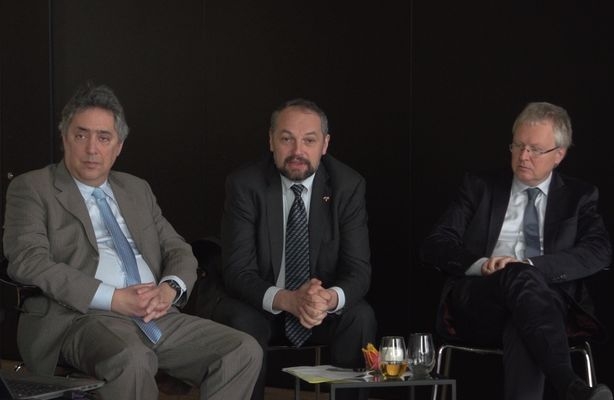
Is posting workers abroad profitable? – this was the topic of a discussion held in Warsaw. In addition to representatives of the National Center for Driver Settlement (OCRK), the expert meeting, which discussed the current situation of the Polish transport industry, was attended by representatives of the embassies of Austria, France, Germany, Sweden, and the Kingdom of Belgium.
The expert meeting was in the form of informal consultations on the transport industry and served to obtain and exchange information on the direction in which the TSL sector is developing in Poland.
– The goal of today’s meeting was not only to exchange views but also to jointly examine the situation of Polish transport companies and, consequently, the profitability of posting workers. As is well known, the European Commission has expressed its reservations regarding the German MiLoG regulations and the French Loi Macron, which is why we wanted to look at the problem from a different perspective together with representatives of individual embassies – explains Bartosz Najman, President of the National Center for Driver Settlement.
As noted by Nils Hedberg Grimlund, Secretary of the Embassy of Sweden, the free movement of services and goods within the European Union creates enormous opportunities for companies in the transport industry. However, he noted that this situation can simultaneously be problematic. Grimlund pointed to the important direction of automation in transport, which he believes the industry is heading towards. Furthermore, he also stated that Poland is one of the countries that could benefit from technological changes. Automatic or remotely controlled vehicles need qualified service providers and programmers, and Poland has already shown its strengths in these areas. He concluded by saying that it is important to find a compromise within the EU regarding working conditions in member states, which at the same time allows for the further development of the Union.
Łukasz Włoch, an expert at the National Center for Driver Settlement, drew attention to the legal basis for the introduction of minimum rates for posted workers.
– One of the most important documents regulating the posting of workers is EU Directive 96/71/EC, which refers to the issue of posting workers in the framework of the provision of services. According to its provisions, a worker posted for a specific time to another country in the Union has the right to the minimum wage applicable in the country to which they are posted, provided that this wage is higher than the minimum wage applicable in the country of origin – explains Łukasz Włoch. – On this basis, since January 1, 2015, Western European countries have been trying to limit Polish carriers’ access to the transport market.
However, according to Bartosz Najman, President of OCRK, it is not European regulations that pose the greatest threat to the TSL industry. – I believe that the Polish transport industry, despite significant fragmentation, is doing really well. Currently, the biggest problem for the market is not the legal barriers imposed by Western European countries, but the shortage of professional drivers. It is estimated that there is a shortage of about 100,000 truck and bus drivers in Poland. I think this is an issue worth considering not only in terms of the TSL industry but also the entire Polish economy – adds the President of OCRK.
At the end of the meeting, a joint expert debate took place, during which representatives of the embassies and specialists from the National Center for Driver Settlement discussed the profitability of posting workers abroad. The summary of the event was the conclusion that the only way to reach a compromise on road transport is to jointly develop measures for the industry at the European level.
The event organized by the National Center for Driver Settlement was attended by representatives of embassies, including: Christian Autengruber – Minister Counselor at the Austrian Embassy, Adam Kapella – Head of the Sustainable Development Sector at the French Embassy, Nils Hedberg Grimlund – Secretary of the Swedish Embassy, Dr. Martin Koppernock – Head of the Social Policy Department and Marta Zawilska-Florczuk – Deputy Head of the Social Policy Department, Gommaar Dubois – Deputy Head of Mission at the Embassy of the Kingdom of Belgium, and Nicolas Neve – Economic and Commercial Counselor for the Brussels Region at the Belgian Embassy.
(Source: Newsrm.tv)