








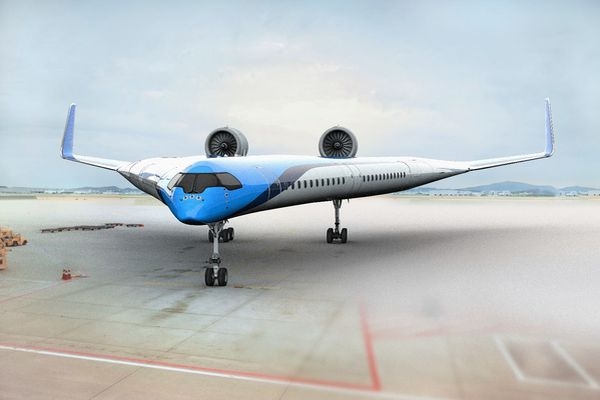
Dutch airline KLM and Delft University of Technology have begun work on a new, fuel-efficient model of the aircraft of the future. A scale model will be presented in October of this year at KLM’s 100th-anniversary celebrations in Amsterdam.
KLM Royal Dutch Airlines, as a pioneer in the field of sustainability in the aviation segment, continues to work on innovations and efforts to make passenger aviation more environmentally friendly. Based on the collaboration initiated with Delft University of Technology (Netherlands), KLM will participate in research and the creation of an innovative aviation concept called the “Flying-V”.
The aircraft of the future – the Flying-V presents a completely different approach to designing passenger aircraft, driven by maximum fuel efficiency and, consequently, the pursuit of a more planet-friendly, sustainable aviation of the future. The completely redesigned, aerodynamic shape of the vehicle and reduced weight will allow for a 20% reduction in fuel consumption compared to the Airbus A350 – currently the most advanced aircraft. Moreover, the design of the propulsion system will be easily adaptable for the use of alternative forms of power. A flying scale model and a full-size section of the Flying-V cabin will be officially presented during the 100th-anniversary celebrations – “KLM Experience Days”, which will take place in October of this year at Schiphol Airport in Amsterdam.
The Flying-V – a project for a potential passenger aircraft of the future, is based on the currently used Airbus A350, which is considered the most technically advanced passenger aircraft in the world. The Flying-V is shorter than the A350 but has the same wingspan. Similar dimensions to the standard A350 will allow the Flying-V to use existing airport infrastructure, such as terminal gates and runways. The aircraft will also easily fit into a hangar designed for the A350. Furthermore, the Flying-V will carry the same number of passengers – 314 people in a standard configuration, and its cargo holds will accommodate a comparable volume of cargo – amounting to 160 cubic meters. However, the Flying-V will be smaller than the A350, which will provide it with less aerodynamic drag.
The streamlined fuselage design of the aircraft will have a “V” shape. Like traditional models of modern aircraft, it will include a passenger cabin and a cargo hold. In this model, the wings will house fuel tanks, and the engines will be placed above the wings.
New interior – a new travel experience
Creating the Flying-V is also a unique opportunity for engineers and designers to further work on improving the passenger travel experience. This is possible by changing the seating arrangement in the cabin, which will also occupy part of the wings, and by redesigning the seats and restrooms themselves. Beyond ensuring maximum passenger comfort in a new, convenient interior, the designers are focusing on the weight of the aircraft. Everything must be as light as possible to maximize the machine’s efficiency, which its specific aerodynamic shape allows.
Fuel and electric propulsion
The Flying-V will be powered by the most fuel-efficient turbofan engines on the market. The aircraft model currently under development still envisions the use of traditional aviation fuel, but the design is intended to be easily adaptable in the propulsion system, which will allow for alternative solutions, such as the use of electric turbofan propulsion.
– Through numerous initiatives undertaken over the past years, KLM has built its position as a pioneer in the field of sustainability in the aviation industry. The emergence of aviation a hundred years ago had a huge impact on the world, giving people a new way to travel. This privilege goes hand in hand with a huge responsibility towards our planet. KLM takes this very seriously and has therefore been investing in sustainability at various levels for many years, thus developing a wide spectrum of initiatives in this field. We are proud of our collaboration with Delft University of Technology, which enables the realization of our strategy. This joint venture represents an important milestone on the path to creating the sustainable aviation of the future – said Pieter Elbers, President and CEO of KLM.
– We are honored to work with such a trusted and experienced partner as KLM as part of our shared mission, the goal of which is a completely new face for passenger aviation that will be highly energy-efficient and much more planet-friendly. To this end, it is very important to develop completely new and highly effective aircraft designs, such as the Flying-V, as well as to apply new forms of propulsion. Our ultimate goal is zero CO2 emission flight. Joining forces with KLM is a huge opportunity for real change in aviation in this regard – said Henri Werij, Dean of the Faculty of Aerospace Engineering at Delft University of Technology.