











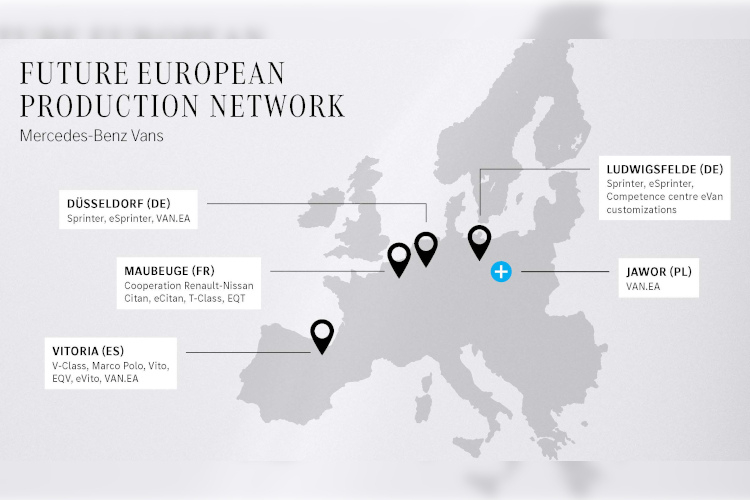
Mercedes-Benz Vans is reorganizing its European production network for the new modular architecture of fully electric vans, based on the VAN.EA platform. This is another milestone on the path of the Mercedes van division towards fully electric mobility.
With the reorganization of the European van production network, the company is securing the long-term prospects of existing plants in Europe and expanding the network with a new plant at the well-known location in Jawor, Lower Silesia, where an engine and electric battery factory already exists. In the future, large vans (closed model) based on the VAN.EA architecture will be produced here.
– Our ambition is to offer the most desirable vans and after-sales services. To achieve this goal, we must be highly innovative and competitive in all areas, while at the same time securing our business in the long term. A key success factor here is the reorganization of our European production network – says Mathias Geisen, Head of Mercedes-Benz Vans. – The decision to choose Jawor is another milestone on the road to electromobility. Furthermore, we must adapt not only our products but also the entire value chain – from purchasing through production and logistics to sales – to the requirements of the future. That is why we are investing in the fully electric VAN.EA platform, and thus in the transformation that is to ensure our position as a leader in the electric vehicle market. In doing so, we are also securing the long-term prospects of existing Mercedes plants in Europe.
Jawor as part of the Mercedes-Benz Vans production network in Europe
In addition to the plants producing vans in Germany (Düsseldorf and Ludwigsfelde) and Spain (Vitoria), a new plant will appear in Jawor, Lower Silesia. The company plans to invest over 1 billion euros between 2023 and 2027 as part of an agreed investment plan within the Wałbrzych Special Economic Zone “Invest Park”. In the future, approximately 2,500 people are expected to be employed here. Engines have been produced in Jawor since 2019, and batteries for Mercedes-Benz electric cars since 2020.
Signing of a memorandum with the Polish government regarding the new factory in Jawor
The Polish government and state agencies, such as the Wałbrzych Special Economic Zone “Invest Park”, the Polish Investment and Trade Agency, as well as the city of Jawor and the Męcinka municipality, support the project and are actively involved in the development of the investment. In a joint statement (Memorandum of Understanding), the parties committed to the further development of the future investment site. The existing plant in Jawor was designed from the beginning as a CO2-neutral factory and thus plays a pioneering role in the sustainability strategy of Mercedes-Benz Group AG.
The decision on the location for the production of electric vans and the construction of the factory still depends on meeting various framework conditions, including the granting of state aid.
– In our global production network, we are consistently implementing the Mercedes-Benz strategy towards “electric only”. The Jawor plant already plays an important role in this today – and will play an even greater one, strengthened by the production of electric vans. I am sure that the experienced and competent team in Jawor will also be successful in the production of fully electric vehicles. I am very pleased with this joint decision – by Mercedes and the Polish government, which creates the opportunity to create and utilize significant synergies in the future – said Jörg Burzer, Member of the Board of Management of Mercedes-Benz Group AG for Production and Supply Chain Management.
Fully electric vans based on the new modular VAN.EA platform. Thanks to the new VAN.EA (Van Electric Architecture), Mercedes-Benz Vans is accelerating its transformation into a provider of a fully electric product portfolio. VAN.EA forms the basis for all electric vans in the mid-size and large segments, which will be introduced to the market from 2025.