










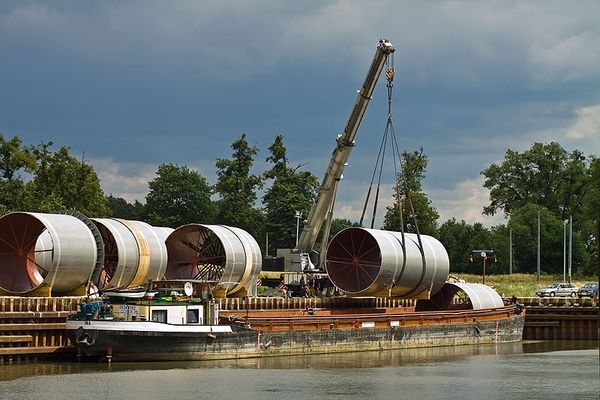
Project cargo, unlike most transport methods, does not have a clearly defined definition. Given that it most often concerns the transport of cargo with non-standard dimensions and weight, the experience of the logistics operator is crucial for the success of such operations. So, what should you look for when choosing the right company?
Narrow – broad specialization
The term “project cargo” encompasses the planning and execution of non-standard transport services for goods that require an individual approach to transport planning.
– Demand for project cargo services is growing; although within the total logistics services provided by large operators, it is still a small segment of activity. Accurately estimating the scale of this market is difficult for two reasons – firstly, the concept of project forwarding is ambiguous, and secondly, many such orders start abroad, so they may not be included in national statistics – says Grzegorz Samoć, Head of the DSV Projects department at DSV Air&Sea Sp. z o.o. – Due to the fact that the cargo in this case is most often oversized and heavy, the target group for these services mainly includes investors involved in various types of industrial projects who need to transport machinery, production equipment, structural elements, etc. The logistics operator is usually responsible not only for the transport itself but often also for the disassembly and reassembly of the transported elements.
Experience above all
Given that so-called project cargo escapes not only clear definitions but also the scope of education in schools and universities, the only way to master the secrets of this field of transport is through practice. For this very reason, when choosing a logistics operator for project cargo, it is worth being guided mainly by their experience and documentation in their portfolio of completed projects.
– One must remember that the transport of heavy and oversized cargo requires the involvement of many more entities than just the carrier, e.g., companies dealing with pilotage, organizing transport permits, arrangements with road authorities, or the Police. Often, such transport requires taking non-standard actions, such as dismantling road infrastructure elements, moving signs, cutting down trees, or even rebuilding a roundabout or intersection. Add to this the fact that the order often requires finding specific means of transport for specific loads and, not infrequently, dismantling the load itself. For example, river transport means problems with water levels, bridge structures, and locks – explains Grzegorz Samoć. – Even the most meticulous planning is not enough. We try to design and prepare everything in advance. However, what can be predicted with certainty is that something unforeseen will always happen. That is when the speed of reaction and flexibility count, as well as ready-made procedures. Project forwarding requires great flexibility and a good knowledge of many areas of transport, the ability to combine, coordinate, and integrate them over time. This is a task for truly specialized, large entities.
The logistics operator carrying out the transport is responsible for all these elements, and it is they who must demonstrate experience and knowledge here to be able to not only efficiently plan the transport route but also execute it within the agreed deadline. So how to deal with all these potential problems and risks? We return here to the issue of experience.
– Project forwarding requires deep knowledge of the market, technology, and above all, openness to continuous learning and non-standard thinking. You have to find available on the market means of transport and use them optimally. In reality, therefore, project forwarding is a task for companies that know how to manage knowledge. The sum of the company’s and its employees’ experience plus the ability to draw from their own and others’ experiences – this is what creates quality in project forwarding, and this is what the client should expect at the stage of choosing a logistics operator – claims Grzegorz Samoć.
The devil is in the details
Work on a project cargo order begins before the client signs a contract with a freight forwarder or carrier. DSV usually prepares the first studies before establishing cooperation with the client.
– Often, after accepting an order, it is necessary to prepare very detailed expert opinions and route plans. There may then be a need to build a piece of road or a shoulder. Such work usually takes months and involves many different types of companies. There are also situations where the client consults with the forwarder at the production stage to jointly determine the optimal way of dividing the largest elements or the optimal placement of support, hooking, and fastening points – concludes Samoć. – Of course, even the most meticulous planning and preparation process does not guarantee that the transport itself will take place without obstacles. Planning and executing a transport order involves looking for an optimal solution for non-standard goods. Sometimes a few centimeters decide whether the cargo will fit under an overpass. However, the most dangerous are unforeseen situations. For example – a route was chosen, transport was planned, and suddenly there is an unplanned road renovation and a detour. This is another example of a situation where the operator’s experience determines the success of the venture.