











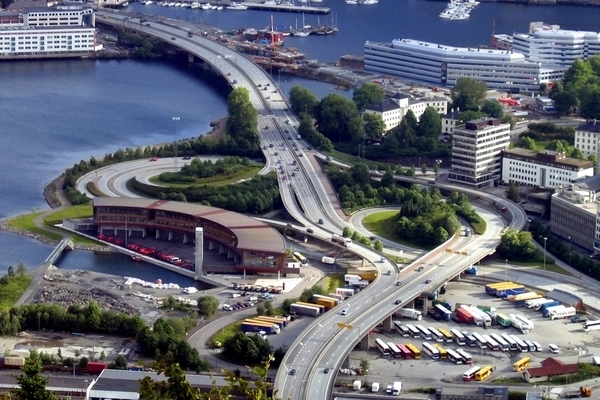
Concepts of urban logistics are nothing new. The first attempts to optimize urban freight and passenger transport appeared as early as the beginning of the 1980s. However, they did not bring the intended results. The intensifying communication problems of urban agglomerations have created a need to search for new solutions.
One of them is the use of intelligent information and communication systems. Their application makes not only cities but also logistics become smart. The purpose of this article is to present the possibilities of using intelligent technologies in the area of mobility.
There is no doubt that it is high time to find a solution to logistics problems. Today, there are over 800 cities in the world with more than a million inhabitants. Every three months, another one appears whose population exceeds five million. It is predicted that by 2050, eight out of ten Europeans will live in urbanized areas. Globally, this percentage will exceed 70%.
Solving the logistics problems of urban agglomerations is a major challenge: the flows of people and cargo within the city and beyond its borders must be organized in such a way as to cause the least environmental pollution while achieving the highest possible efficiency. And this is enabled by, among other things, modern information and communication technologies (ICT). They are the basis for creating intelligent and sustainable communication and transport systems, which are synonymous with smart mobility. Within its framework, forward-looking solutions are sought, adapted to the dynamics of economic development and the constantly growing concentration of the population in urbanized areas. Therefore, the purpose of this article is to present the possibilities of applying the smart concept in the area of urban logistics.
Smart mobility – a challenge for modern logistics
In the context of transport and flow management in a city, “smart mobility” is closely related to the use of ICT (Information and communication technologies) and intelligent transport systems (ITS). Smart mobility means a giant network of high-speed transport and communication connections linking all city resources. ICT solutions used in city logistics systems can be divided according to their cost intensity. The first group consists of low-cost solutions related to the management of applications controlling traffic lights and messages displayed on variable message signs (VMS). This group also includes automatic vehicle identification (AVI) systems. Solutions with higher cost intensity include, among others, telematics, which is a combination of computing technology (informatics) and telecommunications.
The article contains 23,115 characters.
Source: Logistyka Magazine
Kauf_IT_jako_podstawa_wdrozenia_inteligentnej_logistyki_miasta.pdf