








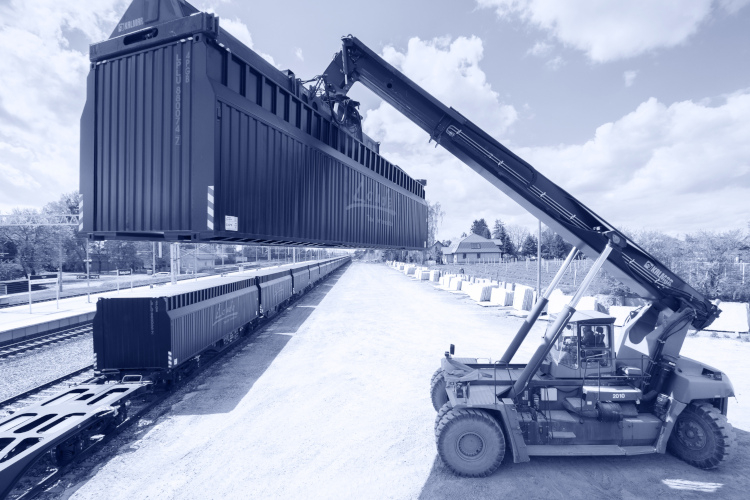
Nałęczów Zdrój, the producer of Cisowianka and Cisowianka Perlage, is focusing on ecology and reducing its carbon footprint – the Polish company is launching intermodal transport, using rail for the mass transport of its products. Two inaugural rail shipments, which took place in May, allowed for the delivery of as many as 88 containers, eliminating the same number of semi-trailer trucks, commonly known as TIRs, from the roads. Thus, 2 million bottles of water were transported by rail at once!
The first two trains with Cisowianka mineral water from Nałęczów reached Poznań and Sosnowiec, from where distribution takes place in the Greater Poland region and in Silesia, the Zagłębie region, and Lesser Poland, respectively. One train allows for the transport of as many as 44 containers with Nałęczów Zdrój products. This means that each rail transport is able to replace 44 semi-trailer trucks that do not have to travel on Polish roads.
– Rail is considered the most ecological and safe means of transport. That is why, in addition to trucks, Cisowianka wants to use tracks more and more often to transport its water – comments Tomasz Wojtasiński, Managing Director of Intermodal, a company belonging to the Nałęczów Zdrój Group, responsible for the distribution of its products.
– Thanks to rail, we will be able to further limit the impact of negative weather conditions on the speed of goods delivery. Due to the low risk of traffic jams, bans, or blockades that we face on the roads, freight trains guarantee even greater certainty and punctuality. In addition, there is greater safety associated with, for example, the elimination of traffic accidents, the risk of which is significantly limited in the case of rail – notes Tomasz Siemiątkowski, Commercial Director at Nałęczów Zdrój, responsible for so-called traditional trade.
Low-emission and safe rail is an element of the Nałęczów Zdrój Group’s comprehensive, sustainable concept of goods distribution. It is about so-called intermodal transport, which consists of combining rail transport with other forms of transport, using the same loading unit (container, semi-trailer).
– Thanks to the location of our plant near the railway line in Nałęczów, it is natural for us that we want to use its ecological potential in the most effective way. Delivering water to the train is fast and non-intrusive for residents in our case. The main transport is carried out by rail over a distance of several hundred kilometers. Each one includes up to 44 containers at a time, which are unloaded at the terminal. The so-called ‘last mile’, i.e., transport from the terminal to the recipient, is carried out by road transport using special semi-trailers for transporting containers, but on much shorter routes compared to rail ones – explains Tomasz Wojtasiński and adds: – The Nałęczów Zdrój Group, with investment and design plans in the field of intermodal transport development and the establishment of a special company dedicated to this, is a precursor of such solutions in our industry.
– I think that one of the most important development factors for trade in Poland will be the expansion of railway infrastructure at large logistics centers. The formal development of intermodal transport carried out by Nałęczów Zdrój shows that this trend is important to us and we are already starting to make it a reality today. We hope that this will be a kind of ‘spark’ for our business partners, accelerating plans for the development of rail at their centers – concludes Tomasz Siemiątkowski.
The development of rail transport is an important alternative to heavy road transport. Among other things, due to the war and the need for many Ukrainian drivers to return to their country, it will have to face even greater problems that have been accompanying it for several years. In the case of Cisowianka, train transport has other, equally important aspects – it means fewer trucks passing through the spa town of Nałęczów and guarantees the real use of new railway infrastructure, thoroughly rebuilt and invested in from the state budget in recent months, including in Nałęczów. Therefore, the Nałęczów Zdrój Group plans to further expand the distribution of its water using trains.