








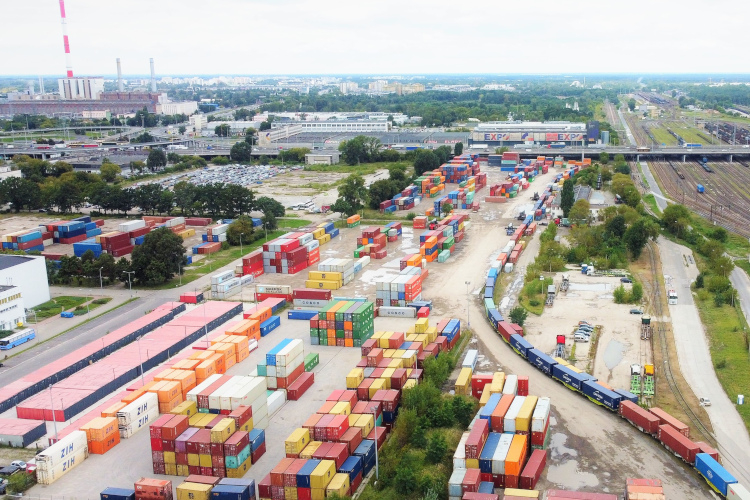
Europe and Poland are shifting towards intermodal transport. Following the unforeseen and sudden global events of recent years, security has become a key aspect of business. In this context, there is increasing talk of intermodal transport, which still has enormous development potential in Poland. This is a type of transport that creates modern chains combining several modes of transport into one system, thus ensuring greater predictability and regularity of shipments than road transport alone. By using primarily rail and waterways, it is also more environmentally friendly than road freight.
– At the root of the development of intermodal transport lies the security it provides to companies in the current, difficult time for business. It is the best logistics solution in conditions of economic downturn, when peace of mind counts more than ever. The expansion of this type of freight forwarding is closely linked to the railway. The network of transshipment terminals is constantly developing in Poland. More and more entities are interested in expanding infrastructure for this form of transport. There are already over 20 companies in our country dealing with the implementation of rail intermodal transport. We are currently conducting processes of searching for logistics land with railway sidings for several clients. It should also be noted that this type of transport is very promising in the context of EU directives due to lower emissions than road transport – says Bartłomiej Zagrodnik, Managing Partner, CEO at Walter Herz.
Less emission-intensive, more subsidized
Due to the European Union’s policy and the global trend of reducing CO2, the intermodal business will grow faster in the near future, increasing the share of rail transport. The European Union plans to minimize the effects of the development of road freight transport, such as air pollution, road devastation, noise, and safety threats. The goal is to reduce greenhouse gas emissions from transport by 60 percent by 2050. This is to be achieved by shifting 30 percent of transport over distances of more than 300 km from roads to lower-emission means of transport, and by 2050, reducing road transport by 50 percent.
A barrier to intermodal transport in our country is the insufficient number and uneven distribution of intermodal terminals, where transshipment to another means of transport takes place. According to Statistics Poland (GUS), in 2021 there were 39 active terminals in Poland where container units are transshipped between two different means of transport. This includes 4 sea terminals handling sea-rail and sea-road shipments, and 35 land terminals, the number of which is constantly growing. In June of this year, the company Laude Smart Intermodal opened its largest domestic terminal in Zamość, which will be used to receive cargo from Ukraine.
However, as much as 75 percent of goods transported in Poland over a distance of more than 300 km are still carried by trucks. Meanwhile, in the EU, long-distance road transport of containers accounted for only 40.5 percent of total road container freight transport on average in 2020.
Great potential for industry development
The potential of intermodal transport in Poland is growing slowly but regularly. According to GUS, in 2021, a total of over 82 million tons of containerized cargo were transshipped in intermodal terminals in the country, which means a several percent increase compared to the previous year. Most of the cargo was transported by sea. Last year, rail intermodal transport carried 26.5 million tons of cargo in Poland, and rail intermodal transport was performed by 23 companies.
In Poland, we have the right conditions for the development of container transport. This is due to, among other things, the high density of the railway network and the convenient location of our country at the intersection of international transport routes. This is particularly important in the perspective of increasing the scale of transport from the Asian market. While in 2011 there were a dozen or so trains carrying goods between China and Europe, in 2018 there were already over 6,000. More than 80 percent of cargo on the Asia-Europe route passes through Poland. However, the problem is the low capacity at our eastern border and the current speed of Polish rail transport.
– Intermodal transport works great in European traffic. The pace of changes in the global economy in recent years has prompted everyone to pay more attention to transporting smartly in terms of time and costs. And this, among other things, has created space for the development of intermodal transport. The network of intermodal connections that we have created is based on the concept of building a regular grid of daily rail connections, enabling the transport of containerized cargo over a long section of the route and correlated with it road transport from/to the place of dispatch or destination. The network of connections has the advantage that it provides access to this method of transport, both for large regular cargo flows and for individual container shipments. Our intermodal trains run according to schedules and take containers, just as passenger trains take travelers. Terminals connected in a network of regular connections are a kind of ‘transfer stops’ that allow for the optimization of the process – explains Monika Konsor-Fąferek, Marketing and Development Director at PCC Intermodal SA.
– Today, transport costs are measured in a broad aspect, also taking into account the impact on the environment. Intermodal allows you to reduce your carbon footprint. Trains, as an environmentally friendly means of transport, carry containers over long distances, e.g., between Gliwice and Antwerp (nearly 1200 km), and on the last part of the route (50-100 km), the cargo is delivered to the door by road transport. Planning a delivery based on a terminal located close to the production plant is easier and allows for adjusting logistics to sudden and surprising situations – adds Monika Konsor-Fąferek.
Faster growth in Europe than in Poland
Intermodal also allows for more efficiently overcoming the challenges facing road transport, such as the shortage of drivers or rising wages. Market analyses show that standard vertical transshipment technologies in the case of container transport become competitive compared to road-only transport over a distance of about 1000 km. Looking through the prism of environmental efficiency, most intermodal transport chains transported over a distance of 600 km already have lower external costs.
An obstacle to the development of this type of service in Poland is still the low unification of semi-trailers used for intermodal transport. There is an insufficient number of those that can be used in both road and rail transport. Moreover, in our country, it is difficult to count on long-term government programs supporting the competitiveness of railways, which, for example, the intermodal business has in Germany.
The intermodal industry in Europe is recording higher growth than in Poland. In 2021, combined transport recorded a record-high annual result in terms of the amount of cargo transported. The rail New Silk Road Asia-Europe also reached a record in this respect.
Building new supply chains
Analyses say that by 2030, transshipment capacities in the EU will not be sufficient to meet demand. The availability of terminals across the trans-European transport network requires investment. Most modernization is necessary in Spain, France, and Italy. On many sections of the TEN-T network, structural upgrades are needed to enable the transport of semi-trailers by train. According to estimates, investments of about 7.7 billion euros are required to remove network bottlenecks.
The conflict in Ukraine revealed the strategic importance of railways when road routes were disrupted and Ukrainian ports were blocked. It turned out that rail is irreplaceable for long-distance transport. If new terminals were launched based on EU funds and existing ones were expanded, which would create new logistics chains, after the war we will be able to think about using rail routes from the East to the west of Europe on a large scale.
Source: Walter Herz