










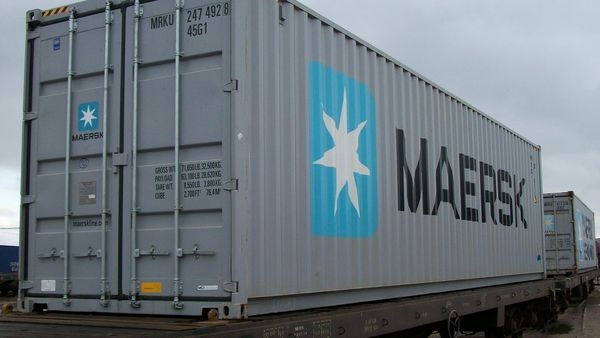
Safety, punctuality, cost optimization, and environmental care are just some of the advantages of intermodal transport. It is one of the most dynamically developing branches of transport, but its share in the Polish market is still insufficient. Maersk Polska, a branch of the global leader in maritime transport services, decided to launch two intermodal rail connections in Poland within half a year. From the perspective of several months, the operation of both services has been assessed positively.
Land transport in Poland is based primarily on road haulage, which had a market share of nearly 74% in 2010. For comparison, rail transport accounted for less than 17% at the same time. These results also affect the entire transport industry. Container transport, despite recent upward trends, still accounts for less than 1% of the total volume of transported cargo in Poland. This state of affairs is primarily due to high investment costs and the low quality of road and rail infrastructure. According to experts, the successive increase in the use of intermodal transport in the economy is an opportunity for companies to maintain a strong market position.
– The economic crisis in 2009 forced companies to take a close look at the costs associated with the transport of goods. In this situation, it was crucial to create an offer tailored to the needs of customers, while at the same time allowing them to optimize the costs they incur – explains Thomas Bagge, CEO of Maersk Polska.
Maersk Line, as the only shipowner in Poland, decided to launch two rail connections as part of intermodal transport within a few months. The growing popularity of the service and positive feedback received from the market convinced the company to open the second rail line. The schedules of the Maersk Amber Express and Maersk Baltic Express trains are synchronized with the arrivals of Maersk Line container ships in Gdańsk. The first one transports containers on the Gdańsk-Kąty Wrocławskie line, while the second one covers the route to Sławków in Silesia. Both lines handle containers unloaded from the AE10 service, connecting Gdańsk with Far East ports, as well as from feeder connections.
Intermodal transport allows for entrusting the entire supply chain to a single operator and reduces costs without the need to lower the quality of services. The aspect of safety and transport risk diversification is also key. Using a single loading unit throughout the supply chain eliminates the need for multiple transshipments. For a customer using the service, this facilitates the optimization of business operating costs while maintaining a guarantee of punctuality and minimizing the risk of cargo damage. The ecological aspect is also significant. Thanks to efficient organization and supply chain optimization, lower unit energy consumption is possible, and thus a lower level of burden on the natural environment.
A modern company builds its position by introducing financially beneficial solutions and maintaining a high level of service tailored to the needs of customers. It is important to also consider pro-ecological aspects when achieving these goals. Intermodal transport allows a company to position itself as a modern contractor that is able to introduce solutions that are beneficial both for business development and friendly to the natural environment.