











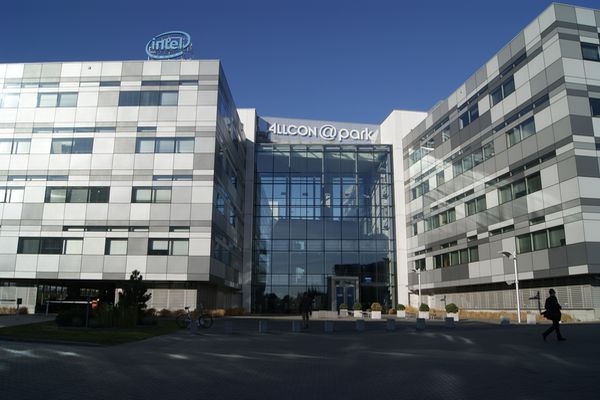
The Intel Research and Development Center in Gdańsk is the largest of the 24 laboratories that the American IT giant boasts in Europe. More than 2,000 top-class specialists work at the facility, and this number is constantly growing.
Intel is a global leader in computer innovation. The company designs and builds key technologies that serve as the foundation for the world’s modern computing devices. Intel is also a leader in corporate social responsibility and sustainable development, and is the first company in the world to offer “conflict-free” microprocessors for sale. More information about the company can be found at newsroom.intel.com and blogs.intel.com, and about Intel’s conflict-free policy at conflictfree.intel.com.
The Intel center in Gdańsk has formally existed since 1999, although its history is actually longer. In 1991, the center first opened its doors as a branch of CrossComm, an American company specializing in computer networks. The team has been continuously developing in its original form – in 1997 through the acquisition of CrossComm by Olicom, and finally, in October 1999, it was incorporated into the Intel corporation. This continuous development is inextricably linked to deepening partnerships between Polish and foreign research centers and culturally diverse academic and business communities. Intel’s success in Poland, based on the knowledge and high skills of graduates and students of Polish technical universities, is proof of the highest professionalism in operating under conditions of increasing global competition.
What is done at Intel Poland?
Several Intel business groups are currently conducting work on the latest technologies at the Gdańsk research and development center:
– 3D Graphics
A team of approximately 400 engineers works on the design, implementation, and validation of 3D graphics drivers for graphics chips integrated with Intel processors used in desktops, laptops, servers/workstations, as well as in the IoT and automotive industries. Driver software compliant with Direct3D and OpenGL standards, as well as OpenCL and Vulkan for Windows, Linux, and Android operating systems, is provided. VPG engineers have extensive experience in code performance optimization (working directly with major game publishers), compiler construction, and parallel programming. Research and development work on 3D drivers in Gdańsk concerns products that are already available on the market, as well as those that will appear in 4-5 years.
– Data Center Solutions
A team of over 600 people deals with server technologies. This is where the technologies of the future are created, which will change the functioning of modern data centers (including Intel Rack Scale Architecture, allowing for dynamic and flexible management of hardware resources, such as computing, networking, and storage components, responding to current application demand). Engineers from Gdańsk are also responsible for developing software that allows for data center management (including energy consumption), drivers for Linux, Windows, and VMMs, as well as solutions improving the performance of cloud infrastructure.
– Big Data and Internet of Things
A team of approximately 100 people deals with the development of security technologies for Intel solutions used in hardware and software. Additionally, about 50 people work on solutions for Big Data and Internet of Things platform components, including Intel Galileo/Edison, smart grid, and wearables.
– Computer Networks
A team of over 100 people works on network technologies of the future, ensuring higher performance, manageability, and support for new solutions in this area, intended for individual users and data centers.
– Audio
A group of over 200 engineers works on sound-related technologies. The goal is, among other things, to develop new ways for humans to interact with electronics. Introducing natural interfaces that will allow for free “conversation” with computers, smartphones, and other devices. Engineers are working on, among other things, high-quality sound (HD Audio), post-processing, speech recognition algorithms in natural environments, and optimization of sound implemented by Intel products for the best possible cooperation with software (e.g., Microsoft Skype/Lync). The developed solutions are also intended for wearable electronics. The Gdańsk branch is responsible for delivering and developing several key technologies for Intel, such as: USB3, HD Audio, BluRay Playback, and Wireless Display. Products from the Gdańsk branch can be found in almost every computer using Intel components.
– Supercomputers and technologies for corporate business customers
A 50-person team works on solutions for supercomputers, including platforms using Intel Xeon Phi coprocessors and server software. These solutions are used in the most powerful supercomputers in the world.
What is there for students?
Intel Technology Poland supports the development of young staff through student programs: internships (1st-3rd year) and apprenticeships (4th-5th year/PhD). It establishes contact with the best students of universities at the very beginning of their professional careers. It offers students part-time work, the opportunity to complete a thesis/PhD under the guidance of an Intel consultant, the opportunity to use acquired knowledge in practice, and to co-create the latest global technologies while working in international Intel teams.
Employer
The attractiveness of Intel Technology Poland as an employer is evidenced by numerous awards – in the Best Employers in Poland study conducted by Hewitt Associates, the Polish branch of Intel has consistently held a leading position for 4 years and can boast the title of Best Employer in Poland. Employees rated their employers, taking into account, among other things, the development opportunities provided by the company, organizational policies and practices, internal company relations, work-life balance, and conditions conducive to self-realization.