








One of the most important aspects of modern logistics is tracking the flow of materials within the supply chain, understood as recording the current location of a given logistic unit in the chain. This can be done either based on information transferred to the IT system by copying it from documents related to the exchange of goods, or by automatically reading information contained directly on the packaging of logistic units. However, the first of these methods carries a certain risk of losing the correlation between the information appearing on the document and the information regarding the physical content of the logistic unit. Automatic identification, on the other hand, ensures that the correct goods being exchanged in the supply chain are recorded at any given moment.
Global Barcode
The exchange of goods between suppliers and recipients carried out in an open environment requires the use of identification standards so that all information is interpreted unambiguously at any link in the chain. This is made possible by the 30-year operation of the global EAN*UCC system, which contains standards for identifying materials in retail and wholesale circulation, logistic units, physical locations, resources, and services. EAN*UCC is the only cross-industry and international system of unambiguous and automatic identification and electronic data interchange, used in industry, commerce, services, and administration. The EAN*UCC system is already used in 102 countries. In order to enable automatic reading of globally standard designations, it has been accepted that IT systems and automatic identification applications operating in the global standard will use the following barcode symbolisms: EAN – 8, EAN 13, ITF – 14 (numeric designations) as well as the EAN – 128 code (alphanumeric designation) along with standard Application Identifiers. Standard code designations are defined by the following acronyms: GTIN (Global Trade Identification Number), SSCC (Serial Shipping Container Code), GLN (Global Location Number), GIAI (Global Individual Asset Identifier), GRAI (Global Returnable Asset Number), GSRN (Global Service Relation Number). Many companies implementing IT systems in logistics start working with an identification system on their own. However, independently implementing a global standard does not always go smoothly. There are dozens of technical barcode standards, but there is only one standard for code designations, and only this standard provides the opportunity to integrate logistics on a global scale. Therefore, when using EAN*UCC standards in IT systems, it is worth seeking help from the Institute of Logistics and Warehousing in Poznań – the EAN Poland National Organization, where in the Automatic Identification Department (formerly the Consulting Department), supported by the competencies of specialized institute units, any doubts can be clarified.
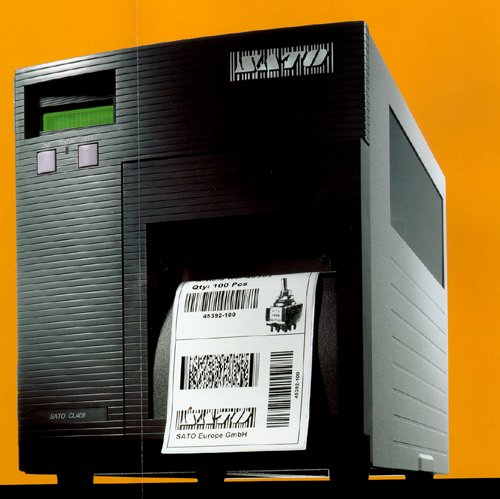
Fig. 1. Barcode printer
Automatic Identification Department
Its primary activity is promoting and implementing new ADC (Automatic Data Capture) technologies, comprehensive service for coding companies, assistance in selecting ADC devices, software, and consumables. Among automatic identification devices, one can distinguish handheld and fixed barcode readers from various manufacturers connected directly to a computer, portable terminals, and barcode printers. The former are used primarily in shops and supermarkets, where numeric code designations (GTIN) presented in standard barcode symbolism (most commonly EAN – 13) are scanned, through which reference is made to the appropriate record in the IT system. Portable data collection terminals (PDTs), also called portable data collectors, are used wherever direct connection of a barcode reader to the IT system is impossible or unprofitable, e.g., in large warehouses, loading yards, etc. Equipment from companies such as Denso, Symbol, and Metrologic is most commonly used. Information read from codes is stored in the terminal’s memory, and after the operation of receiving shipments into the warehouse is completed, it is transmitted to the main recording system. A significant portion of the portable terminals offered by the Automatic Identification Department complies with standards developed in recent years for personal computer operating systems regarding the software of both the terminal and the computer that collects and stores data. Terminals are equipped with data transmission devices via RS ports, floppy disk drives, or radio frequency (RF system). Especially the latter enjoy great interest because they are the most convenient to use. The Automatic Identification Department provides detailed information on all devices in its offer. This is particularly important when a company is choosing equipment that will operate in harsh conditions. Terminals can be exposed to adverse factors such as dust and moisture, so it is worth checking whether the chosen equipment is resistant to them. Terminals have additional sockets for connecting handheld barcode readers, scanners, magnetic stripe readers, barcode printers, label printing scales, etc., and allow monitoring, for example, working time based on barcode timesheet card reads, monitoring equipment operation, collecting data for real-time production management, and they can also be used at shipment formation points to check whether the right products are being sent to the right recipient. Another type of ADC device is barcode printers from manufacturers such as Zebra, Eltron, Sato, Tec, Citizen. Installing them in a company allows for the independent printing of barcode labels.
Proper selection of ADC equipment, taking into account the company’s internal conditions on an individual basis, allows for the execution of required tasks at the lowest implementation costs. However, it should be remembered that ADC equipment, even if correctly selected, is the final link in the process of implementing modern logistic solutions intended to function in an open supply chain. The equipment must cooperate with a suitably selected IT system, and the IT system must take into account a properly designed organization of the logistic system.

Fig. 2. Code reading scanner
Consultations for Everyone
The ILiM Automatic Identification Department does not limit itself solely to presenting and selling ADC devices. To a large extent, it conducts consultations regarding issues that are not answered by the numerous computer companies supplying hardware and software for enterprise IT systems. Consultations provided to companies joining the EAN*UCC system primarily address the rules of applying EAN*UCC standards, registration procedures, methods of marking goods (consumer units and collective packaging), methods of coding variable-quantity goods, selection of barcode labels taking into account goods storage conditions, and check digit calculation. In addition, employees of the Automatic Identification Department, supported by the competencies of EAN Poland (ILiM) specialists, conduct large-scale consultations for offices, institutions, and universities on the use of various barcode and matrix code symbolisms, printing codes in dusty conditions, marking fixed assets, marking MDF profiles, pallet labeling, using security labels, printing rating plates, using peel-off labels, applying code symbols to ID cards, printing barcode-marked tags, wireless identification equipment, using barcodes for device control, selecting equipment for operating IT systems, controlling material flow in production, selecting barcode readers, and warehouse identification using RF terminals. An additional activity of the department is the fulfillment of orders for EAN-13, EAN-8, ISSN, ISBN, and EAN-128 barcode masters.
Helping companies that apply for assistance, the Automatic Identification Department allows them to effectively absorb the basics of operating the identification system in a short time, while at the same time providing the EAN Poland National Organization with valuable material on the actual needs of customers. Cooperation with other organizational units of the Institute has made it possible to prepare comprehensive offers for IT support system solutions for warehouses of any scale.

Fig. 3. Code reading scanners
Identification Inside Out
An integral part of automatic identification processes is IT, without which neither the effective use of ADC devices nor the effective use of the global EAN*UCC system would be possible.
In an open supply chain serviced by various IT systems, there are many locations that should be identified by trading partners of various companies moving many logistic units among themselves. The process of cooperation on a global scale is often still new for some companies and frequently requires organizational changes.
Various events occur along the route of logistic unit movement in the open supply chain. They determine the scope of information generated in subsequent links of the chain through their successive addition or updating. The open supply chain must be organized in such a way that data transmitted along with the logistic unit can be retrieved by various IT systems at each of its links. Therefore, there is a need to place appropriate logistic information not on documents, but on the materials themselves (logistic units). And this requires the use of a single exchange standard that will be “understood” by various IT systems operating in the supply chain. As a result, a harmonized system supporting physical supply chain management is obtained.
The EAN-13 code has been operating in Poland for a long time, so its handling by various types of devices and IT systems poses no problems. What is most interesting for logistics is identification using a more sophisticated code designation, which is EAN-128. This code allows for recording a lot of important information in the form of a single character string (128 alphanumeric characters from the upper range of the ASCII table available on a computer keyboard can be encoded). This is very useful throughout the logistic chain. With a single scanner movement, it is possible to read several different pieces of information recorded in the code. To distinguish – by the IT system – what type of information is encoded in the read character string, standard Application Identifiers are used. Each applied AI clearly defines what type of data appears immediately after it. ADC devices only read a specific sequence of characters by which information is recorded. When using the EAN-128 code, ADC devices alone without an IT system are of little use. The most significant problem for customers is properly selecting programs for ADC devices and the devices themselves to match the IT system. Many company representatives make the mistake of purchasing ADC devices first and only then figuring out how to make them work in a satisfactory manner. The order of purchase should be reversed – the system along with reading programs is built first, and only then is the appropriate equipment selected. There are not too many good IT solutions on the market that can read global codes used by entrepreneurs, especially EAN-128. As a rule, IT system suppliers wait for signals from their recipients in order to adapt programs to their expectations in this way. On the other hand, recipients do not yet have sufficient awareness and knowledge about possible applications. Logistic systems designed at ILiM based on available or custom-made software allow ADC devices to read full EAN-128 code character strings, and the software selects only the information necessary in the given enterprise, omitting that which is needed by other participants in the open supply chain. Decoding information recorded in the barcode is done via Application Identifiers (two-, three-, or four-character digital strings), which unambiguously imply the character strings following them. This is one of the fundamental features of EAN*UCC standards, allowing for the unhindered exchange of goods on a global scale with unambiguous – automatic – identification of logistic units by IT systems using ADC devices.
Michał Koralewski