









To encourage customers to purchase their products, manufacturers compete in creating various types of promotions intended to increase interest in their goods and, consequently, translate into sales. Product promotions have become so common nowadays that we encounter them not only during holidays or other important occasions, but they accompany us in our everyday shopping.
By design, a promotional product is seasonally modified. It should be available for sale on a specific day or during a specified time. There is a need for its unambiguous identification in the supply chain. Such unambiguous identification is provided by the GTIN (Global Trade Item Number) placed on the product in the form of a barcode. It is what uniquely identifies any item (product or service) that can be priced, ordered, or invoiced for commercial purposes between participants at any point in the supply chain. A trade item can be both a retail product (consumer unit) and a non-retail one (e.g., a carton or a pallet). Whether a new GTIN should be assigned in the case of a given product modification related to a promotion is determined by the GTIN management rules. These were created globally by the GS1 organization, in cooperation with representatives of companies from all over the world, and they ensure consistent product identification in the supply chain.
The manufacturer or brand owner usually decides on the promotion, and it is their responsibility to correctly label the promotional unit. A promotional product may replace the classic version of the product for the duration of the promotion or exist alongside it.
Most often, promotions are associated with a price change, promotional content of a given product, a change in the packaging design, modification of the packaging shape, inclusion of a free product, or the creation of promotional bundles. Here are some of the most popular cases:
1) Product price change related to a promotion
If the promotional price change of a product is the result of the manufacturer’s actions and is declared by them on the packaging, one must always remember to change the GTIN, i.e., to uniquely identify the promotional product for which the promotional price has been printed (Fig. 1). However, let us remember that in this case, the price is defined as the price placed by the manufacturer/brand owner, which is a graphic element of the packaging. This rule does not apply to price labels placed by the retailer in the form of stickers, tags, or other forms that can be easily removed from the product packaging. Therefore, let us keep in mind that all price promotions organized by the retailer within their store or chain do not in any way affect the GTINs originally assigned by the manufacturer.

Fig. 1. Printing a promotional price on the product packaging requires changing the GTIN for the retail consumer unit and the outer packaging.
2) Promotional change in product content
This is a very popular form of promotion, which most often involves increasing the net weight of the product. In the case of this type of promotion, we must take into account a very important issue – how will we declare the promotional change in product content to the customer? If it is an official declaration of the changed weight on the product packaging, then we absolutely assign a new GTIN for the promotional packaging, regardless of the percentage by which the weight, volume, or quantity of the product has changed (Fig. 2).
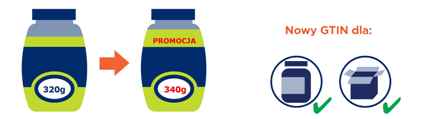
Fig. 2. Declaring a promotional change in the net content of a product (e.g., from 320 to 340 grams) requires assigning a new GTIN for the retail consumer unit and the outer packaging.
However, if the promotional change in the net content of the product is declared to the consumer in the form of a “marketing declaration,” and the officially declared weight of the product does not change, then we can leave the existing GTIN unchanged for the retail packaging (Fig. 3). Let us remember, however, the rule stating that any change in the gross weight of a product by more than 20% requires the assignment of a new GTIN. Therefore, if our promotional change in the net content of the product causes its gross weight to change by more than 20%, it is absolutely necessary to assign a new GTIN, regardless of how it was declared to the customer on the packaging.
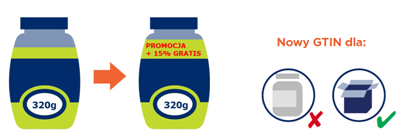
Fig. 3. Promotional change in product content in the form of a “marketing declaration” (e.g., +15% FREE), without changing the declared net weight, requires assigning a new GTIN only at the outer packaging level.
3) Change in packaging design
Often, a promotional variant of a product is associated with a change in the packaging design prepared specifically for a particular occasion or seasonal promotion. A change in the design may involve changing the packaging color scheme, adding commemorative graphics, a photo, or a banner. In the case of this type of packaging modification, remember that the GTIN of the consumer unit does not require a change (Fig. 4). However, the GTIN of the outer packaging does require a change, which will guarantee us correct identification of promotional units in the supply chain at a level above the consumer unit.

Fig. 4. Changing the packaging design related to a promotion requires assigning a new GTIN only for the outer packaging.
4) Freebies
This is another popular form of promoting products. Customers often receive both free product samples and full-size packaging. While in the case of miniature samples (which do not cause a change in gross weight of more than 20%), changing the number at the consumer unit level is not necessary (Fig. 5), in the case of adding a full-size product (Fig. 6) or creating a new trade unit consisting of several products (the so-called standard MIX of units), the GTIN should absolutely be changed.
Freebies related to the promotion of a given product can also be all kinds of promotional gadgets, stickers, tags, discount coupons, contests, or lotteries. All such additions do not cause a change in the GTIN of the consumer unit, but they do cause a change in the GTIN of the outer packaging.
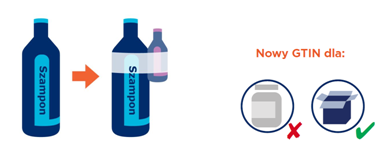
Fig. 5. Adding a miniature product sample requires assigning a GTIN only at the outer packaging level.
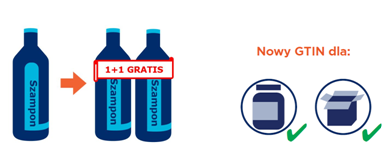
Fig. 6. Adding a full-size free product requires creating a separate GTIN for the promotional trade unit.
By following the above rules for labeling promotional trade units, we can be sure that, on the one hand, the functioning of the supply chain will not be disrupted – thanks to the partial limitation of introducing new GTINs for retail consumer units, and on the other hand, that we will maintain full control over the flows of promotional products through unambiguous identification of outer packaging. Adherence to standard GTIN management rules by all links in the supply chain is also the key to ensuring effective, efficient, and consistent exchange of product information and a guarantee of cost minimization.
More information on the rules for assigning GTINs can be found at: http://www.gs1.org/1/gtinrules/pl/en/
Bibliography: Own study based on GS1 materials.
Photo source: Internal GS1 materials.