








Everyone in the transport industry knows that the heavier the truck, the higher the fuel consumption. But how much higher is the fuel burn when a vehicle carries an extra three tons? In the daily operations of transport companies, where time, safety, and maximizing payload capacity are priorities, such questions often take a back seat. Yet, vehicle weight is one of the few factors that a carrier can actually influence—unlike the weather, road conditions, or fuel prices.
The pressure for better weight management is also growing for another reason. The European Union is successively tightening emission standards for trucks—by 2030, manufacturers must reduce CO₂ emissions by 45%, and by 2040 by as much as 90%[1]. In practice, this means that not only new vehicles must be more efficient, but also those already driving on European roads today.
More and more EU countries are also introducing road tolls linked to CO₂ emissions. In Germany, since 2023, rates have already been differentiated based on the vehicle’s emission class—not yet based on actual fuel consumption, but that is the direction in which the system is heading[2]. This solution motivates carriers to better match vehicles to the type of cargo and focus on more economical driving. Larger trucks consume more fuel, which automatically means higher fees for every kilometer driven.
On top of this comes another factor—the renewed rise in fuel prices in Europe, which increases carriers’ operating costs. As a result, vehicle weight optimization is no longer just a matter of environmental responsibility, but a tool for savings and better economic planning.
In operational practice
Vehicle operation data shows how significant weight is—even a difference of a few tons can clearly affect fuel consumption. Many carriers are aware of this, but few can directly compare fuel consumption under different conditions and with different loads on longer routes. Thanks to telematics systems monitoring thousands of trucks across Europe, Eurowag is able to provide a more detailed picture in this regard. Data analysis indicates that every additional ton of cargo increases average fuel consumption by approximately 0.25 l/100 km. This may seem small at first glance, but in practice, it means that a vehicle three tons heavier will burn almost a liter more for every 100 km. This is a factor that can be decisive when choosing a route, the type of trailer, or the amount of fuel to refuel.
Based on operational data, we see that even small differences in total weight translate into higher costs in the long term. In heavy traffic, a difference of a few tons can mean an increase in expenses of several hundred zlotys per month, even with
an exemplary driving style.
– says Jaroslav Altmann, Director of Research and Development at Eurowag.
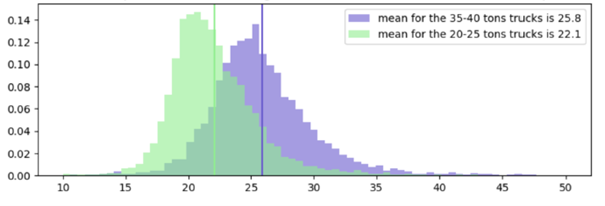 Figure 1: Fuel consumption in l/100 km for heavier and lighter trucks (Eurowag data for May–June 2024)
Besides weight itself, the conditions in which the vehicle moves are also of great importance. In urban traffic, where constant starting and stopping is a daily occurrence, vehicle weight affects fuel consumption more than on the highway. It is here that Eurowag data shows the greatest differences—a lighter truck covers the route significantly more economically, while a heavier vehicle in dense traffic burns noticeably more, without the possibility of balancing this with aerodynamic drag or constant speed.
Analyses therefore confirm that vehicle weight is a key factor not only in long-haul transport but also in urban logistics. And its role is growing with the development of last-mile deliveries, the creation of low-emission zones, and the increasing scale of construction transport in cities.
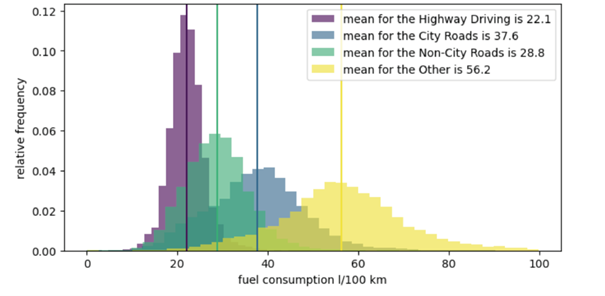 Chart 2: Summer fuel consumption in liters/100 km (June 2024) – average values for highway, urban, extra-urban, and other conditions
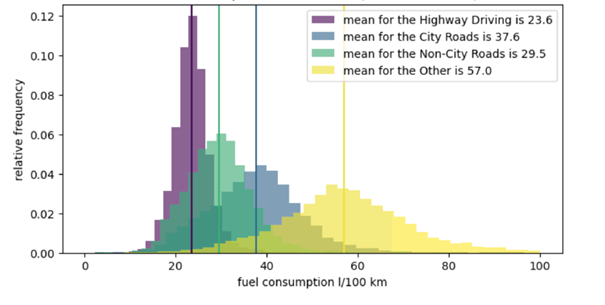 Chart 3: Winter fuel consumption in liters/100 km (December 2024) – average values for highway, urban, extra-urban, and other conditions
Where to look for savings?
Savings do not only concern the cargo itself. For example, a full 600-liter fuel tank is almost half a ton of extra weight. If a vehicle operates on shorter routes and regularly returns to base, it may be more profitable to refuel less—without any technical intervention, you can reduce weight and fuel consumption this way.
When planning loads, the issue of volume and weight is often overlooked. However, it is the vehicle’s weight that can have a significant impact on fuel consumption, especially in the city, where every start and stop means higher consumption. And the less thought-out the load distribution, the higher the costs.
That is why some companies are introducing indicative weight profiles for specific types of orders. It is not about daily weighing, but about a simple system that allows monitoring which routes and vehicles carry the heaviest loads and where the highest costs are generated.
Savings can also be found when upgrading equipment. Comparing trailer and body designs often shows that choosing lighter materials or a more economical design allows for reducing weight by even several hundred kilograms—or increasing payload capacity with the same efficiency.
Telematics data shows that even seemingly small differences in vehicle weight can have a significant impact on fuel consumption. Weight optimization, for example by reducing the amount of fuel on shorter routes or choosing a lighter body, can bring measurable savings in operating costs.
– says Altmann from Eurowag.
Weight as an operational lever
Tracking vehicle weight does not require large investments or the implementation of complex systems. In most cases, these are simple changes that a carrier can implement immediately. Regardless of whether we are talking about the amount of fuel refueled, the choice of equipment, or more thoughtful load planning—every kilogram less can mean real savings at the end of the month.
-If you need to transport a 1-ton load, it is definitely better to choose a larger van consuming about 9.5 l/100 km than a truck burning 22.25 l/100 km and always fully utilize the vehicle’s capabilities.
– adds Altmann.
In a situation where fuel prices are rising and road tolls are increasingly dependent on emissions, weight control is no longer a minor operational detail. It is one of the few parameters over which the carrier has full control and which can become a source of competitive advantage in the market.
[1] https://www.consilium.europa.eu/cs/press/press-releases/2024/05/13/heavy-duty-vehicles-council-signs-off-on-stricter-co2-emission-standards/
[2] https://www.toll-collect.de/cs/toll_collect/bezahlen/maut_tarife/p1745_mauttarife_07_2024.html
Source: Eurowag