











When starting online sales, e-store owners face the choice of a specific logistics service model, which aims to ensure efficient and effective delivery based on a clearly defined role and responsibility of the logistics operator. Before the era of e-stores, customers bought goods in brick-and-mortar stores, ordering home delivery services. Currently, with online shopping, we talk about e-commerce deliveries.
From the perspective of a logistics operator like ROHLIG SUUS Logistics, both services differ in the place where the order is placed and the range of additional services, including, among others, delivery notification methods. The following e-commerce service schemes present a varied scope of logistics operator services, without, however, exhausting all variants available on the logistics market.
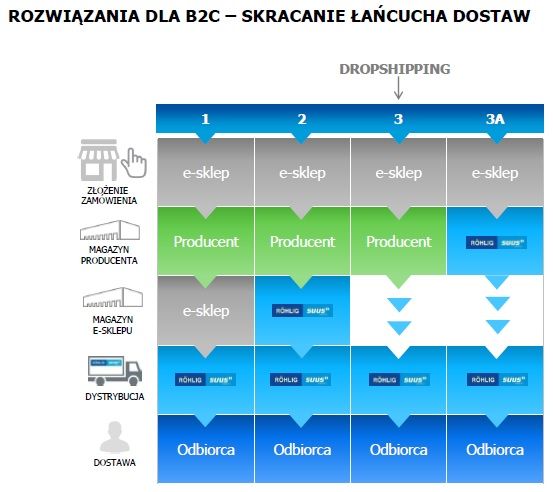
Scenario No. 1 – Limited role of the logistics company in e-store service.
This is the simplest e-commerce service model, where the e-store manages its own warehouse, importing goods from manufacturers or distributors with whom it cooperates. The task of the logistics company is solely to deliver the goods from the e-store’s warehouse to the final recipient.
Scenario No. 2 – Expanded role of the logistics operator.
When an online store decides to expand its cooperation with a logistics company, the operator manages the e-store’s warehouse or warehouses, from which deliveries are made to final recipients via the operator’s distribution network.
Scenario No. 3 – Shortened logistics chain bypassing the e-store warehouse (dropshipping).
Scenario No. 3 is a logistics service model in which goods (usually larger products, e.g., large household appliances, furniture) never reach the e-store’s warehouse. Based on a notification received from the online store, the operator collects the shipment directly from the manufacturer’s (or importer’s) warehouse and delivers it to the final recipient.
Scenario No. 3A – Distribution of e-store goods directly from the manufacturer’s warehouse serviced by the same operator.
This is a variant of model No. 3, known as dropshipping, extended to include the operation of the manufacturer’s or importer’s warehouse by the same logistics operator that carries out deliveries to the e-store’s final recipients.
Choosing the optimal logistics service model
Online stores can use various logistics service models. Depending on the number of stages a shipment goes through on its way to the recipient and the scope of outsourcing, the role of ROHLIG SUUS Logistics as a logistics operator requires different involvement at each phase of the supply chain.
The first of the mentioned models (the e-store manages its own warehouse) represents the most common delivery method currently found on the B2C market. Its advantage is the transparency of the scope of responsibility and an equal division of roles between the e-store and the logistics operator.
The second scheme (the operator manages the e-store’s warehouse(s), from which it makes deliveries to final recipients) works well when there is an increased demand for warehouse space and when the e-store decides to hand over the warehousing service to a specialized logistics operator, e.g., due to a wide assortment or specific picking methods.
The next of the presented scenarios (the operator, after collecting the shipment from the manufacturer’s/importer’s warehouse, delivers it directly to the final recipient), eliminating the e-store warehouse from the logistics chain, guarantees the lowest costs and the fewest shipment damages. Companies deciding to cooperate based on scheme No. 3 should remember that choosing this logistics service model as the most favorable is, in this case, a joint decision of the manufacturer/distributor and the online store and requires tripartite agreements with the participation of the logistics operator. Especially in terms of information flow, indicating the moment of transfer of ownership, or handling returns or cash-on-delivery payments. Scenario No. 3 therefore carries the greatest challenges in the area of establishing responsibility and system integration.
Market observations show that online stores most often decide to maintain their own warehouse intended for handling smaller or lower-value goods (scenario No. 1) while simultaneously testing and implementing the dropshipping concept (scenario No. 3), usually for larger or high-value goods, where the benefits of this model are the greatest. In such a situation, we are dealing with a mixed scenario.
From the point of view of a medium or large online store, scheme 3A is also a favorable solution. In this model, both deliveries to the final recipient of the online store and the warehouse of the main manufacturer(s) of goods offered by a given e-store are managed by the same logistics operator.
Decisions on whom to entrust with the logistics operation of the manufacturer’s warehouse and the e-store’s deliveries are, of course, independent. However, an entrepreneur operating in e-commerce, by choosing the same operator that serves the manufacturer of the goods they offer as their logistics service provider, can maximize the benefits of dropshipping.
In each of the scenarios mentioned above, ROHLIG SUUS Logistics enables customers to use modern interfaces integrated with the e-store system. In the most advanced model, information about goods released from the warehouse automatically turns into an order for the logistics operator.