











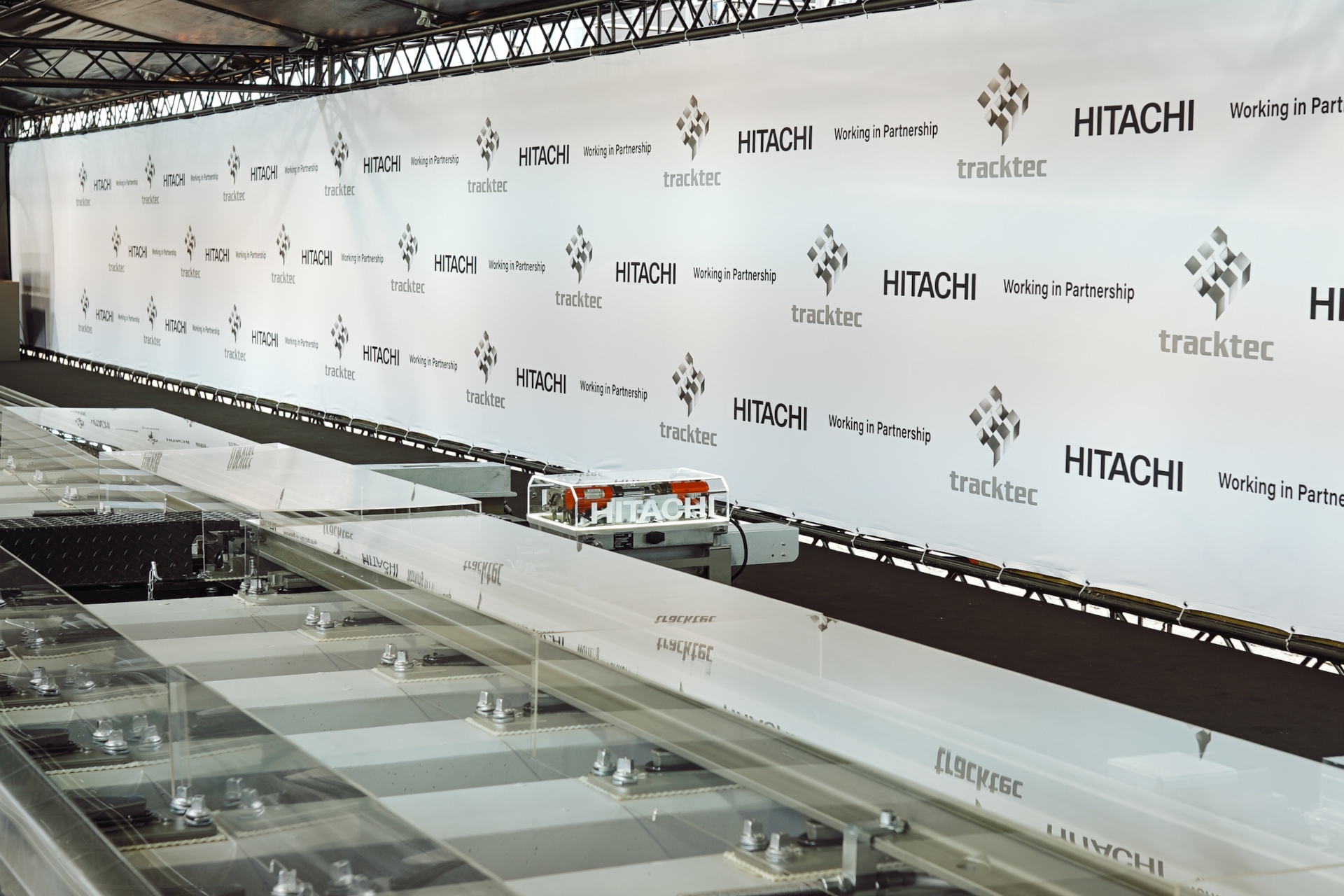
Hitachi Rail, a pioneer in modern solutions for railways and the mobility of the future, has partnered with Track Tec, a leading European manufacturer of railway track materials, to create an intelligent turnout system. The solution, named Smart Turnout Powered by Track Tec & Hitachi Rail, combines a turnout integrated with a CMS (Condition Monitoring System) from Track Tec and point machines from Hitachi Rail, enabling communication via the EULYNX protocol. Such innovations align perfectly with the new strategy of PKP PLK, which includes measures to improve the safety and efficiency of rail traffic. Smart Turnout Powered by Track Tec & Hitachi Rail will be presented during this year’s TRAKO trade fair, taking place from September 23-26 in Gdańsk.
- Smart Turnout Powered by Track Tec & Hitachi Rail is an innovative solution integrating a latest-generation turnout for high-speed railway lines, equipped with a CMS system, integrated with a modern electro-hydraulic point machine.
- This type of solution can significantly increase the safety and efficiency of rail traffic.
- The cooperation with Track Tec at the TRAKO fair fits perfectly into the development strategy of Hitachi Rail on the Polish market.
Cooperation with Track Tec in preparation for this year’s TRAKO fair is a very important and valuable experience for Hitachi Rail. We want to invest in Poland and for Poland, because we see huge potential here, both for the development of our business and for modern railway systems, especially for high-speed rail. We are open to local partnerships to build the railway of the future together with Polish companies. Responding to contemporary needs and anticipating future challenges, we are also constantly looking for newer solutions that will increase the reliability and efficiency of railways around the world. One such solution could be a product operating like Smart Turnout Powered by Track Tec & Hitachi Rail.
– said Paweł Przyżycki, CEO of Hitachi Rail Polska.
A turnout is the most critical element of railway infrastructure – safety, capacity, and railway availability depend on its reliability. To ensure the continuous, correct operation of turnouts, it is necessary to have continuous, remote, and automated monitoring that replaces periodic inspections performed by maintenance crews. For this reason, Track Tec and Hitachi Rail have developed an innovative solution: an integrated turnout system, including a turnout with an advanced CMS system and a universal point machine that could work with international interlocking systems. In Poland, this would be achieved through the standardization of interfaces at the national level, in accordance with the PKP PLK Ie-114 instruction, and in foreign markets, it would be possible thanks to compatibility with the EULYNX standard.
A higher dimension of diagnostics and prediction
A significant role in the Smart Turnout Powered by Track Tec & Hitachi Rail solution is played by the CMS (Condition Monitoring System), which is a system for monitoring the technical condition of infrastructure that offers broad capabilities in terms of continuous supervision of device and vehicle operation, analysis of data on their operating parameters, and the creation of predictive models. Thanks to this, it provides the ability to detect irregularities and faults early, and consequently, to optimize maintenance work. The CMS thus contributes significantly to increasing safety, efficiency, and the service life of devices, as well as reducing operating costs. Furthermore, it operates independently of existing signaling systems (SRK), which additionally translates into improved railway reliability. This is particularly important in an era of increasing cyberattacks and rapidly changing weather conditions, which pose a significant threat to the integrity of railway systems.
In the Smart Turnout Powered by Track Tec & Hitachi Rail solution, the CMS system consists of four independent but cooperating measurement modules. The first of these (M1) is an electrical module that measures and records the electrical parameters (current and voltage) of the point machine power supply and their switching time. In this way, it allows for the analysis of the correctness of the switching cycle and the detection of increasing mechanical resistance. As a result, it enables better prediction of the availability of the point machine and turnout for operation. Appropriate preventive actions taken as a result of the M1 module’s operation would allow for increased railway efficiency, e.g., reducing vehicle delays on routes. Importantly, this module acts as an “overlay” system, which means it does not require interference with existing control or power supply systems.
The second module (M2) is a vibroacoustic module based on accelerometers measuring rail (stock rail) vibrations transmitted through the integrated sleeper. Changes in the vibration spectrum can indicate damage to the surface of rail profiles, the rolling surface of vehicle wheels, or wheelset suspension systems, as well as degradation of the ballast and subgrade. Data from the measurements allow for the assessment of the dynamic state of the track, identification of deviations from the norm, and predictive detection of potential damage using artificial intelligence algorithms. The system can be updated and developed through the application of newer algorithms, based on, among other things, machine learning.
The next module (M3) is the switch blade – stock rail position module, in which sensors continuously measure the distance between the switch blade and the stock rail. This enables the identification of irregularities in the contact between the switch blade and the stock rail, both in a static state and during the passage of a train, before an alarm is triggered in standard signaling systems. This would allow not only for an increase in railway traffic safety but also its efficiency due to more accurate prediction regarding the need for turnout maintenance.
The last module (M4) is the weather module, which uses a weather station and temperature sensors installed on the stock rail to monitor atmospheric conditions, such as precipitation, air humidity, or sunlight. Based on this, it can warn, for example, about icing on rails, the temperature of which is also monitored.
The architecture of the CMS system has been designed with the use of ML/AI algorithms in mind. Synchronized data streams from modules M1-M4 have consistent formats and operational metadata, which facilitate machine learning and inference.
Hitachi drives innovation
The whole system is fully integrated with an electro-hydraulic point machine for external locking, with an adjustable throw of the setting slide, supplied by Hitachi Rail. This point machine has been designed for maximum safety on high-speed lines that require the use of multi-drive systems. The variable and adjustable throw of the setting slide and setting force allow for extremely precise control of the switch and accurate adjustment to the turnouts, which is crucial for minimizing the risk of derailment. Integration with the integrated sleeper strengthens the point machine’s resistance to track work and provides additional protection against external factors.
Another important element of the integrated turnout-point machine solution is the interlocking system from Hitachi, which can be equipped with an FEC (DCA3) object controller, compliant with the European EULYNX standard (EULYNX Object Controller), as a component managing railway infrastructure elements, such as switches or signals, within the EULYNX standard.
Smart Turnout Powered by Track Tec & Hitachi Rail will be available to see at stand TZ 02 during the TRAKO fair, which will take place from September 23-26 this year at the AMBEREXPO Exhibition and Congress Centre. Additionally, at the internal Hitachi stand, where Hitachi Rail and Hitachi Energy will present – A45, visitors will be able to learn about:
- the advanced, modular ARAMIS (Advanced Railway Automation Management Information System) traffic management system, designed to improve efficiency and increase the capacity of the railway network, and thus reduce the carbon footprint. This system will work perfectly in Area Control Centres, the creation of which PKP PLK is working on;
- the innovative, comprehensive HMAX digital asset management platform, which enables the prediction of problems and optimization of services, especially maintenance and repair, which translates into lower operating costs and greater reliability of rail transport;
- an interlocking system in the cloud (IXL in the Cloud) – it will be presented using a segment based on the ETCS L2 system of the Gotthard Base line in Switzerland, supported by a hybrid public-private cloud infrastructure and server infrastructure.
Source: Hitachi Rail / MSL Group