










Henry Humphrey Evans Lloyd was a Welshman – an officer and diplomat, and a well-known military theorist. His works were studied by, among others, G. Washington and G.S. Patton, and used by J.F.C. Fuller in the development of military science. It is believed that he addressed the issues of logistics in his works.
Career
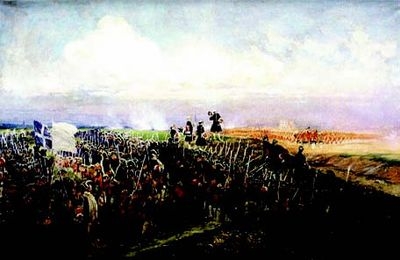
H. Lloyd was born in 1718 into a pastor’s family. He was educated at Jesus College in Oxford. His initial efforts to become an officer in the British army, and subsequently the French army, ended in failure as he was unable to purchase an officer’s commission. Upon returning to his alma mater, he spent a year teaching geography and military engineering in classes he conducted for officers. In 1745, he was accepted into the French army and took part in the war against Austria. He earned a promotion to officer in the engineering corps when the sketches he made of the Battle of Fontenoy caught the attention of his French commander. He served as a captain in the Jacobite forces of Ch. Stuart fighting against the British, and as a major in the French army during the siege of Bergen in 1747, then in the Prussian army, and from 1754 again in the French army. After returning to England, posing as a merchant, he conducted reconnaissance of the coast necessary for a French landing.
In the initial stage of the Seven Years’ War, he served as a lieutenant colonel in the Austrian army (fighting against the Prussian army) as a quartermaster on the staff of Field Marshal F. Moritz von Lacy. After being promoted to the rank of major general, Lloyd moved to the army of his former adversary, and his superior became Prince Ferdinand of Brunswick. In 1763, he was to join the Portuguese army, which was preparing for war with Spain, but the conflict ended before he could take up his new position. When he returned to England, he combined writing military texts with carrying out diplomatic and secret missions. He took part in negotiations regarding the marriage of King George III and Princess Caroline. In 1768, during a secret mission in Italy, he organized supply deliveries for the defense of Corsica. From 1773, he served in the Russian army fighting against Turkey, and then Sweden, which he left when he did not receive the Order of St. Anne due to a lack of “noble birth.” After several trips to Italy, Spain, and Gibraltar, H. Lloyd died in The Hague in 1783.
The article comes from the magazine “Logistyka” 2/2012.