








This year, the Department of Transport at the Warsaw School of Economics (SGH) was renamed the Institute of Infrastructure, Transport and Mobility. What research changes has this brought about? What are you currently working on?
<\/strong><\/p>
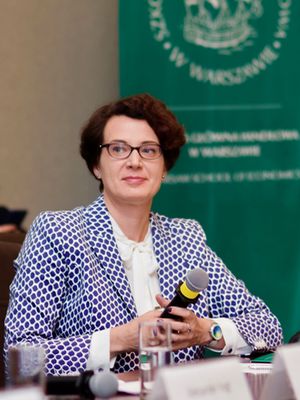 dr hab. Jana Pieriegud, p<\/strong><\/strong><\/em><\/strong><\/em>rof. of the Warsaw School of Economics, Head of the Department of Infrastructure and Mobility Research<\/strong><\/strong><\/em><\/strong><\/em>: <\/em><\/em>Last year marked 50 years since the establishment of the Department of Transport. During this time, many changes have occurred. The name of the newly created institute and the two departments that comprise it – the Department of Infrastructure and Mobility Research and the Department of Business in Transport – reflect the issues we have been dealing with in recent years. The mission of our institute is to conduct interdisciplinary scientific research, provide education, and popularize knowledge regarding the development and operation of infrastructure, conducting business related to transport services for the economy, and meeting the mobility needs of society in the digital economy era.
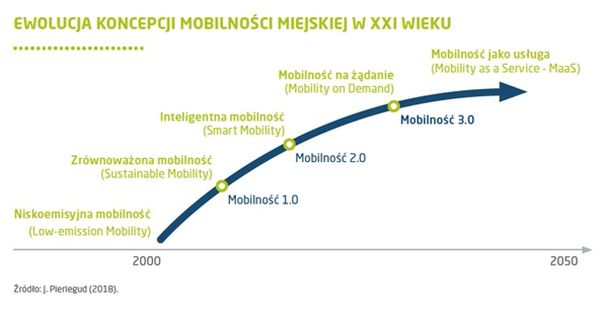
From the perspective of meeting transport needs, today’s mobility is not just a simple overcoming of time and space, but a new dimension of freedom, lifestyle, quality of life, feelings, and dreams for each of us. This requires a new approach not only to the development of transport systems but also to power engineering and telecommunications. Autonomous, connected, electric, and shared vehicles are key elements of the Mobility 3.0 era, which is approaching at an unimaginably fast pace. Changes in these areas will affect thousands of stakeholders from various sectors of the economy. They should be included in urban mobility development strategies for both large metropolitan areas and medium and small cities. We analyzed these aspects in our research and presented them in monographs: Mobility in the agglomerations of the future<\/em> (2018) and Electromobility in Poland against the background of European and global trends<\/em> (2019).
We devote a lot of attention to observing technological changes and the digital transformation of enterprises, economic sectors, and supply chains. Cyber-physical systems and artificial intelligence will be the basis for the phase of socio-economic development known as the “fourth industrial revolution”. In September of this year, we are organizing the Euro-Trans 2019 conference, the main topic of which will be artificial intelligence and its role in the process of developing mobility systems and managing supply chains.<\/p>
 <\/p>