











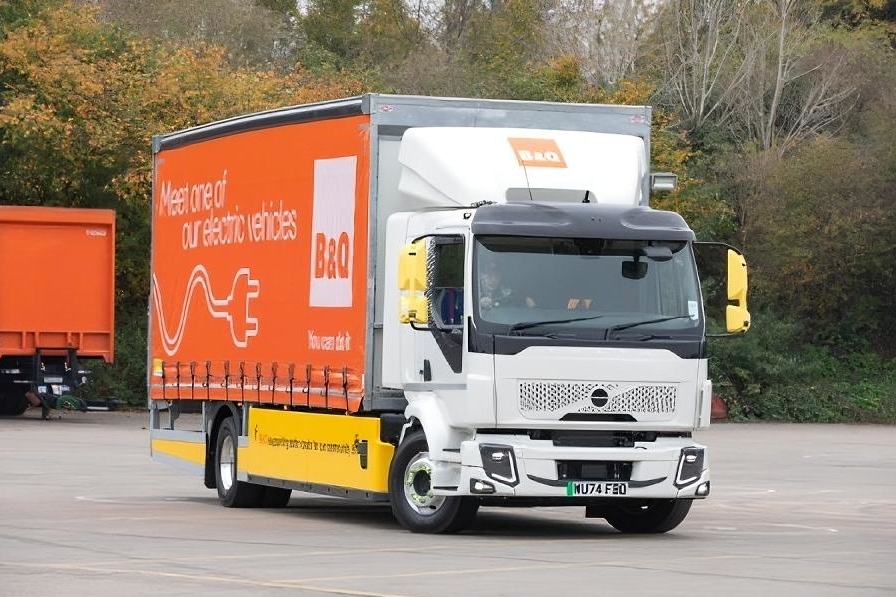
GXO Logistics, Inc., the world’s largest pure-play contract logistics provider, and B&Q, the UK’s leading home improvement and garden retailer, are on track to achieve their shared goal of net zero carbon emissions across B&Q’s entire logistics operations by 2040.
Since the partnership began in 2015, GXO has managed B&Q’s transport network, including national and regional distribution centers, “Store to Home” services, returns processing, and a flagship seasonal warehouse. B&Q has a strong online and market presence, offering over 700,000 products for home delivery or “click and collect.” Both companies are working together to drive innovation and sustainability in retail logistics, in line with the vision of B&Q’s owner, Kingfisher: “Better homes. Better lives. For everyone.”
Achieving net zero in logistics transport is a major challenge that can only be met by combining various strategies. Our partnership with B&Q is an example of how a thoughtful combination of available technologies and a shared commitment to decarbonization can contribute to real progress. B&Q’s approach is a model for the industry, proving that innovation, collaboration, and sustainability can go hand in hand to create a more efficient and environmentally friendly fleet.
– said Gavin Williams, Managing Director of GXO for the UK and Ireland.
Decarbonizing our fleet and utilizing the latest available technologies is a key step in our transition to alternative fuels, which allows us to offer customers a greater choice of sustainable delivery options and reduce our environmental impact. We are pleased to work with GXO, which helps us realize our ambitions and achieve our net zero goals by 2040.
– said Darren Hall, Logistics Director at B&Q.
Accelerating towards net zero
In 2022, GXO and B&Q launched the “B&Q Sustainability Path,” a comprehensive roadmap for decarbonizing the logistics fleet. By combining efficiency improvements, accurate emissions reporting, and strategic initiatives, the companies reduced projected emissions by 40% in 2024, putting B&Q ahead of schedule for its net zero target.
Fleet transformation through alternative fuels
The foundation of the decarbonization strategy is the transition to alternative fuels. Since 2019, B&Q has introduced 105 vehicles powered by liquefied natural gas (LNG) – currently the second-largest fleet of LNG-powered vehicles in the UK – which has reduced carbon emissions by 16,000 tons. In December 2024, the companies completed the conversion of all remaining vehicles and 80 refrigerated trailers to hydrotreated vegetable oil (HVO), which reduces CO₂ emissions by up to 90% compared to diesel.
Electrification and innovation
GXO and B&Q have also invested in electric vehicles (EVs), putting five electric vans and two electric trucks into operation. In 2025, two more electric trucks will join the fleet, and 55 additional electric vehicles are planned over the next five years. The current electric vehicle fleet is expected to deliver savings of 250 tons of CO₂ equivalent per year.
In addition to fuel changes, GXO has implemented a number of initiatives to reduce mileage and improve B&Q’s operational efficiency. These include:
optimizing backhaul transport, which saved 104 tons of Scope 3 emissions in 2024 alone, a digital receipt system to improve route planning and driver efficiency, and a 9.5% reduction in the fleet since 2021 through smarter planning and improved driving style based on driver behavior. In the first quarter of 2025, the companies introduced 35 new Volvo FH Aero LNG-powered tractors. These vehicles are equipped with extended aerodynamic cabs that improve fuel efficiency by 3%, saving approximately 100 tons of CO₂ annually.
AI-powered logistics of the future
Looking ahead, B&Q is testing GXO’s proprietary AI-powered transport optimization platform. This technology analyzes millions of route variations to identify the most efficient schedules, with initial results indicating potential savings of 240,000 kilometers and 150 tons of CO₂ per year. Full implementation is planned for 2025.
As part of its decarbonization efforts, GXO in the UK uses an activity-based carbon accounting methodology, utilizing DEFRA conversion factors to calculate emissions from fuel and energy consumption. This data is reported monthly to Kingfisher and independently audited once a year.
Source: GXO Logistics