








The courier company has started ordering energy from renewable sources. This also applies to the operator’s largest facilities. Approximately 500 clean megawatt-hours will be generated monthly for GLS’s needs.
The scope of the orders covers 85% of the total electricity consumption of GLS Poland. It concerns nearly 20 of the operator’s branches and subsidiaries across the country, including the largest facilities, such as sorting centers near Warsaw and in Stryków near Łódź.
– We have implemented the solution in all of the company’s own locations and in those leased facilities that could be covered by a central electricity purchase agreement. We should soon receive a certificate confirming the origin of energy from RES for the first quarter – says Justyna Glaza, Environmental Manager at GLS Poland.
How does the certificate work? Recipients using this solution are not connected directly to RES installations. The energy supplier issuing the certificate undertakes to generate exactly as many megawatt-hours from photovoltaic power plants, wind farms, hydroelectric power plants, biomass, or geothermal sources as the recipient has consumed. Therefore, it is not a flat-rate form. The settlement takes into account the actual energy consumption at each location.
The scope of clean energy sources is regulated by the Renewable Energy Sources Act of 2015. Data from Statistics Poland (GUS) shows that in 2019, the share of RES energy in Poland’s gross final energy consumption reached 12.18%. According to Eurostat, in the entire European Union in 2018, energy from renewable sources already accounted for 18.9% of consumption. Let us add that the European Green Deal has set goals that will make Europe the first climate-neutral continent in the world by 2050.
The operator on a green path
GLS Poland is also planning to install photovoltaic systems at its own facilities in the coming months – where technically feasible – and thus generate its own electricity. Let us recall that companies can be prosumers on the same terms as, for example, owners of single-family homes. There is only one condition – the capacity of the installation cannot exceed 50 kW.
– Consistently, since 2008, we have been implementing the Think Green initiative. Today, it is a mature and comprehensive program that is an integral part of our development strategy. Using the RES certificate is another element of activities in this area – emphasizes Justyna Glaza.
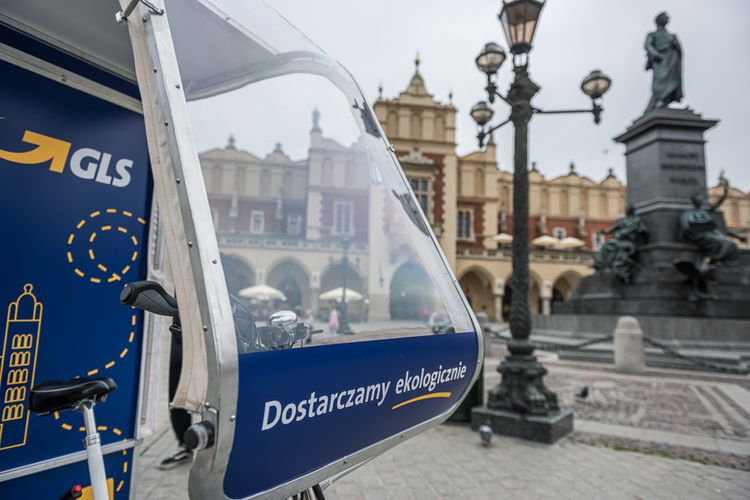
GLS was the first operator in Poland to introduce a courier bicycle into regular parcel service. This solution has been in operation since June 2020 in the very center of Krakow, where traffic restrictions apply. Across Europe, the company is currently conducting dozens of tests of various types of zero- or low-emission vehicles. In many European cities, it is testing the possibilities of alternative vehicles – in addition to bicycles, including those with electric assistance, also small vehicles such as e-scooters.
According to Eurostat data, in 2018, the share of energy from renewable sources in transport in Europe was 8.3%. For comparison: in Poland, it was 5.6%. This statistic includes a wide range of fuels – from electricity, through liquid biofuels and hydrogen, to biomethane. This shows that it is still not decided which type of drive will gain a dominant position on European roads in the future.
However, it is known that heavy transport will not be electrified for many years to come. Experts generally agree that in this category of vehicles, ways to reduce emissions must be sought, but based on internal combustion engines. Technically, this is already realistic. Since 2019, an important long-distance route in the international GLS network has been served by LNG-powered trucks – Iveco Stralis NP 460. In the case of these vehicles, fuel consumption is up to 15% lower compared to similar diesel-powered trucks. These vehicles emit as much as 99% fewer particulate matter and 60% fewer nitrogen oxides than required by the limits set in the Euro VI standard.
– Our entire fleet, including vehicles belonging to subcontractors and company cars, is gradually being replaced with more ecological models. However, this is a process largely related to the pace of technological development – adds Justyna Glaza.
Advanced digital tools also bring benefits to the environment. Since last year, GLS has been using an advanced tool for managing courier routes. The solution is based on geocoding. Precise geographical coordinates, so-called geocoordinates, are assigned to each parcel pickup or delivery address. In this way, it is possible to very accurately map real courier routes, and in real-time, which enables optimal planning of the entire delivery process. The more accurately the routes are determined, the shorter the transport time and the greater the fuel savings, which of course directly translates into lower emissions.
– Striving for solutions that fit into the idea of sustainable development is one of the most important trends in logistics today. It is important to develop optimal solutions both from the point of view of customer expectations and environmental protection. Basing on geocoding is an excellent example of such a solution – concludes Justyna Glaza.
Source: GLS