











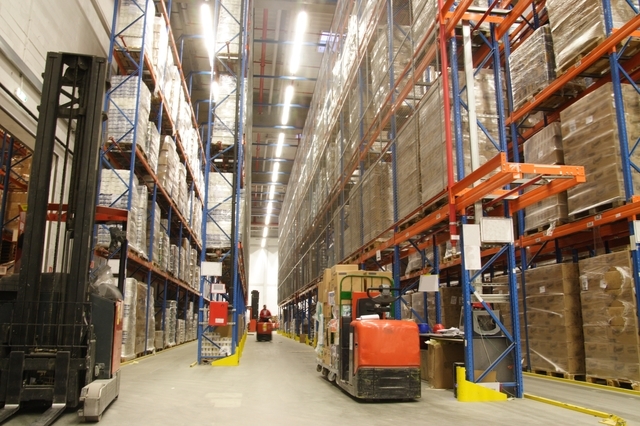
Warehouse processes are an essential part of logistics processes in supply chains. Proper organization of the warehouse process in terms of resource utilization – people and equipment, as well as buffer spaces, is crucial for maintaining the competitiveness of the entire supply chain. Scheduling warehouse process tasks and allocating labor resources to them is one of the fundamental ways of organizing work in a warehouse.
The issue of scheduling technological processes is widely discussed in the subject literature; however, the scheduling of warehouse processes is not directly addressed in scientific works. Fijałkowski formulated the issue of warehouse process organization by creating a schedule as a function of minimizing labor intensity balanced by labor costs. Ambroziak and Lewczuk developed a mathematical model for warehouse process scheduling and extended it to buffer area estimation issues. Lewczuk continues the topic by defining scheduling principles for the purpose of planning human labor and equipment utilization for the design of logistics facilities.
The problem of organizing warehouse processes (due to its complexity) is simplified into a descriptive form or detailed for specific cases. The literature considers a wide family of job shop scheduling problems with various constraints. These problems have been well described and mathematically formulated, along with appropriate heuristic and exact solutions. The paper demonstrates that the organization of a warehouse process has the characteristics of a scheduling problem, although there are also significant formal differences. The application of genetic algorithms to solve optimization problems is popular due to the effectiveness of this approach and is well documented. In the case of designing warehouse solutions, the literature presents examples of using genetic algorithms to optimize parts of warehouse designs, selected work organization principles, or resource management. However, there is a lack of the approach proposed in this article. Warehouse processes are the subject of modeling and discussion. The model presented in the work, which was cited in section 2 of the article and discussed in terms of the possibility of solving it using genetic methods, was chosen as the basis for further work. The application of genetic methods will enable its practical implementation, i.e., obtaining a satisfactory solution in an acceptable time. In the case of warehouse process organization, an approximate fulfillment of problem constraints and basic rationalization of the solution is sufficient. This results from the practical features of the issue. Since genetic algorithms do not operate schematically, there is a probability of obtaining rational solutions that are better than intuitive ones. The primary advantage of these algorithms, however, is the ability to efficiently search the state space of the problem and thus find feasible solutions – satisfying all constraints or solutions that satisfy the largest possible part of the imposed constraints.
The article contains 43,940 characters.
Source: Logistyka Magazine
Lewczuk_Genetic_programming_applied_to_warehouse_process_scheduling.pdf