











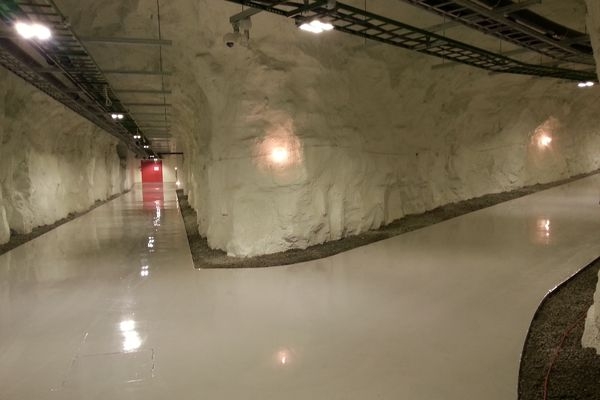
There is no doubt that one of the most important decisions accompanying the construction of a data center is the choice of location. Network access and electricity costs, connectivity, security, weather conditions, and topography are the most important factors. Why, then, would anyone want to build a data center in an abandoned coal mine, deep inside a mountain, or in the middle of a desert?
It does not matter whether it concerns full-scale regional data centers or prefabricated structures and micro data centers. There is no environment too extreme to build them in.
– Coal mines provide protection against the elements. You do not need to build a reinforced structure prepared for tornadoes, hurricanes, or other types of atmospheric discharges. The temperature remains at 10-15 degrees Celsius all year round, and the entrance is easy to secure – explains Mark Hurley, Executive Manager at Schneider Electric.
There are plenty of abandoned coal mines, and they often pose a threat to the natural environment. Their closure also affects local communities, often causing unemployment. Therefore, giving a mine a second life by locating a data center there is very beneficial for everyone. Placing a data center in a location such as a disused coal mine carries certain difficulties.
– Some equipment, for example, generators, must be placed outside to avoid dangerous emissions. The same applies to data centers located deep inside mountains. Ventilation ducts must be drilled into the rock – adds Mark Hurley.
Nevertheless, in some cases, the benefits far outweigh the challenges. For example, the Green Mountain data center in Norway is located 100 meters inside a mountain on the coast of the North Sea, in a former NATO ammunition depot. The conditions in this unique facility are so favorable that the data center has an almost zero carbon footprint. A data center can also function efficiently at an optimal level in the scorching sun. The best proof of this is the Supernap data center, which is one of the largest such facilities in the world. Despite its location in the Nevada desert, it guarantees 100 percent uptime.
– It is a place where natural disasters such as earthquakes, floods, or fires do not occur. Paradoxically, despite the desert location, the climate is cool enough to allow Supernap to operate in free cooling mode for over 75 percent of the time – adds Steve Carlini, Sr. Director, Data Center Global Solutions at Schneider Electric.
The trend of building data centers in extreme locations does not only apply to land. In 2009, Google filed a patent application for a floating data center, and just a few years later, the first barge of this type appeared in San Francisco Bay. From a provider’s perspective, the location of a data center matters for all the reasons mentioned, without affecting its operational capabilities or limiting its potential.
– We have solutions adapted to difficult conditions and we build them wherever the client wishes – concludes Mark Hurley.