











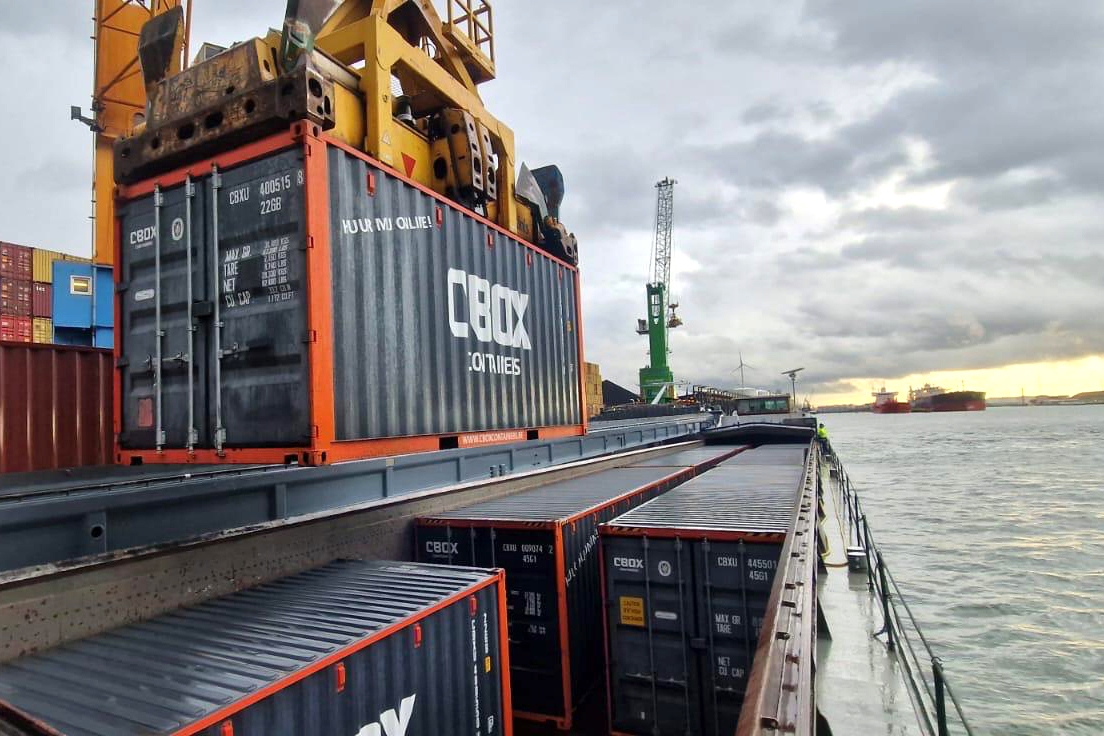
Instead of Gliwice, the barge had to sail to Szczecin; another one experienced a several-month-long stopover. Water levels and infrastructure make it impossible to safely plan voyages on Polish rivers. These are the conclusions from a pilot study conducted by researchers from the Łukasiewicz – Poznań Institute of Technology and the University of Gdańsk.
Since barges with goods sail along the Rhine, and our ancestors transported grain and timber down rivers to Gdańsk, why not try inland navigation in Poland? This is the question posed by researchers participating in the international research project CRISTAL. Its goal is to increase the share of freight transport in river shipping in Europe.
Poland has approximately 3,680 km of inland waterways classified as navigable. Polish researchers chose the two largest rivers, the Oder and the Vistula, for their tests. They have already completed three voyages with cargo barges with varying degrees of loading, and a fourth is still underway.
Smart buoys
Before that, however, the researchers installed special buoys on the Vistula, designed at the Łukasiewicz – Poznań Institute of Technology. They are equipped with sensors and collect information about route parameters – e.g., bridge clearance, water level, or current speed.
Such buoys could transmit data to the SCMS system (supporting transport users in planning cargo routes using various modes of transport), which in turn would make them available to, for example, vessels, infrastructure managers, or logistics operators.
Renovations, delays, and changes of plans
The voyages undertaken by the researchers showed that inland navigation in Poland is a challenge.
In the first one, the barge was supposed to sail from Antwerp to Gliwice, on the last section via the Oder Waterway. When it was already in the vicinity of Berlin, it turned out that the route had to be changed. The renovation of the Lipki lock on the way to Gliwice had been extended. Instead of Silesia, it ended its journey in Szczecin.
The second voyage on the Vistula to Gdańsk, in turn, was extended by… several months. The barge set sail at the beginning of November 2024, but due to low water levels and work at the Włocławek dam, it got stuck there for three months. When it reached Gdańsk in February of this year, it turned out that due to the renovation of the Siennicki Bridge, it could not get to the unloading terminal in the port. It had to go out into the waters of the Gulf of Gdańsk, for which it needed a special permit (and obtaining it took a week).
The only voyage that has taken place without obstacles so far was from Gdańsk to Płock.
We can already see that it is difficult to conduct inland transport in Poland. The Oder is easier to navigate than the Vistula, as the latter requires many investments that would increase water flow. Low water levels, caused by this year’s drought and – more broadly – climate change, make navigation dangerous. Captains say that they often touch the riverbed with the bottoms of their ships and barges. Our voyages on the Włocławek – Toruń section also encountered many difficulties caused by shallows in this area of the Vistula.
– admits Marta Waldmann from the Łukasiewicz – Poznań Institute of Technology, coordinator of the CRISTAL project.
In March, a barge set off from Gdynia to Płock. It is carrying an oversized cargo for one of the companies, which is being awaited by cranes and specially prepared unloading infrastructure at the Płock port. It is sailing slowly, although so far without disruptions.
Paradoxically, there are several clients who would be interested in using inland transport to deliver their cargo, but with the degree of unpredictability shown by our pilots, their concerns are very significant and justified.
– comments Marta Waldmann.
The main goal of the CRISTAL project is to increase the share of freight transport in Europe by inland navigation by 20 percent, while ensuring 80 percent reliability of this navigation. River transport is low-emission and can contribute to the European Union achieving climate neutrality. CRISTAL is co-financed by the EU.
Source: Łukasiewicz Research Network – Poznań Institute of Technology