











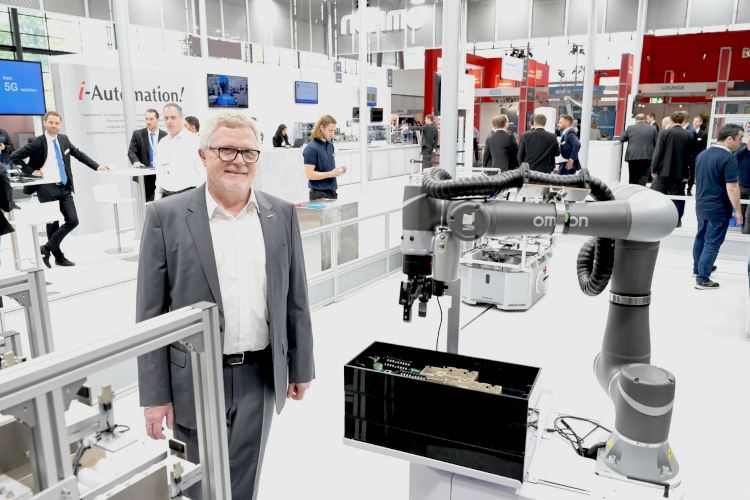
Fernando Colás, CEO of OMRON Industrial Automation Europe, presents the most important trends in the field of automation for the coming year.
OMRON Europe identifies the five most important trends that will influence industrial automation in 2023 and beyond. The manufacturing industry will continue to face many challenges, and overcoming them will involve building resilient and flexible business models. At the same time, companies must use new technologies — including sensors, robotics, 5G, and artificial intelligence — to address problems resulting from social challenges.
Trend 1. — Value for money
It is a fact that inflation will cause an increase in the costs of equipment and components in 2023. Consequently, automation suppliers will need to focus on providing solutions that neutralize these cost increases by generating value for users.
– For example, at OMRON, we always offer a complete and connected solution, not just products. This is contained in our innovative approach to automation, which involves generating value through solutions. All our innovations are based on three ‘i’ pillars: integration (evolution of control), intelligence (development of intelligence through ICT), and interaction (human-machine collaboration) – explains Fernando Colás, CEO of the Industrial Automation Business (IAB) at OMRON Europe.
Trend 2. — OpEx instead of CapEx investments
At the same time, many companies are holding back on capital expenditure due to the economic climate. Inflation is always accompanied by rising interest rates, which means that the return on investment for projects will be delayed. However, companies are aware that they still need to invest in automation to stay in the industry, continue to grow, and increase efficiency, which involves shifting to CapEx investment models. OMRON predicts that this trend will increase in 2023, and leasing options that facilitate capital investment will gain popularity in automation projects. To help companies considering investing in collaborative or mobile robots and to obtain quick and easy insight into the return on investment based on real data, OMRON has introduced an ROI calculator with OpEx and CapEx options, also offering financial solutions such as leasing options.
Trend 3. — Harmonized automation
Industrial automation has historically been seen as a replacement for human labor. With collaborative robots and automation, OMRON has moved towards employees and machines working together.
– We believe this will transform into harmonized automation, an approach that will help companies maximize human potential through human-centric automation technologies. Accelerating data-driven operations through digitalization will be key to this business transformation and empowering employees – comments Fernando Colás.
For example, AI-assisted high-speed inspection can help less experienced employees make better decisions. The main goal in the field of automation will become building more harmonious and stronger relationships between people, machines, and the environment. Harmonized automation solutions that increase productivity while reducing carbon emissions will be a step forward.
Trend 4. — Adaptation to autonomous production
OMRON predicts that over the next few years, there will be a shift away from the ‘optimization’ model of society, where consumption is the main driver and quantity is valued more than quality, to an ‘autonomous’ society model that prioritizes quality, ecology, and the development and well-being of the individual. This trend will be visible in the production space as we move towards ‘autonomous’ production. In the last decade, China was the factory of the world. Mass consumption was the main driver of production, while little attention was paid to the use of raw materials and the environment. Today, companies are moving away from this approach to focus on an approach that prioritizes sustainability, employee well-being, and quality over production volume. Automation solutions will evolve to reflect this trend, helping manufacturers achieve carbon neutrality, digitalization, and improve the quality of life for employees.
Trend 5. — Protection against supply chain instability
In 2022, the automation industry was hit by a series of supply shocks, particularly due to chip shortages, and worked hard to prevent future supply chain disruptions. In that year alone, OMRON redesigned over 1,000 products to be as universal as possible in terms of component compatibility. This was a huge undertaking, but it made it easier to replace components in case of shortages. The company also increased flexibility in its production processes and adjusted production capacity to component shortage cycles. Additionally, OMRON doubled the number of production lines in plants around the world, so that in the event of shortages in one region, production can continue in another. The net effect of these initiatives should be better protection for automation users against the supply uncertainty expected in 2023.
– As a company, we have always believed that social challenges drive technological development and vice versa. This has never been more applicable than in today’s times, when we face countless challenges — from climate change to an aging society and rising costs of living. In 2023, OMRON will use technology to help various industries reduce labor shortages, increase efficiency, and achieve carbon neutrality. Ultimately, our goal is to create an efficient production floor where both harmony with the environment and employee satisfaction are achieved – concludes Fernando Colás.
Source: OMRON Corporation