








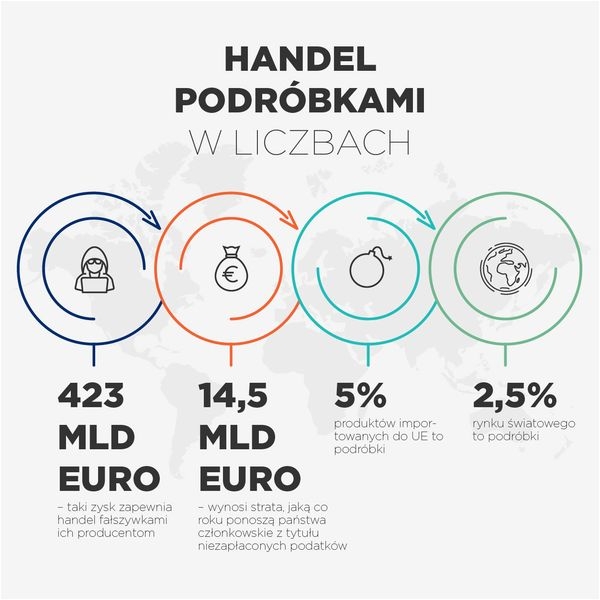
The number of counterfeit goods sold continues to rise, despite the development of security technologies. Manufacturers and owners of well-known brands, who lose the most from this practice, do not have sufficiently effective tools and solutions to curb this phenomenon.
Counterfeit cosmetics, clothing, and even medicines
The problem affects many industries, including pharmaceuticals, cosmetics production, clothing, electronics, and the food industry. The most dangerous negative consequence is the threat to the health and life of the consumer by introducing products to the market, which particularly applies to medicines, cosmetics, or food products. Currently, increasingly modern solutions are being created to protect products against counterfeiting, which combine physical product security with access to information about them on the Internet.
As much as 30% of alcohol in the world is counterfeit
Dynamic economic development and rising living standards are causing increased interest in branded products. Counterfeiters exploit this trend, seeing it as an opportunity to generate large revenues. The trade in counterfeits, as reported by Puls Biznesu, brings 423 billion euros in profit to their producers, while in Europe alone, member states lose approximately 14.5 billion euros annually due to reduced tax revenues. The main product groups with the highest upward trend in the number of counterfeit products include medicines, cosmetics, and alcohol, especially wine. A 2012 report by the International Center for Alcohol Policies states that as much as 30% of the alcohol consumed worldwide is counterfeit. Spirits Europe, in turn, reports that in the same year, as much as 25% of European alcohol sold in China was counterfeit. There are at least several reasons for this state of affairs. One of the main factors facilitating this practice is the progressing globalization of markets and, as a result, the limited availability of information allowing for the effective identification of counterfeit products and the tracking of their supply chains. Another significant factor is the limited access to information about currently used product marking methods and the relatively high costs of using such security measures. However, the most important problem is the lack of direct cooperation between manufacturers, who are unable to create effective security methods recognizable by consumers on their own.
ISO standards and authentication
A way to protect the market against counterfeits is authentication. This is a process consisting of identification and then verification of a product’s identity. Authentication and authorization are related terms, but they refer strictly to issues related to cryptography – the ISO/IEC CD 9798-1 standard. The process of verifying the authenticity of products generally involves a series of actions – from assessing the credibility of the supplier through, for example, simple visual verification of product features (quality of packaging, labels, markings, etc.) to the verification of additional security elements (e.g., holograms, etc.). However, in order to achieve the best possible result in the context of protection against counterfeiting, one must take into account not only the issues of physical security but also the potentially best method of sharing data with trading partners and the consumer. Hence, for several years, solutions have been appearing on the market based largely on product traceability, and not just on its physical security features. Such a solution is characterized by low implementation costs, ease of verification, and a relatively high level of security.
One solution and a global standard. Work on it is already underway
This is exactly the path being followed by the global organization GS1, which creates and manages identification and communication standards used widely in supply chains. There are a number of national solutions supporting product authentication, developed and implemented by local GS1 organizations, including in France, Italy, Hong Kong, or New Zealand. In 2017, a working group was established at GS1, whose task is to develop an authentication solution for alcoholic products and wines, based on the use of GS1 standards. In addition to the use of so-called GS1 identification keys, the primary one being the GTIN (Global Trade Item Number), the target solution takes into account such standards as:
- GDSN – (Global Data Synchronization Network), a grid of compatible electronic catalogs enabling secure and uninterrupted data synchronization, thanks to which all trading partners have consistent data about a specific unit in their systems at the same time;
- EPCIS – (Electronic Product Code Information Services), a set of standards that enables the construction of an information service on the Internet that ensures the sharing of information about events concerning the movement of goods and cargo, their groupings, quantities, and dates. EPCIS acts as a bridge connecting the world of physical events with business information systems.
Only by combining them into one functioning authentication solution will it be possible to effectively fight the illegal introduction of counterfeits into circulation and protect consumers from their unforeseen effects.
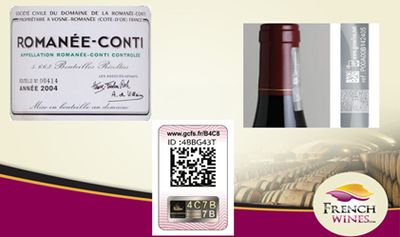
Fig. 1. Product authentication based on 2D code – French solution. Source: prepared based on materials from GS1 France
We want safe and original products
Currently, the consumer expects the manufacturer to provide a safe and original product, as well as to ensure reliable information about the purchased product. GS1 standards help reduce the number of counterfeit goods in the supply chain by monitoring their flow, as well as tracking the history of the journey from the production plant to the end customer. This facilitates the verification of product authenticity, and thus ensures consumer satisfaction.
Want to know more? Contact us:
Grzegorz Sokołowski
GS1 Traceability Expert
61 850 49 78
Grzegorz.Sokolowski@ilim.poznan.pl