












The fashion world is moving away from production in China, but other Asian countries will primarily benefit from this shift, meaning the region will remain a hub for the logistics market serving the fashion business. On the other side of the Pacific, the escalation of the trade war with China could severely harm operators in the US, where clothing imports reach 98%. Europe, which generates nearly 16% of revenue in logistics serving the clothing, footwear, and accessories sector, will compete for brands that, due to draconian tariffs in the United States, will be looking to expand their sales markets for their products.
Fashion market logistics with growth until 2029
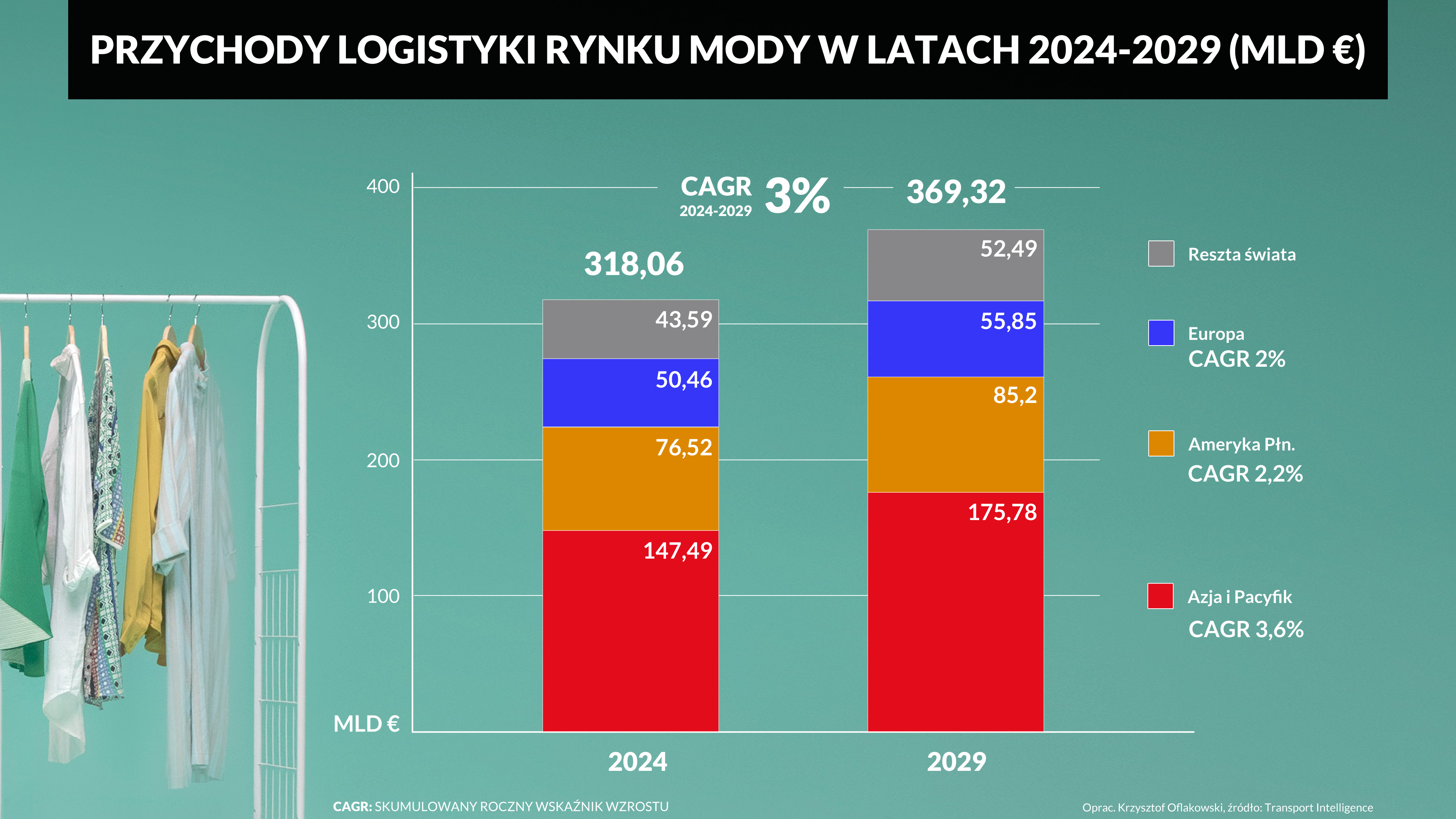
According to Transport Intelligence (Ti), spending on logistics serving the global fashion market will reach over 327.9 billion euros this year, representing a 3.1% increase compared to 2024, when the market value exceeded 318 billion euros. By 2029, logistics operations carried out for manufacturers and retailers of clothing, footwear, and accessories are expected to be worth over 369.3 billion euros, with an average annual growth rate of 3% assumed for the 2024-2029 period.
Asia leads, but China’s position is being undermined
The driving force behind global dynamics will be the Asia-Pacific region, where logistics spending in the fashion sector grew by 3.5% year-on-year in 2024, reaching a value close to 147.5 billion euros. This represents a 46.36% share of the entire market, and estimates suggest it could exceed 153 billion euros this year, marking a 3.7% year-on-year jump in value. The Asian growth rate, clearly above the global average, is expected to continue until 2029, when local fashion logistics will approach 175.8 billion euros. This means an average annual growth of 3.6% between 2024 and 2029 and a market share of 47.59% at the end of the forecast period.
This confirms the key importance of this region for both the fashion and logistics sectors. It is worth noting, however, that although the long-standing growth momentum has been primarily due to China, the situation in this area is changing significantly. This is happening, among other reasons, due to increasingly aggressive US trade policies aimed at China, including its fashion sector, and especially online platforms specializing in direct-to-consumer deliveries. A new chapter in the escalation includes 145% tariffs imposed on all Chinese imports and an executive order signed by the US President on April 8, 2025, which eliminates the de minimis exemption for low-value e-commerce shipments (up to $800) and imposes a 90% levy on these goods. This will certainly be a severe blow to the Chinese fashion sector and related logistics operations, but other markets will also suffer, especially in the US, where demand will fall and prices will rise.
The loss of China’s position, however, has a much broader context, resulting from, among other things, increasingly clear declarations and actions by fashion manufacturers regarding relocating production closer to sales markets (nearshoring) and moving operations to other countries, still located in Asia. Internal factors also play a role, including weakening consumer sentiment in China. This latter aspect is highlighted in this year’s McKinsey report on the state of the global fashion market. The forecast by their analysts indicates that in 2025 we may see a continuation of the downward trend in the area of luxury fashion items sold in the Middle Kingdom. Retail trade in this segment may stagnate or even fall by 3% year-on-year, which would be a repeat of the result from the first half of 2024. In the second half of last year, the slump was even deeper, oscillating between minus 7 and 10%. Such results were not observed simultaneously in Europe and the US.
China’s loss does not yet mean that production will be massively relocated to Western economies, which would benefit local logistics operators. While fashion brands are looking for other locations, they are still remaining in the Asia-Pacific region, which is generating growth in logistics in countries such as Vietnam, Bangladesh, and India—significant global producers of textiles and clothing. It is also worth noting that Chinese exports of fashion items to non-Western economies are still growing, so China’s overall position, despite weakening potential, remains very strong, and it remains the largest exporter and producer of fashion items in the world, accounting for about 31% of the market.
Fashion logistics in North America is developing slower than in Asia and is burdened with high risk
Although the North American market is very absorbent, its growth dynamics lag behind the achievements generated by Asian competitors. This is despite data from the US International Trade Commission indicating that the US is the largest single importer of clothing in the world, absorbing 20% of global exports coming mainly from Asia. According to data published in early 2025 by Statista, the US is currently the largest sales market for clothing in the world, with sales worth $365.7 billion. The importance of these factors for the growth of the logistics sector is balanced, however, by the fact that only 2-3% of clothing is produced in the US, and footwear imports reach 99%. In the context of tariffs imposed on key producers of fashion items, such a trade structure creates huge risks for brands and the operators working for them, because it is the United States that sets the tone for dynamics in the fashion logistics market across North America, which in 2024 achieved 2.3% year-on-year growth, exceeding 76.5 billion euros. This is just over 24% of global potential, and calculations by Ti indicate that by 2029, the average annual growth rate will remain at 2.2%. This means revenues reaching 85.2 billion euros, but at the same time a slight decline in global share to the 23.07% level.
Europe is chasing other markets and has certain advantages
European logistics serving the fashion sector generated revenues of nearly 50.5 billion euros last year, but the average annual growth between 2024 and 2029 is estimated at only 2%, which is the lowest result among key regions in this market. Currently, the Old Continent can count on 15.86% of the total revenue pool, but by the end of the forecast, this share will shrink to 15.13%. In four years, European operators providing services to manufacturers and sellers of clothing, footwear, and accessories will share over 55.8 billion euros, which will guarantee Europe 3rd place on the global podium.
Despite a relatively small share in the global logistics market serving fashion, Europe has certain assets that, while not a guarantee of sector growth, will at least allow for stability in the current economic situation. First of all, unlike the US, which is the driving force of the North American region, European economies are not entangled in an aggressive trade war with China. Due to the scale of production in that country and the scale of imports to the Union, this is one of the fundamental factors that will affect price security and the condition of the fashion sector in Europe. Although European brands are announcing a move away from imports from the Middle Kingdom, which will take years, and the Union is planning certain steps to limit trade, such as abolishing the customs exemption for low-value e-commerce shipments, 91% of which come from China, there is currently no talk of imposing draconian tariffs on fashion items. It is different in the US, where traditional imports from China have already been subject to unprecedentedly high rates, just like cheaper items in e-commerce that were previously exempt from fees. This is an exceptionally risky step for local operators because the United States basically does not produce fashion items on its own market, so it is only a matter of time before high import duties lead to price increases and lower demand. If tariffs are maintained for a long time, sales will certainly fall, also because other important producers of fashion items, including Vietnam, Bangladesh, and India, are still threatened with high burdens. To diversify risk, both Chinese manufacturers and other economies will look for other markets for their products, so they will naturally turn towards wealthy Europe. They will, among other things, want to take advantage of still-open opportunities in European e-commerce, where fashion has dominated other categories, both in terms of revenue and share of orders. This will create an impulse for development among logistics operators, as brands have long been locating their distribution, order fulfillment, and returns centers in Europe. We have been observing this process for years, and now it will accelerate, also in Poland. – explains Beata Troczyńska, Strategic Account Manager and Communication Manager at ID Logistics Polska, which provides comprehensive logistics and transport solutions, e-commerce support, and supply chain management in 18 countries.
What is the potential of fashion sold in Europe online?
According to data from the business intelligence firm ECDB, which specializes in researching e-commerce markets, last year’s online fashion purchases generated revenues of $149 billion in Europe. It was also the most valuable category in European e-commerce, with a revenue share reaching 21%.
The huge attachment of Europeans to online fashion shopping is also confirmed by Eurostat, which indicates that clothing, footwear, and accessories were the most popular product category in 2024 in terms of order share. As many as 46% of people using the internet in the EU made purchases in this category. The fashion sector thus outclassed the second-place ready-made meals (21%) and the beauty category (20%).
In Poland, too, the fashion sector plays a key role in e-commerce. According to the Central Statistical Office (GUS), in February alone, the share of textiles, clothing, and footwear accounted for 28% of total online sales. According to calculations by the Polish Chamber of Commerce (KIG), this category generated turnover reaching 999 million PLN in February, which accounted for 15.5% of the total e-commerce sector turnover.
Who dominates and what does the global clothing market look like?
According to McKinsey’s calculations, the clothing market generated $1.7 trillion in 2023, and according to Statista, this value could reach $1.84 trillion in 2025. Although the industry itself is very fragmented, both in terms of production and variety of assortment, it maintains an upward trend. Current estimates assume an average annual rate in 2025-2029 of 2.64%, which is slightly slower than the dynamics forecast for logistics serving this market (3%).
A significant role for the future condition of the sector is attributed to the sale of fashion items online, and the potential of the clothing market for logistics operators has been confirmed by industry analysts for years. Those associated with the British analytical center Transport Intelligence believe that the supply chain linked to various elements of fashion production, distribution, and sales is one of the most dynamic sub-segments in the entire global logistics market. Developed logistics capabilities are simultaneously the foundation for building the competitiveness of fashion brands. They will also be a key factor taken into account when changing the location of the production base and launching distribution centers, especially those focused on serving wealthy economies.
For many years, however, China has played a dominant role in the fashion industry, maintaining its position as a leading exporter. Last year’s calculations conducted at the University of Delaware show that it has a share in global clothing exports reaching 31.6%. Other places are occupied by Bangladesh and Vietnam (7.4% and 6%) as well as Turkey, India, Indonesia, and Cambodia, which together account for 9.8% of global potential. The United States, on the other hand, looks very weak, with an export share of only 1.4%. The Union performs much better, as a bloc it is responsible for 31.2%, but the Community countries trade clothing mainly internally, which on the other hand builds some additional stability for regional logistics operators.
China’s position on the global fashion stage is weakening
Fashion market analyses show that although very slowly, the position of the Middle Kingdom as a leading clothing exporter in the world is clearly weakening. University of Delaware data shows, among other things, a decline in China’s share of global exports from 38.5% in 2015 to 31.6% in both 2022 and 2023, where annual stagnation became apparent. At the same time, the importance of Bangladesh and Vietnam is growing, which in 2015 accounted for a total of 10.7% of global exports, and in 2023 for over 13%.
Similar conclusions flow from this year’s McKinsey report on the fashion market. Industry analysts assume, among other things, that in 2030 the share of clothing and textiles imported to Europe from China will fall to 26% from 34% in 2019. Other countries will gain, but production will still be located primarily in Asia. According to current assumptions, the import share of India, Vietnam, Bangladesh, and Cambodia will increase from 29% in 2019 to 33% at the end of the current decade. Logistics routes will also follow this path.
The same applies to the US, where the share of textile and clothing imports from China is expected to fall to 30% in 2030 from 40% in 2019. At the same time, imports from India, Vietnam, Cambodia, and Bangladesh are expected to jump by 5%, reaching a 30% share.
Along with the weakening position of the Middle Kingdom, both in the US and Europe, spending on nearshoring, i.e., moving production capacity closer to sales markets, is simultaneously increasing. This year’s data shows that in Europe, foreign direct investment aimed specifically at relocating clothing and textile production increased from 17% to 37% between 2015 and 2024. Resources are being moved mainly to North Africa and European countries that are not members of the Union, excluding the UK. An important element of this landscape is, among others, Turkey.
The same process is taking place in the US, where investments in clothing nearshoring increased from 41% in 2015 to 49% in 2024. The United States chooses primarily Latin American countries and its closest neighbors on the continent for production locations.