









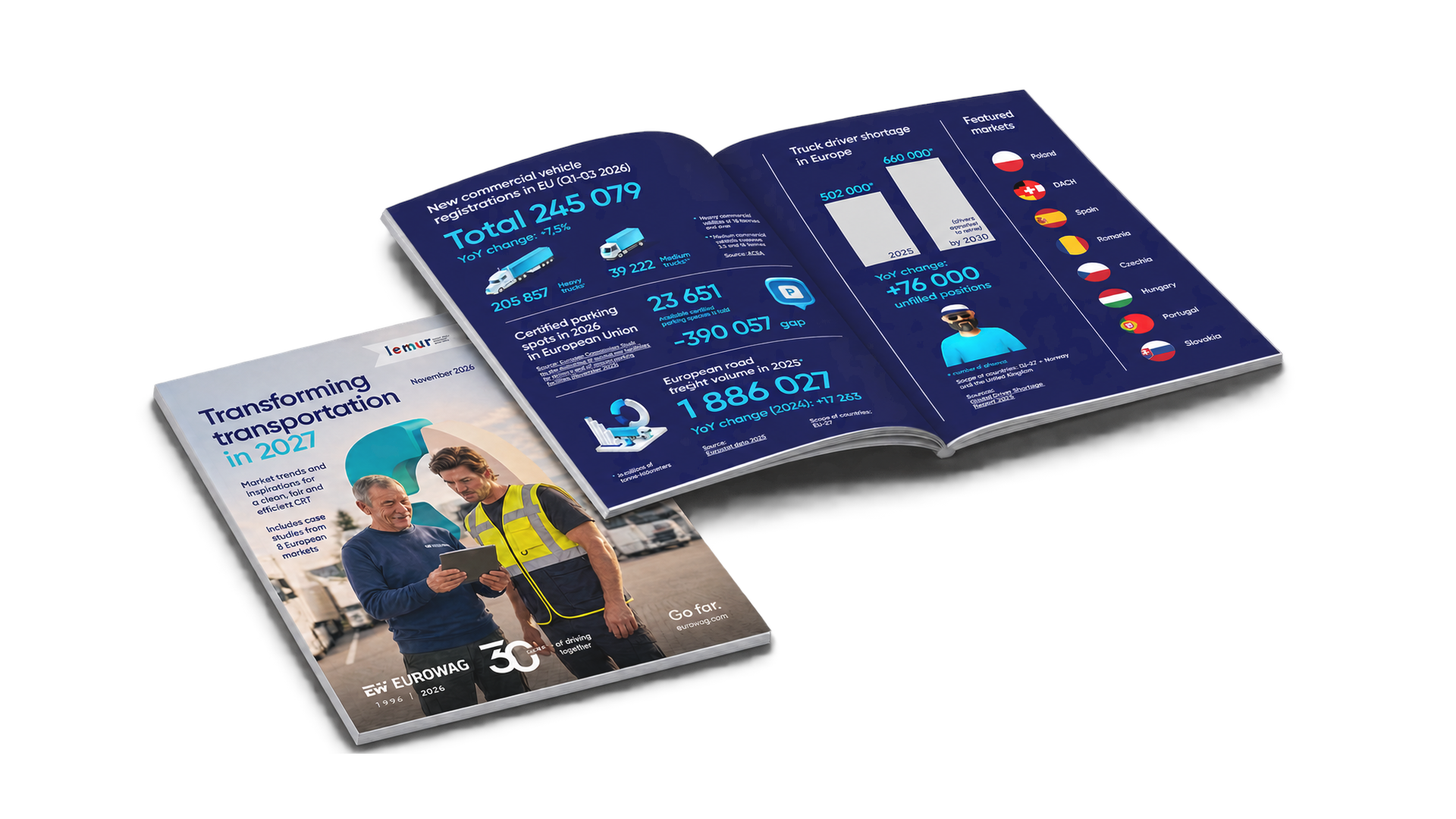
European road transport is undergoing a transformation. Carriers are facing a shortage of over 500,000 drivers, and it is estimated that another 660,000 will retire by 2030. At the same time, operating costs are rising, and the pressure to reduce emissions is increasing. These are some of the most important conclusions of the latest edition of the Eurowag “Transforming Transportation in 2027” report. The publication points to the significant role of digitalization, automation, and more effective use of data in meeting these challenges.
This is the third edition of the “Transforming Transportation” report. It presents the most important trends in European road transport. This year’s edition includes insights from 8 European markets and 24 examples of companies that are successfully dealing with industry challenges. They have been presented in three categories: “Market Leader”, “Sustainability Star”, and “Technology Innovator”. The experiences of these enterprises show how transport companies adapt their operations to the economic, technological, and environmental changes affecting the industry.
The report also indicates that the competitiveness of transport companies will increasingly depend on the skillful use of data, process automation, and the optimization of day-to-day operations.
Digitalization helps protect the profitability of transport companies
In the face of rising costs, digitalization is no longer just a technological advantage; it has become an essential tool that allows for more effective fleet management, expense control, and margin protection. Transport companies are increasingly integrating data on fleet management, refueling, toll payments, telematics, and finance into a single digital system.
Automation of administrative processes, intelligent route planning, fleet management, and the use of artificial intelligence help reduce operating costs, increase productivity, and streamline decision-making. Thanks to access to real-time data, companies can identify areas requiring improvement faster, use vehicles more effectively, and respond more efficiently to changes in current operations.
Reducing empty runs allows for lower costs and emissions
The fastest path to greater operational efficiency and lower emissions does not necessarily have to be replacing the fleet. Significant potential lies in better transport planning, reducing empty runs, and encouraging drivers to drive more economically.
Data is the key to these savings. Carriers that have access to operational and financial information in one place can more effectively monitor vehicle usage, fuel consumption, costs of individual routes, and differences in fuel prices at stations.
Transport is becoming increasingly complex, which is why companies need quick access to reliable data that supports daily decision-making. Integrating operational and financial information into a single digital platform, such as Eurowag Office, allows transport companies to control costs more effectively, improve operational efficiency, and maintain long-term profitability.
– comments Radoslaw Tatarski, VP Commercial Strategy & Operations at Eurowag Group.
Another solution is the transition to lower-emission fuels such as HVO100 or LNG, or to electromobility. HVO100 can be used in diesel-powered vehicles without the need for significant technical modifications. Over the entire life cycle of the fuel, it reduces CO₂ emissions by up to 90 percent. As a result, it is a more accessible solution for carriers. Electrification of truck fleets, however, requires large investments, and further development of the charging network is also necessary. Eurowag is starting to build reliable charging infrastructure at its own truck parking lots and in cooperation with strategic partners, i.e., leading charging infrastructure providers in Europe. The first charging hub for trucks will be opened in the Czech Republic later this month.
Europe is missing over half a million drivers
Alongside rising costs and pressure to reduce emissions, the shortage of professional drivers remains one of the greatest challenges for European road transport. In 2025, there was a shortage of approximately 502,000 drivers in the European market. The deficit problem is also worsening due to the aging of this professional group. According to forecasts, another 660,000 drivers will retire by 2030.
Therefore, transport companies are looking for new ways to increase the attractiveness of the driver profession and retain qualified employees. One of the significant problems remains working conditions. There is a lack of safe and well-equipped parking lots in the European Union. According to estimates, the deficit exceeds 390,000 spaces, which is felt daily by both drivers and transport companies.
Examples from the Polish market: Data instead of intuition
Currently, Polish road carriers operate on narrow margins and a small margin for error. Rising operating costs and increasingly stringent regulatory and environmental requirements are associated with thoughtful and optimal planning, current cost control, and taking care of employees. Digitalization of processes and making informed decisions based on data is a prerequisite for carriers to maintain profitability.
Z Trans, a transport company employing nearly 400 people, focuses on partnership relations, transparent settlements, and an understandable bonus system for employees. The company encourages drivers to drive economically and reduces costs using transport management systems and telematics. The company’s drivers also have OBU devices, which facilitate toll payments in EU countries.
Aldo is an example of a transport company that carefully watches the market and selects technological solutions suited to their needs. Their priority is to establish long-term contracts with clients, invest in a modern fleet (the average age of their fleet is 3 years), and take care of employee competencies. They regularly conduct eco-driving training and reward drivers for achieving good results in this area. On a daily basis, they are also supported by transport management systems, a working time accounting system, and telematics.
JTRANSPORT is a company engaged in road transport and handling container imports from China. The enterprise combines investments in fleet replacement with data-driven management. The company monitors fuel consumption, mileage, and vehicle utilization rates, which allows it to react quickly to deviations in transport execution.
The experiences of all three companies show that there is no one-size-fits-all solution that would work for the entire industry. However, they are united by a pragmatic approach to innovation – they implement new technologies that bring them measurable operational or economic benefits.
The full “Transforming Transportation in 2027” report is available for download at this link.
Source: Eurowag