











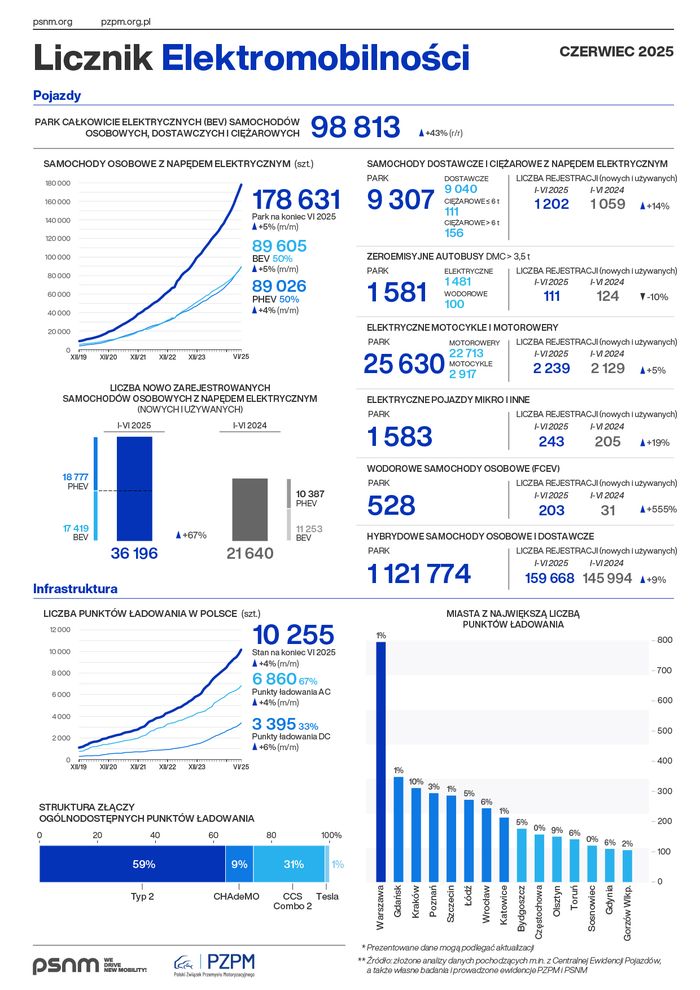
According to data from the end of June 2025, a total of 98,813 fully electric passenger and commercial vehicles (BEVs) were registered in Poland. In the first half of this year, their number increased by 18,553 units, which is 51% more than in the same period of 2024, according to the Electromobility Meter launched by PZPM and PSNM.
At the end of June 2025, there were 178,631 electric passenger cars on Polish roads. The fleet of fully electric passenger cars (BEVs) numbered 89,605 units, and the plug-in hybrid (PHEV) fleet totaled 89,026 units. The number of electric delivery and heavy-duty vehicles stood at 9,307 units. The fleet of electric mopeds and motorcycles is constantly growing, consisting of 25,630 units at the end of June, as is the number of hybrid passenger and delivery vehicles, which increased to 1,121,774 units. At the end of last month, the zero-emission bus fleet in Poland grew to 1,583 units (of which fully electric vehicles accounted for 1,481 units, and hydrogen vehicles for 100 units).
Parallel to the fleet of electric vehicles, charging infrastructure is also developing. At the end of June 2025, there were 10,255 publicly accessible electric vehicle charging points in Poland. 33% of them were fast DC charging points, and 67% were slow AC charging points with a power of 22 kW or less.
June was another consecutive month in which we recorded a record market share for electric passenger cars – almost 8%. This result is nearly 3 times better than at the end of 2024, but still more than twice as low as the EU average. That is why it is so important to continue subsidies after the NaszEauto program ends in the middle of next year. A solution could be a social leasing program, the draft of which PSNM submitted as part of the consultations on the government’s social-climate plan. This is a document that determines the direction of subsidies from the Social Climate Fund (SCF), an EU instrument intended to combat transport exclusion associated with the introduction of the new Emissions Trading System (ETS2). The proposal for leasing based on 100 percent financing of the initial fee and a monthly installment for a new car of approximately 300-400 PLN fits perfectly into the goals of the SCF, significantly increasing the accessibility of zero-emission transport. A similar program has already proven successful in France, among other places – says Jan Wiśniewski, Director of the PSNM Research and Analysis Center.
The record registration results for zero-emission vehicles in the last few months – including June – show how important it is to support this market. The launch of the grant program from the KPO (National Recovery Plan) resulted in a clear increase in registrations of zero-emission passenger vehicles. In this context, the announcements from the Ministry of Climate and Environment that a review of applications will be carried out soon are welcome; we can hope that individuals and sole proprietorships who want to buy zero-emission delivery vehicles will join the group of program beneficiaries. While this does not guarantee that all funds from the program will be used, it will certainly be an excellent stimulus for the program. The issue of expanding the program’s beneficiaries to include companies remains open, because although the European Commission does not agree to this, we hope that the responsible ministries will resume discussions on this topic. I would like to note once again that charging infrastructure is developing at a very fast pace (approx. 50% per year). Currently, there are already over 10,000 charging points in Poland – of which 1/3 are fast chargers. This is very important because many customers base their decision to purchase a zero-emission vehicle on the state and quality of the infrastructure – says Jakub Faryś, President of PZPM.
Source: Polish Alternative Fuels Association