










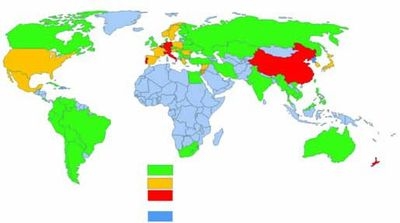
Effective e-business solutions for the pharmaceutical industry utilize barcodes and electronic data interchange. To apply them throughout the supply chain and improve business processes for manufacturers, wholesalers, pharmacies, and hospitals, it is essential to use global identifiers according to the worldwide GS1 system.
How these global designations for the identification of medicinal products are used in individual European countries, including Poland, was partially presented in the previous issue. In practice, there are three basic methods of identifying registered drugs used worldwide:
-
global GTIN numbers
-
so-called NTIN, which is a GTIN, but not created by the manufacturer, rather by, for example, the Ministry of Health according to GS1 rules
-
national ID number.
For the above reason, all countries can currently be divided into 3 groups, depending on the identifiers they use for registered drugs:
1. countries where GTIN is accepted, currently covering the largest part of the world – in Figure 1, these are the countries marked in green,
2. countries where the so-called NTIN number according to GS1 is required, currently covering mainly the so-called old/Western Europe, USA, Mexico, and Japan – in Figure 1, these are the countries marked in yellow,
3. countries where a national ID number is required are mainly China and 4 Western European countries: Belgium, Germany, Portugal, and Italy – in Figure 1, these are the countries marked in red.
Countries for which we do not have clear data are marked in blue.
Currently, in Europe, the vast majority of countries, as many as 17, use GTIN numbers. Poland did the same when it was admitted to this system, i.e., from March 1990. However, in 1998, it switched to NTIN numbers according to GS1, also known as GTIN numbers.
The second group of countries, also numerous, consists of 12 countries that use NTIN numbers, with 6 of them using only NTIN numbers, and the other 6 using both NTIN numbers and typical GTINs assigned by the manufacturer. Poland has belonged to this group since 1999.
The last group consists of 4 countries: Belgium, Germany, Portugal, and Italy, where a national ID number is still required and which have not yet managed to switch to global GS1 standards – as this is a long-term and costly process. However, all manufacturers from these countries, if their goods are also to be exported, must still label them in accordance with the GS1 system, which is required by recipients.
The article comes from the magazine “Logistyka” 6/2011.