









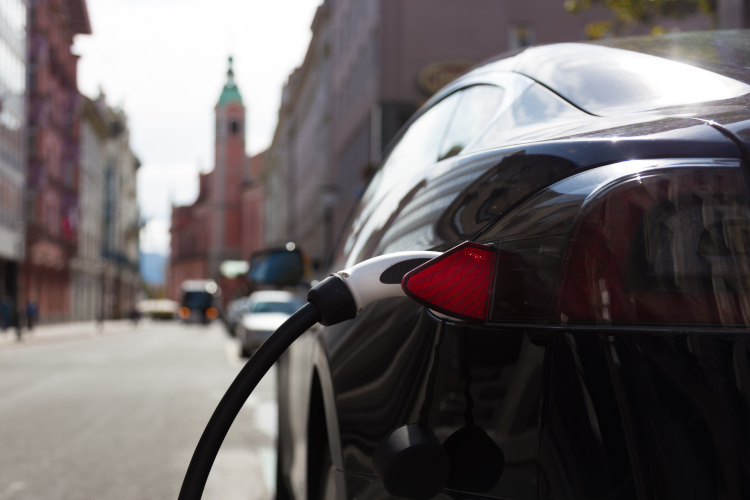
A new study conducted by the organization Transport & Environment (T&E) has shown that Poland has one of the slowest electrification rates in Europe, while simultaneously experiencing a boom in the sales of polluting luxury and premium cars.
Vehicle registration data in Poland shows that the premium car market is thriving. Premium and luxury cars proved to be the most resilient to market turbulence caused by the Covid-19 pandemic – in 2021, the value of this sector grew by 25.3%. It must be remembered that premium cars emit, on average, more greenhouse gases and pollutants than the average from other segments. At the same time, Poland is the fifth slowest in terms of electrification in Europe. According to T&E, this situation is explained by the outdated car taxation system in Poland, which in no way penalizes the level of greenhouse gas emissions.
Poland has one of the largest vehicle fleets in Europe (over 25 million vehicles) and is the sixth-largest country in terms of new passenger car registrations – approximately 500,000 are registered each year. Due to the small scope of tax incentives for purchasing electric vehicles, few electric cars are registered in Poland, and as a result, the average CO2 emissions from new cars are among the highest in Europe.
– While the rest of Europe is accelerating its course toward transitioning to a zero-emission fleet, Poland is developing its segment of polluting luxury and premium cars at an alarming rate. The tax system does not really promote the purchase of clean electric cars at all, which makes our country one of the slowest in Europe on the path to transformation – says Rafał Bajczuk from the Polish T&E office.
Poland clearly deviates from other European countries in terms of attempting to reduce greenhouse gas emission levels through a car taxation system. It is, for example, one of only four European countries without a vehicle ownership tax, and fuel excise duty is among the lowest in Europe here. The other three countries without the aforementioned tax are the Czech Republic, Estonia, and Lithuania, although their three fleets combined do not equal the number of cars in Poland.
Another key element of the Polish car taxation system is the excise tax on cars, which is based on engine capacity and the value of the car, but does not take into account the level of greenhouse gas emissions. Therefore, the “polluter pays” principle does not apply to cars covered by this tax.
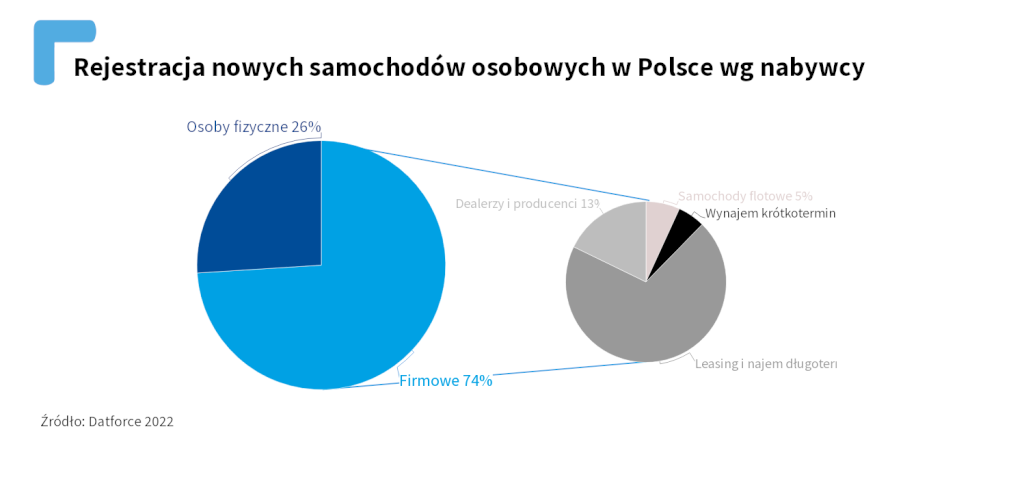
Company cars account for the vast majority (74%) of newly registered vehicles. When an employer provides an employee with a company car, and it is used by the employee for private purposes, a taxable benefit in kind arises. The rates of this tax in Poland are very low, amounting to 250 PLN per month for cars with an engine capacity below 60 kW and 400 PLN per month for cars above this capacity (electric vehicles are covered by a lower rate). This system of imposing a benefit-in-kind tax as a flat amount encourages the purchase of the most expensive company cars.
There are very few incentives motivating the purchase of electric vehicles in Poland, and they are more favorable for companies than for private individuals. For the latter, the subsidy for purchasing an electric car is 18,750 PLN or 27,000 PLN for holders of the Large Family Card. For companies, it is 18,750 PLN or 27,000 PLN, respectively, if the buyer declares an annual mileage of at least 15,000 km.
The small number of tax incentives for electric vehicles explains the slow transition to a zero-emission fleet in Poland. Currently, zero-emission vehicles account for only 1.6% of newly purchased cars, which is the fifth-lowest result in Europe. Poland also ranks last (together with the Czech Republic) among European countries in the Leaseplan 2022 EV Readiness Index.
– A reform of our outdated tax system is essential. Electric cars are currently too expensive for families, and polluting vehicles are not expensive enough. This situation must be reversed quickly to help Poland achieve its climate goals and improve air quality in cities – concludes Rafał Bajczuk.
T&E has just published The Good Tax Guide – the first-ever report comparing car taxation systems in European countries. The report includes a comparative analysis of 31 countries, seven forms of taxation, and two types of vehicle registration (for private and company purposes). It can be found at the link. https://www.transportenvironment.org/wp-content/uploads/2022/10/The-good-tax-guide.pdf
Source: European Federation for Transport and Environment AISBL