








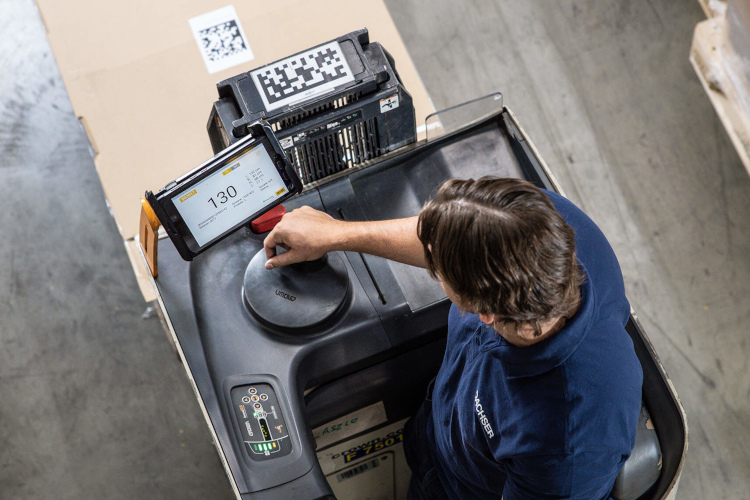
The German Logistics Association (BVL) has awarded the German Logistics Award 2023 to DACHSER and Fraunhofer IML for the creation of the @ILO (Advanced Indoor Localization and Operations) digital twin. The technology, developed in collaboration with the DACHSER Enterprise Lab, has already been piloted at two branches. This system automatically creates and continuously updates digital counterparts of shipments, assets, and workflows in the transit terminal. Employees have access to all this information in real time. The data is presented clearly on the displays of their mobile devices.
The @ILO digital twin increases transparency of warehouse operations. Individual work steps are optimized and take less time. The application benefits not only logistics operators and drivers but also customers, who will be able to receive more precise information about their shipments in the future. The @ILO digital twin is the result of over six years of joint research conducted at the DACHSER Enterprise Lab. It is here that experts from the logistics service provider work with scientists from the Fraunhofer Institute for Material Flow and Logistics IML. The work is carried out in small, agile teams and focuses on developing innovations for the European groupage network, including its associated transit terminals.
– We are investing in joint research with Fraunhofer IML to accelerate digitalization in logistics and further increase the quality of services we offer our customers. In this way, we ensure the company’s profitability and a secure future – said Burkhard Eling, CEO of DACHSER, during the awards ceremony in Berlin – Furthermore, the fact that our joint work has resulted in an innovation significant enough to impress the German Logistics Award jury has only confirmed the validity of our approach and given us an additional boost of motivation.
DACHSER is now planning to take the next step in the development of this innovation. In 2024, the family-owned company expects to begin the systematic rollout of the new technology across its European branches. “The @ILO digital twin represents not only a key milestone in our digital transformation but also an important step in groupage logistics,” says Burkhard Eling.
– At our institute, we translate research into reality on a European scale, and I must admit that even compared to the long history of Fraunhofer IML, the digital twin is an exceptional research success. It underscores the value of combining scientific research with practical applications. Especially when such interdisciplinary cooperation is conducted as intensively and sustainably as it is at the DACHSER Enterprise Lab – says Prof. Michael ten Hompel, Executive Director at Fraunhofer IML.
– The @ILO digital twin represents not only a key milestone in our digital transformation but also an important step in groupage logistics – said Burkhard Eling, CEO at DACHSER
Proven in practice: Artificial intelligence and automation are gaining popularity
The @ILO software uses special AI-based algorithms that interpret data collected every second by hundreds of optical scanning units mounted on the terminal ceiling. Based on this data, they automatically and instantly identify and locate all shipments, and in the future, they will also measure them. This creates a complete, always up-to-date picture of the terminal and its processes — a digital twin.
This technological innovation, integrated into practical workflows, has already proven its value in the @ILO pilot transit terminals. This took place at the DACHSER branches in Unterschleißheim near Munich and Öhringen near Heilbronn. Some process sequences performed between incoming and outgoing goods were executed 15 to 35 percent faster there. This was achieved by eliminating tasks such as manual barcode scanning and daily manual inventory of packages. As a result, short-haul transport vehicles can start deliveries earlier in the day, giving drivers an advantage during the morning rush hour.
– By using artificial intelligence and automation technologies in handling groupage shipments, we can ensure high quality and continue to meet the diverse requirements of our customers. This also helps us meet the challenges resulting from a lack of space and skilled workers – explains Alexander Tonn, COO Road Logistics at DACHSER – New technologies, such as the @ILO digital twin, provide the data we need in real time. However, technology really starts to add value the moment it relieves and supports employees in their daily work, and @ILO has impressively proven in the pilot branches that it can do just that.
– Fully automated, constant measurement of all shipments represents another step towards Logistics 4.0, which we will take together with Fraunhofer IML as part of our research partnership – said Stefan Hohm, CDO at DACHSER
Another innovative step: AI-assisted loading
– Fully automated, continuous measurement of all shipments represents another step towards Logistics 4.0, a step we will take together with Fraunhofer IML as part of our research partnership. As he adds, during pilot tests, the system was able to determine the length, height, and width of a shipment with such high accuracy that it provided this information in real time without the need for measuring stations. Additionally, as soon as the system is fully ready for practical use, data regarding the volume of each package will also be fed into intelligent algorithms. For example, this information will help with loading and route planning, and to further increase the capacity utilization of swap bodies, trailers, and short-haul transport vehicles. “This reduces both the number of kilometers driven and CO2 emissions – Stefan Hohm, CDO at DACHSER, is aware of the future potential of @ILO. Furthermore, DACHSER and Fraunhofer IML are currently developing an improved @ILO system, with which users will be able to upgrade their shipping zones to increase distribution transparency. – However, there is still much to be done in this area – adds Stefan Hohm.