Every organization, regardless of its industry, faces a similar challenge today: how to ensure processes run smoothly, predictably, and efficiently, despite the increasing number of variables resulting from ever-more stringent social and economic expectations. As the pressure to achieve the highest possible speed, precision, reliability, or quality of products and services grows, so does the importance of data and tools that support process management. One of the most promising methods for supporting informed process management is the use of digital twins — solutions that combine modeling, the collection and processing of current information, and intelligent analysis to design and create dynamic interactions with active processes operating within an organization.
Although the concept of digital twins is most often associated with the representation of machines, industrial equipment, or technical infrastructure, in reality, it can take many forms. A digital twin can reflect both a physical object — such as a production line or a device — and a complex process that has no physical form. The latter category, known as a business process digital twin, is becoming an increasingly important support in conducting research and analysis, thanks to its ability to provide better insight into how an organization functions, with particular attention to bottlenecks.
Starting work with process digital twins requires the gradual, consistent construction of organizational foundations that allow a digital replica to be developed. This process does not take place within a single, short project — it generally resembles an evolution rather than a technological leap. Preparation begins with organizing knowledge about the process, then transitions into the stage of identifying and ensuring reliable data sources required to feed the digital model, which only then opens the possibility of simulating potential or forecasted future states and influencing the actual operation of the system.
In the following sections of the article, we will examine what the construction of business process digital twins looks like in practice and which stages lead to their full maturity, showing the path from simple models created based on expert knowledge, through solutions powered by current operational data, to fully integrated digital twins that enable real-time decision support. Each of these stages brings a different value and addresses different organizational needs, which is why it is worth viewing them not as competing solutions, but as successive levels of development along the same path of digital evolution.
1. Digital Model — an organized representation of the process
The Digital Model is the first phase of maturity for a digital twin in the process of digital transformation, allowing for the conversion of scattered knowledge about processes into an organized and understandable model. At this stage, a logical, digital representation of the process is created — encompassing its structure, sequence of actions, roles, resources, and dependencies between individual process steps — thus providing an organized picture of how the analyzed process functions. A key feature of the Digital Model phase is that data is entered manually. Operation times, resource availability, or decision rules come from documentation, observation, and employees’ expert knowledge. Although this requires commitment, it allows one to precisely understand the process and “translate” it into the language of a simulation model. Even at this stage, it is possible to conduct initial analyses and draw conclusions based on the results generated by the model.
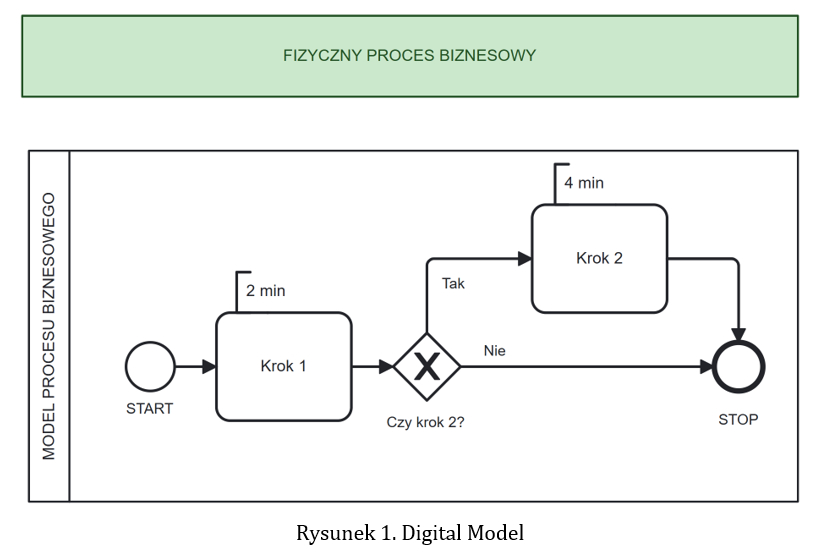
Example of a Digital Model application (industry: manufacturing)
A manufacturing company creates a digital model of its order fulfillment process, built as a simplified yet consistent representation of the actual workflow. The process structure, operation times, machine availability, and employee engagement are not yet automatically pulled from IT systems but are manually fed based on observations, documentation, and the team’s knowledge.
This approach allows for the precise mapping of process logic in a simulation model and the creation of a safe environment for analysis. The organization can test how the process behavior changes under different input assumptions before deciding to automate the data flow.
What does the Digital Model provide?
The Digital Model provides a solid information base that allows for transitioning from an intuitive perception of a process to its measurable, logical description. Without this foundation, it would be difficult to build subsequent levels of digital twin advancement.
Digital Shadow — a “reality-powered” model
The Digital Shadow is the stage where the digital process model, already known from the earlier stage, is integrated with sources of real operational data. In this stage, the model begins to be systematically and automatically fed with data that is the product of the organization’s current operations, which gives it a new analytical dimension.
At this level, data — such as lead times, order sequences, or resource availability — are no longer average values but reflect the actual variability of the process. Thanks to this, the digital representation not only shows how the process should work, but above all reveals how it works in practice, including natural deviations, disruptions, and instabilities that are difficult to capture and analyze based on static data or statistically averaged figures.
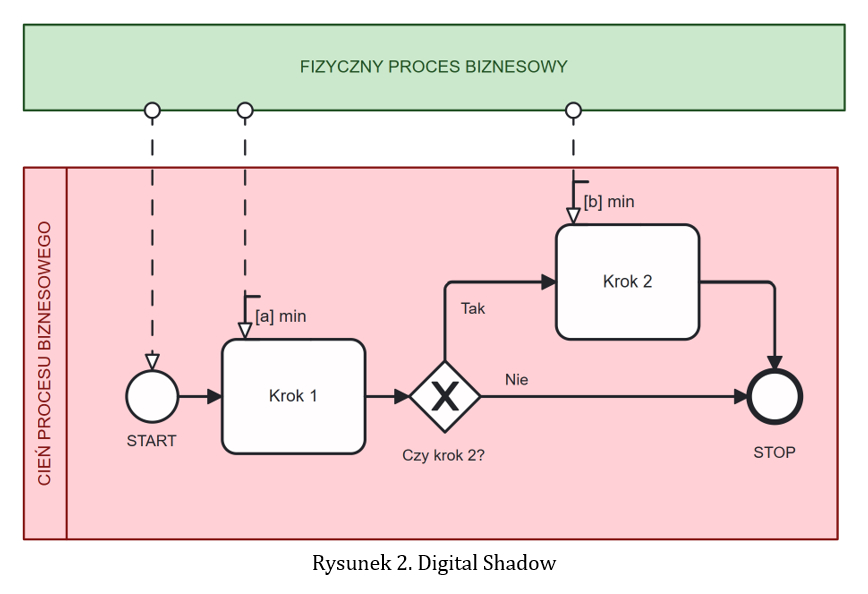
Example of a Digital Shadow application (industry: manufacturing)
The same simulation model is connected to data coming from production systems. Information about completed orders, machine operating times, and resource availability automatically feeds the model, updating its state in near-real-time.
As a result, the digital representation of the process becomes an analytical tool that allows for instantly observing and understanding how the process actually functions, including all deviations from statistics, where delays appear, and what factors influence its efficiency.
Why is the Digital Shadow a breakthrough?
The Digital Shadow constitutes a natural stage of transition from static analysis to working with a process in real-time. It allows the organization to learn how to interpret current data, understand variability, and observe the operational consequences of decisions made. It is precisely at this level that the competencies and infrastructure necessary to build the most advanced forms of process digital twins are created.
Digital Twin — intelligent process control (a model powered by reality, reality controlled by a model)
The Digital Twin is the most advanced form of digital process mapping, in which the model is continuously linked to what is actually happening in reality. It does not merely show how the process was designed or how it should work on average, but allows for observing its actual progression — the way it occurs day-to-day, including variability, delays, and disruptions.
Thanks to this, the digital representation of the process is not based on simplified assumptions or averaged values, but reflects the actual conditions of its implementation. In its mature form, a digital twin can support operational decisions, recommend actions, and even automatically influence the actual process based on the results of analyses and simulations, creating a coherent loop between observing the process and improving it.
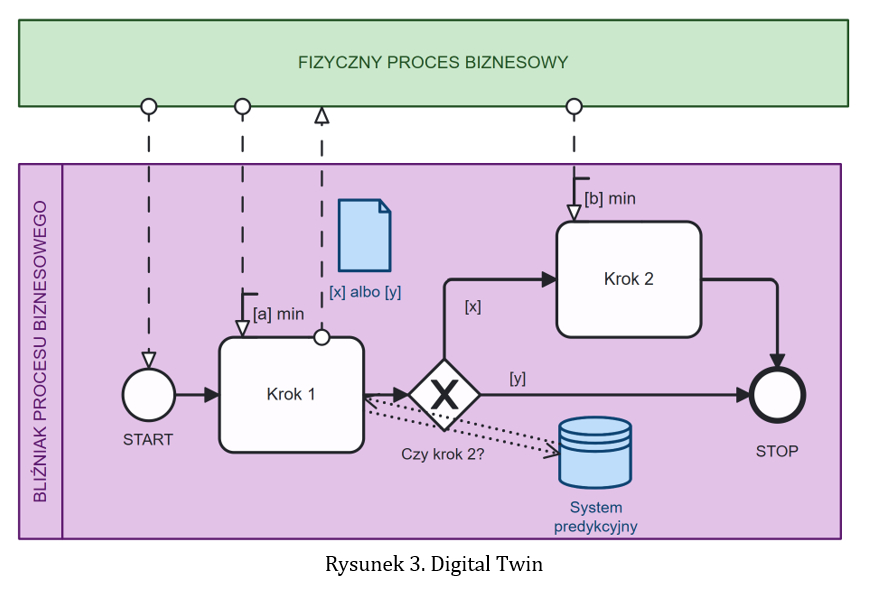
Example of a Digital Twin application (industry: manufacturing)
The simulation model is fully integrated with the production system, creating a digital twin of the order fulfillment process. Operational data feeds the model in real-time, and simulations allow for predicting the effects of changes in schedules or resource availability.
In the most advanced configuration, the insights generated by the model can automatically influence the real system, modifying production plans or operational parameters. The digital copy and the real process begin to function as one interconnected system.
When do we talk about a full Digital Twin?
A full Digital Twin creates an environment where the real process and its digital representation function in close interdependence. The model becomes a tool for active management, enabling the prediction, testing, and implementation of improvements in an informed and safe manner.
Summary
Process digital twins open up entirely new possibilities for organizations to understand, analyze, and improve their daily work. They allow one to look at processes not as static schemes, but as dynamic systems that can be observed, tested, and consciously developed. Gradually moving through the stages of Digital Model, Digital Shadow, and finally the full Digital Twin implementation stage ensures that data stops being merely an unstandardized collection of numbers and becomes real support for operational decisions.
A full digital twin allows an organization not only to analyze reality but also to influence it in a predictable and informed way. It is a tool that enables testing changes without risk, forecasting future states, and automatically implementing improvements — provided that the organization is ready for such process maturity and is prepared to delegate some decision-making to partially autonomous systems.
It is worth remembering, however, that reaching a full Digital Twin is not easy. It requires automation, the integration of multiple systems, high-quality data, and operational readiness. This is a level that many organizations are only just aiming to reach. And that is natural — building a digital twin is an evolutionary process, and each step brings a company closer to more effective and informed process management.
The following literature sources were used in the preparation of this article:
- Fornari, F., Compagnucci, I., Callisto De Donato, M., Bertrand, Y., Beyel, H. H., Carrión, E., Franceschetti, M., Groher, W., Grüger, J., Kilic, E., Koschmider, A., Leotta, F., Li, C.-Y., Lugaresi, G., Malburg, L., Mangler, J., Mecella, M., Pastor, O., Riss, U., … Valderas, P. (2025). Digital Twins of Business Processes: A Research Manifesto. Internet of Things, 30, 101477. https://doi.org/10.1016/j.iot.2024.101477
- Kritzinger, W., Karner, M., Traar, G., Henjes, J., & Sihn, W. (2018). Digital Twin in manufacturing: A categorical literature review and classification. IFAC-PapersOnLine, 16th IFAC Symposium on Information Control Problems in Manufacturing INCOM 2018, 51(11), 1016–1022. https://doi.org/10.1016/j.ifacol.2018.08.474
- Nowak, F., Niemir, M., & Woźniak, W. (2025). Cyfrowy bliźniak procesów i AI: Duet, który zmieni zarządzanie energią w elektrociepłowniach. Nowa Energia, (4). https://nowa-energia.com.pl/2025/10/10/cyfrowy-blizniak-procesow-i-ai-duet-ktory-zmieni-zarzadzanie-energia-w-elektrocieplowniach/
If you have any additional questions, please ask our expert:
Filip Nowak – Head of the Process Transformation Research Group at Łukasiewicz – Poznań Institute of Technology
Tel.: +48 606 460 036
Filip.nowak@pit.lukasiewicz.gov.pl