








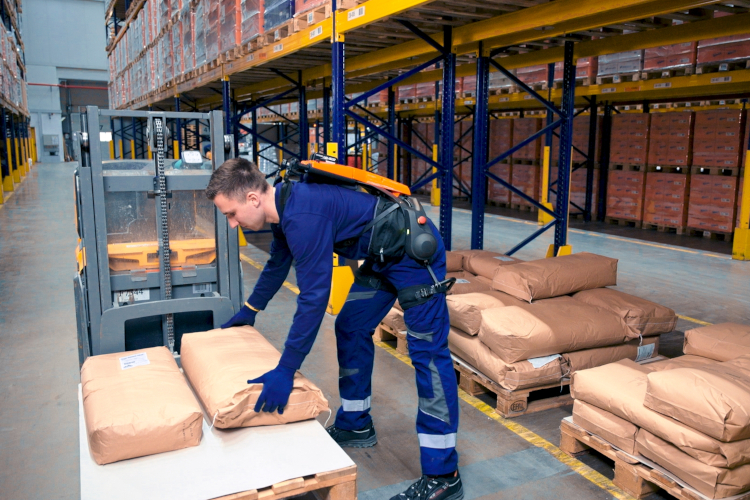
Dachser has for the first time tested active exoskeletons manufactured by German Bionic under everyday warehouse working conditions. The technology will soon be implemented in further locations.
The active exoskeletons from the German manufacturer were tested at the warehouse of the Dachser logistics center in Magdeburg. The goal was to collect empirical data in real-world conditions and gather feedback from employees. The Cray X devices provide support for tasks related to goods receipt, order picking, and at the packing table. The exoskeleton assists in carrying and lifting heavy loads, relieving the employee by up to 30 kilograms.
– The benefits of using exoskeletons quickly became obvious. Our employees are supported when carrying heavier loads and are also provided with external body stabilization. This prevents excessive strain and reduces the risk of injury. An additional advantage of the devices is their ease of use, which meant that the testers accepted them in the blink of an eye – says Stephan Heinemann, Contract Logistics Manager at Dachser in Magdeburg.
German Bionic exoskeletons in Magdeburg
In the future, three active exoskeletons will be used regularly at the Magdeburg logistics center. The Dachser logistics center in Ulm also plans to implement the new technology in its warehouse this autumn.
– By introducing innovations, we are constantly working to make processes, including those in the warehouse, more efficient and effective. The main goal is to provide employees with support in all aspects related to warehouse operations. The use of active exoskeletons is proof that modern technology not only immediately makes their work easier but can also have a positive impact on their health – adds Thomas Klare, Head of Corporate Contract Logistics at Dachser.
Technology with a future
Warehouse work still involves a large amount of physical labor, for example during the unloading of goods. Dachser has long sought to provide employees with technical support that will make it easier for them to perform demanding tasks. Exoskeletons are particularly promising. In medicine, such solutions have been used for a long time. In industry, however, there are more and more devices ready for market introduction.
As early as 2019, Dachser conducted preliminary tests in its warehouses, mainly of passive exoskeletons with mechanical spring systems, rails, or weights that assist in lifting loads. In the meantime, active exoskeletons have reached a level of maturity that can also improve warehouse processes. Active exoskeletons use battery-powered robotics to facilitate lifting operations, significantly relieving the lower back of people handling heavier loads. Because users experience less fatigue, they are able to maintain a correct body posture.