








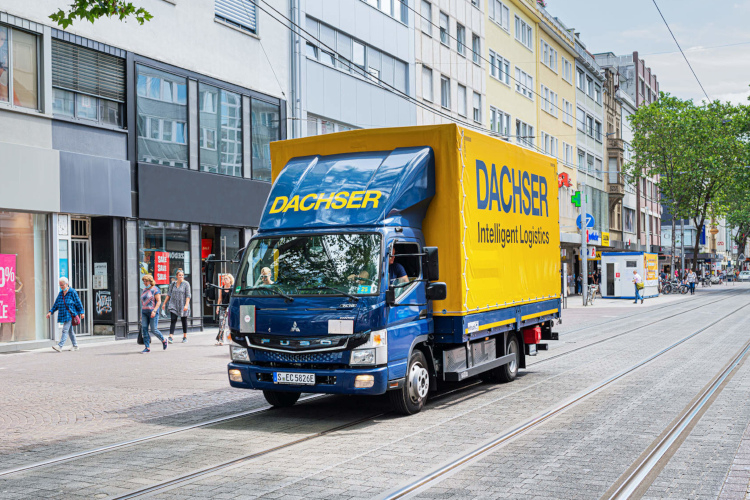
The DACHSER Emission-Free Delivery system has already been implemented in twelve European metropolitan regions.
The concept of zero-emission deliveries in city centers, which began as an innovative pilot program, has proven to be a huge success. As part of DACHSER Emission-Free Delivery, there are already twelve zero-emission delivery areas for non-food goods, and at least ten major European cities will join them by 2025.
Zero-emission deliveries of goods that do not require refrigerated conditions have been implemented in specific zones in Berlin, Freiburg, Stuttgart, Munich, Dortmund, Copenhagen, Oslo, Prague, Strasbourg, Paris, Madrid, and Porto. In these cities, the fleet consists of various zero-emission vehicles, including electric vans and trucks, as well as electrically assisted cargo bikes. These bikes are specially designed to carry loads and pallets weighing up to 250 kilograms. They start their route from a transshipment terminal located close to the city center, known as a microhub, and transport goods in busy pedestrian zones. In turn, e-trucks supply the microhubs with goods or deliver parcels and pallets that are too large or too heavy to be transported by bike directly to recipients.
– DACHSER Emission-Free Delivery proves that we can carry out deliveries of parcels and groupage shipments in a specific city area without emissions at the last-mile stage. What was a research project until recently has now become part of our business operations, outlining the path to more sustainable urban logistics – Stefan Hohm, Chief Development Officer (CDO) at DACHSER
When implementing the urban logistics concept, the availability of zero-emission vehicles and the associated charging infrastructure is crucial. DACHSER Emission-Free Delivery focuses on major European cities with at least one million inhabitants where DACHSER European Logistics already has a branch.
Positive impact on the environment and drivers
DACHSER’s zero-emission deliveries to city centers help local authorities improve air quality and reduce noise emissions generated by traffic. Since battery-electric trucks and cargo bikes do not emit any exhaust fumes, they play an important role in maintaining clean air. Since Dachser committed to using only renewable energy, greenhouse gas emissions on the last leg – from the branch to the recipient – have been reduced to zero. The noise level emitted by diesel engines is also significantly reduced, and the use of cargo bikes means fewer trucks and less congestion on the road. Electric vehicles are also good news for drivers, who are no longer exposed to engine vibrations felt in the cabin.
– As vehicle manufacturers have increased their production capacity, we expect electric trucks to be more readily available in the future. Therefore, we plan to launch zero-emission deliveries in at least ten more cities by 2025, in line with the wishes (or expectations) of many of our customers – Alexander Tonn, Chief Operations Officer (COO) Road Logistics at DACHSER
Part of a long-term climate protection strategy
Introduced for the first time in Stuttgart, the DACHSER Emission-Free Delivery concept was developed in cooperation with the Kornwestheim branch. In December 2018, DACHSER received an award for sustainable urban logistics from the German Ministry for the Environment and the German Environment Agency.
Thanks to the modular system, the concept can be applied in all European cities. This means that DACHSER is well prepared for potential bans on internal combustion engines, which some metropolises have already introduced and others are planning to introduce. DACHSER Emission-Free Delivery is part of an overall, long-term climate protection strategy. By promoting sustainable business development and focusing on efficiency, innovation, and social responsibility, this family-owned company based in Kempten, together with its customers and partners, is paving the way for sustainable logistics.