








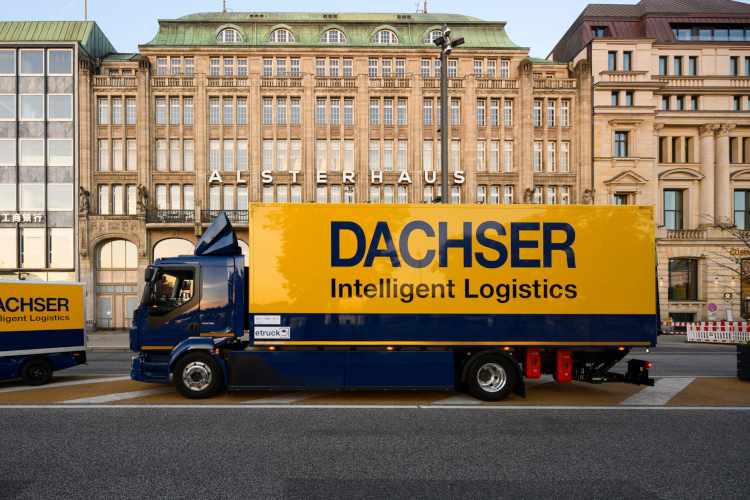
DACHSER is starting a new era in urban logistics by introducing its sustainable DACHSER Emission-Free Delivery concept to Hamburg. Since August 2023, the logistics operator has begun emission-free deliveries of non-refrigerated shipments to customers located in the city center.
In Hamburg, the city center delivery zone, where only emission-free vehicles are permitted, extends from the area around the City Hall along the Alster River to the Hamburger Meile shopping center. The city joins a growing list of major urban centers where DACHSER provides emission-free deliveries of non-refrigerated goods within a designated zone. By the end of 2025, the company plans to implement its sustainable urban logistics concept in a total of 24 major European cities.
DACHSER Emission-Free Delivery is based on a modular toolkit for making deliveries in city centers. Depending on local requirements, the company uses electric vans and trucks, as well as electrically assisted cargo bikes designed specifically for general cargo and palletized goods. By using all these vehicles, shipments made in the city center are delivered with zero local emissions as standard. This means that no pollutants or greenhouse gases are released into the atmosphere within the city. Furthermore, noise emission levels are lower.
E-trucks and cargo bikes in the city center
DACHSER began zero-emission deliveries to the HafenCity district in Hamburg back in 2020. These are carried out using the eCanter – a fully electric truck manufactured by FUSO, a subsidiary of Daimler Truck – driven by professional drivers from the local branch. “To serve an even larger area of Hamburg’s city center exclusively with zero local emission deliveries, we have significantly expanded our green fleet. It currently consists of four e-trucks with a payload capacity of 7.5 to 16 tons. We also operate a microhub, which is a small urban transit terminal located at Gänsemarkt square. This is where all smaller shipments are picked up and delivered within the city center area using transit bikes,” says Ralf Hansen, General Manager of the two DACHSER Road Logistics locations in Hamburg. By purchasing and using only electricity generated from renewable sources, DACHSER is able to reduce greenhouse gas emissions on the last mile to zero.
Three 16-ton Volvo FL Electric trucks with a range of approximately 250 km and 18 pallet spaces are proving to be a particularly effective alternative to conventional diesel vehicles for city center deliveries. In Hamburg, they have been joined by the Nanuk Megaliner, a cargo bike designed for general cargo that offers three pallet spaces and can carry loads of up to 500 kilograms.
By the end of the year, DACHSER Hamburg plans to expand its fleet with five battery-powered vehicles, which will also make the shunting of swap bodies and trailers in the yard emission-free. In addition, the location is gradually switching to electric company cars, and in addition to the vehicles, the Hamburg branch is investing in the expansion of the necessary charging infrastructure. This year, four charging points for trucks and 18 for passenger cars were added.
The DACHSER Emission-Free Delivery program has already been implemented in twelve metropolitan regions across Europe. These include the five largest German cities: Berlin, Dortmund, Freiburg, Munich, and Stuttgart, as well as Copenhagen, Madrid, Oslo, Paris, Porto, Prague, and Strasbourg. By 2025, at least eleven more major European cities are expected to join this group after Hamburg.
Hamburg, along with Freiburg and Malsch near Karlsruhe, is also one of three DACHSER locations for e-mobility. This is where the logistics service provider focuses on researching and testing the suitability of climate-friendly technologies and processes, as well as intelligent energy and load management. The operator’s long-term goal is to increase the number of emission-free vehicles across the entire European DACHSER network and achieve net-zero greenhouse gas emissions.
The DACHSER Emission-Free Delivery concept and the extensive e-mobility research conducted at the Hamburg branch support the logistics service provider’s long-term climate protection strategy. By promoting sustainable business development and focusing on process and energy efficiency, innovation, and corporate responsibility, the family-owned company, together with its customers and partners, is paving the way for sustainable logistics.
– We expect that in the coming years, road freight transport in the European Union will gradually shift to vehicles with emission-free powertrains. Depending on the application, these will be battery-electric trucks or those powered by hydrogen fuel cells. Thanks to our current research and innovation activities in Hamburg and elsewhere, we are already preparing for this far-reaching transformation of the transport and logistics sector – says Alexander Tonn, COO Road Logistics at DACHSER. – Until then, however, many challenges remain to be overcome, especially regarding vehicle range, the availability of fast-charging zones on highways, and the provision of adequate energy infrastructure by public utilities at our locations.
Meanwhile, Ralf Hansen is confident that Hamburg will generate key insights into climate-friendly mobility – Here, in one of the most important logistics locations in the world, we are pleased to play an important role in testing and applying climate-friendly and emission-free technologies in logistics.