











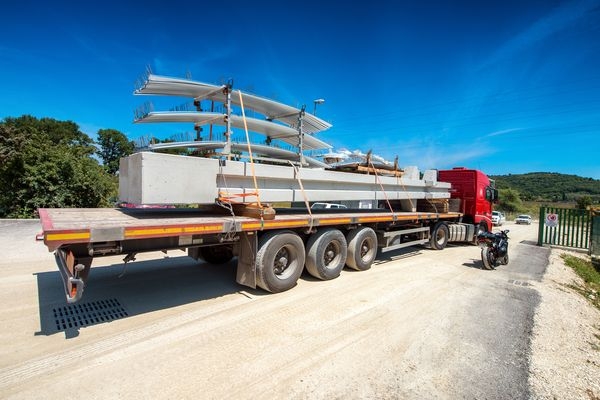
Developing technology and the economy show an increasing demand for transport. A special type of cargo increasingly appearing in the practice of transport companies in Poland is oversized cargo. Oversized cargo is a special type of freight that requires very good preparation and organization from transport companies. Logistics by its very nature is based on the proper planning and organization of logistical processes. One of them is transport.
Oversized transport is becoming part of logistical processes related to, for example, the construction of a plant or the equipping of technological lines. It is an inherent element of road infrastructure construction (e.g., bridges) or the equipment of modern ports (e.g., gantry cranes, cranes). Oversized cargo is appearing more and more frequently in construction in the broad sense, because new material technologies and new engineering technologies allow for the construction of increasingly larger, taller, or even deeper structures.
The transport of oversized cargo by road is an extremely interesting and complex issue. The planning process itself requires taking many aspects into account. On the other hand, the execution of the transport is a collaboration of many people and machines. Oversized transport is a very special and, each time, unique undertaking.
Classification of oversized cargo
Oversized cargo, also called non-standard cargo, is cargo whose movement requires the use of special means of transport and handling equipment. The classification of oversized cargo takes into account its dimensions, weight, and shape. In this regard, six groups of oversized cargo can be distinguished:
1. Ordinary oversized – these are usually steel structures (of various types), small-sized machines, or industrial equipment. This group also includes work machines or, for example, small tanks. These loads are characterized by a weight not exceeding 25 tons. Their dimensions slightly exceed the parameters permitted by standards for road and rail transport. In practice, this means that their dimensions fall within the limits: length 15-16 m, width 3.5-4 m, and height 3.0-3.5 m. Loads of this type generally do not require specialized trailers for their transport. They can also be transported by standard rail cars, equipped with appropriate devices for their marking and securing.
2. Special oversized – these are large-sized loads, e.g., combustion chamber elements for the energy industry, equipment elements for open-pit mining. This group of loads also includes steel structures or larger tanks for the food and brewing industry. Despite their large dimensions, these are usually loads with a relatively low mass. This group includes loads with dimensions reaching up to 5 m in length, 7 m in width, and 6-7 m in height.
The article contains 27,110 characters.
Source: Logistyka Magazine
003_Barcik_Uwarunkowania_transportu_ladunkow_ponadgabarytowych.pdf