








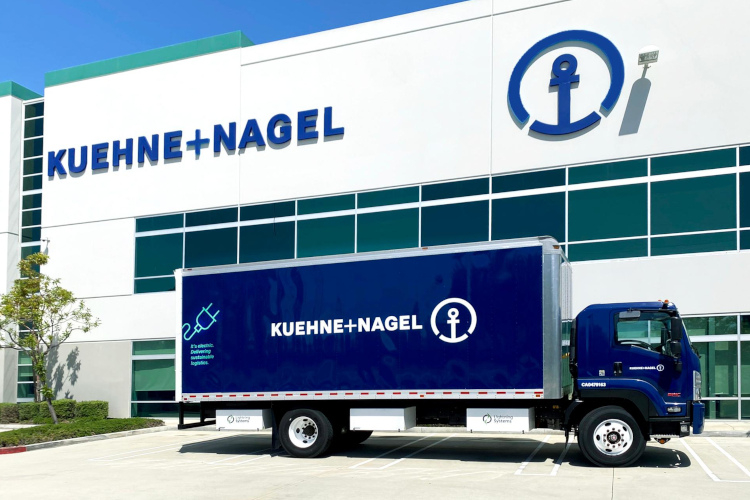
The year 2024 begins with electrifying news – Kuehne+Nagel announces the introduction of a Book & Claim solution for electric vehicles. This makes the company the first logistics service provider to introduce a solution previously limited to low-emission fuels. Implementing decarbonization solutions and supporting customers in achieving their sustainability goals is a key element of Kuehne+Nagel’s Roadmap 2026 strategy and its Living ESG pillar.
Developing Book & Claim insetting solutions for road transport has been a priority for Kuehne+Nagel. Last October, the company introduced an insetting solution for HVO, and now it has done the same for electric vehicles. This first-of-its-kind solution has been tested and validated in collaboration with leading third-party entities.
- New Book & Claim solution for electric trucks available from January 2024.
- First operator in the industry where carbon insetting solutions previously existed only for low-emission fuels.
- Supporting logistics decarbonization in line with Roadmap 2026.
Customers using Kuehne+Nagel’s road transport services can now “claim” carbon emission reductions through the use of electric trucks, even if it is not possible to physically transport their goods using these vehicles. The reason may be insufficient charging infrastructure or limited range and payload capacity of the vehicles. The solution will help address these challenges, which currently limit the deployment of electric trucks.
– We see battery-electric vehicles (BEVs) as the future of reducing emissions in road transport. Carbon insetting supports the scaling of low-emission solutions like BEVs and helps reduce the costs that customers pay for these solutions, thereby supporting the decarbonization of road transport – commented Hansjörg Rodi, Member of the Management Board of Kuehne+Nagel International AG, responsible for road logistics.
Helping carriers finance fleet electrification
For now, only BEVs owned by Kuehne+Nagel are part of the Book & Claim offer. This is to maintain full control and transparency over the accuracy of the data used in calculations. However, the team intends to extend the solution to BEVs operated by their partners to support them in the fleet electrification process as well.
– Purchasing electric trucks can be a significant financial burden, especially for smaller carriers. Including them in our solution requires further complex changes to accounting methodology, which would simultaneously help them finance this transformation. This is our next priority – concludes Rodi.