








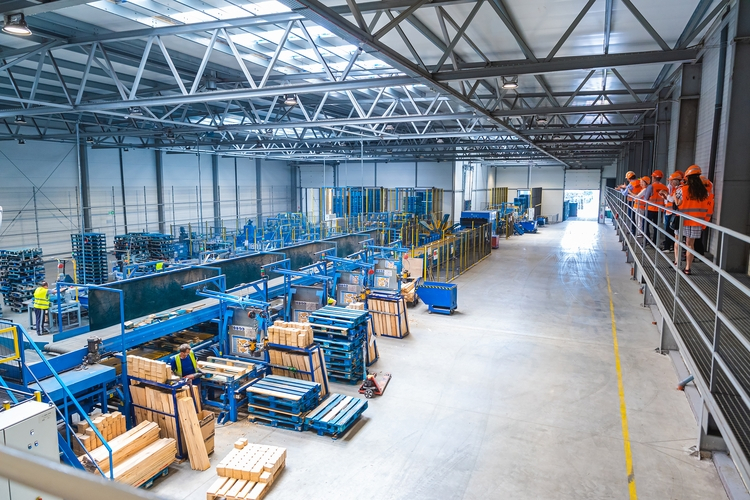
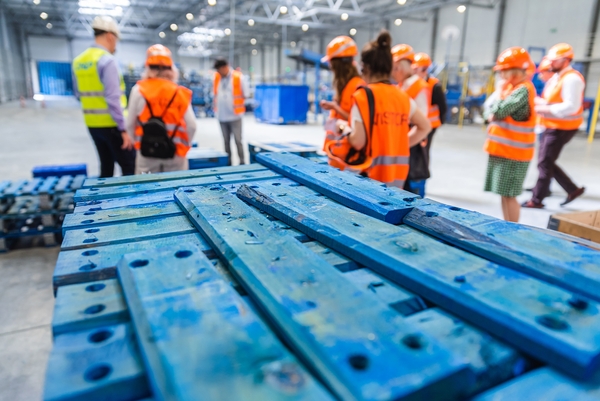
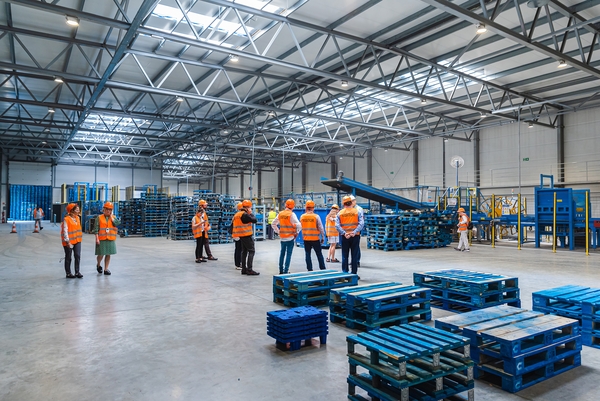
Non-stop movement, trucks arriving and departing. All filled with blue pallets. Soon they will be loaded with goods that will reach store shelves across the country. A few days ago, CHEP Polska invited journalists to visit its service center in Kampinos near Warsaw. During the special event, it was possible to learn, among other things: how many pallets pass through the CHEP service center daily, how pallets are inspected, sorted, and sent on their way, and what the quality control procedures look like.
Carriers arrive at the service center only for a moment to undergo a thorough inspection before continuing their journey. CHEP has 8 such centers in Poland and as many as 750 worldwide. Supply chains cannot function efficiently without them. The service center is both a starting point and a destination on the route of the closed-loop system that CHEP pallets travel. The company offers them to its customers on a rental basis. It is from here that the carriers are sent to CHEP’s customers, i.e., manufacturers, importers, and exporters of products. Once loaded at the customers’ facilities, the pallets are then transported to distribution centers, from where they are sent directly to retail locations. After the pallets are unloaded at the stores, CHEP organizes the collection of empty pallets, which are returned to the service center, where they undergo meticulous quality control processes and, if necessary, are repaired before being released for reuse.
Each of the service centers operates almost continuously to ensure a constant availability of pallets. First, the carriers are unloaded from trucks. Then, each pallet is evaluated by inspectors who decide whether it will go for repair or can immediately continue its journey. CHEP ensures that the carriers serve as long as possible, and consequently, components from damaged pallets are also reused. CHEP has eight such locations throughout Poland: in Kampinos, Warsaw, Radom, Niewiadów, Kraków, Świętochłowice, Wrocław, and Środa Wielkopolska. The extent and optimal distribution of the network, the number of pallets in circulation, and advanced collection processes are supported by tools using Big Data analysis. CHEP employees ensure that at any moment, loaded trucks can set off with a fresh delivery of fully functional carriers. In Poland alone, there are 38 million blue pallets of various types and specifications in circulation. If we were to lay just the Euro-type pallets side by side, one could walk on them from Warsaw to Sydney and even further.
To maximize the lifespan of the pallets and minimize the risk of damage to goods during transport, CHEP operates a special Innovation Center located in Orlando. It is essentially a large laboratory where engineers test carriers under all conditions and situations that may arise during their use. Pallets and the test goods placed on them are frozen, heated, subjected to intense vibrations, dropped, struck, torn, crushed, and doused with water. The results of these experiments improve the safety of goods in the supply chain.
Circular model and positive impact on the planet
CHEP operates in 60 countries, where it has a total of 750 service centers, handling over 345 million pallets and containers. This scale of operations means that it has a significant impact on creating sustainable supply chains globally. CHEP’s pallet pooling operates on a circular model. This means that the entire journey of the carriers begins and ends in the same place – the service center. The global CHEP network is also significant, allowing for the building of strategies based on a huge scale and having a real impact on the surrounding reality. The company’s philosophy today is based not only on being “less harmful to the environment,” because today that is no longer enough. CHEP’s Sustainable Development Goals involve creating regenerative supply chains, i.e., those that have a positive impact on the planet, the climate, but also on people and society.
In 2021 alone, CHEP achieved carbon neutrality in its own operations, saved 87 million kilometers of unnecessary transport, helped deliver meals to 17 million people through cooperation with Food Banks, and introduced a product made 100% from upcycled materials to the market. Every second manager in Poland is a woman. All this is confirmed by rankings, according to which CHEP is, among other things, number one among the most sustainable companies according to Barron’s, achieved an AAA MSCI rating, and is the first company in Poland to have submitted an action plan under Lean&Green aimed at reducing CO2 emissions by 20% by 2023. Thanks to the CHEP Transport Collaboration program, which involves connecting companies and proposing shared routes to reduce empty runs, from July 2021 to June 2022, CHEP managed to reduce as much as 373,000 kilometers that would have been traveled by partially loaded trucks, completed 2,543 shared transports, and reduced CO2 emissions by as much as 311 tons.