











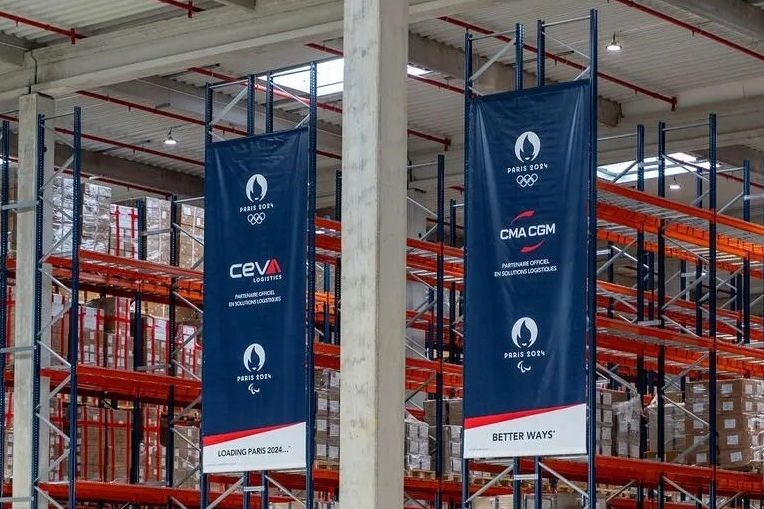
On July 26, 2024, the opening ceremony of one of the world’s largest sporting events – the Paris 2024 Olympic and Paralympic Games – will begin in Paris. CEVA Logistics, which together with the CMA CGM Group is the Official Logistics Partner of the event and Technical Partner of the Torch Relay, talks about the preparations for logistics support and the challenges in organizing the first shipments.
In the warehouses – a safe working environment
An experienced team of 180,000 employees worldwide is responsible for ensuring efficient logistics and transport services for the Paris 2024 Games. Additionally, CEVA has hired and trained 700 people specifically for this operation. For the company, ensuring a comfortable and safe working environment for employees is of key importance. The actions and procedures implemented in one of the warehouses dedicated to the Games’ logistics were presented by Jérémy Jaen, Quality, Health, Safety and Environment (QHSE) Coordinator at CEVA Logistics.
– My role is to check that our employees are working in safe conditions. I visit the warehouses regularly to ensure the fluidity and safety of operations. I have to be attentive and ask employees the right questions, and sometimes implement action plans aimed at improving working conditions – explains Jérémy Jaen.
Every workplace involves risks. Therefore, it was important for Jaen to thoroughly familiarize himself with the risk analysis contained in the occupational risk assessment document, as well as the preventive measures already implemented, such as mandatory personal protective equipment or designated traffic routes, etc. Safety meetings, briefings, and equipment inspections were organized in the warehouse. Various initiatives promoting safety and increasing employee awareness are also being conducted, including training, audits, and educational campaigns.
– Communication with employees is the most important thing. Open dialogue and promoting a culture where reporting incidents and concerns is encouraged help maintain a high level of safety. I strive for my colleagues to have a sense of responsibility and take an active part in creating a safe workplace – emphasizes Jérémy Jaen.
In promoting a “safety first” attitude, Jaen pointed out the need to explain to new employees what the risks are and why certain solutions must be used. This is all the more important as they may often be perceived by them as restrictions. An example could be a situation where some forklift operators, wanting to save time, do not fasten their mandatory seat belts. Explaining the importance of fastening seat belts and the consequences associated with it facilitates acceptance and making the right decisions.
Always one step ahead – on the route of the Olympic Torch Relay
The task of CEVA Logistics and CMA CGM, as the technical partner of the Paris 2024 Torch Relay, is to organize the delivery of necessary materials, including gas cylinders, butane, propane, paraffin, lanterns, torches, burners, and clothing for the relay participants, to several selected locations along the route.
For the CEVA team, the first stage of the Relay began as early as March 17 with the transport of materials from a warehouse in Reims, France, to Greece, even before the Olympic flame lighting ceremony. Now, the CEVA Ocean Freight team is responsible for organizing deliveries for ceremonies held in French overseas territories, i.e., Reunion, French Guiana, Tahiti, Martinique, and Guadeloupe. All shipments are carried out well in advance, which requires the involvement of not only delivery planning specialists but also compliance with regulations governing the transport of dangerous goods, warehouse operations, sea freight, and customs clearance.
The biggest challenge is the transport of goods classified as “dangerous materials” or potentially dangerous, i.e., propane, paraffin, butane, and gas. CEVA teams work with loading and destination ports to ensure compliance with handling procedures and safety regulations on various routes.
Additionally, although the cargo could be transported in a standard 40-foot container, for safety reasons, it is separated and placed in two 20-foot containers. After each ceremony, since most of the goods are donated, only one container returns to France. Such a solution not only increases cargo safety and transport organization efficiency but also reduces the carbon footprint of the shipments.
Logistics of the Paris 2024 Games – by the numbers
As part of the Paris 2024 Games support, the CEVA and CMA CGM teams provide a wide range of logistics services, including freight – international transport of goods, customs clearance, warehousing, end-to-end logistics at Olympic venues, special transports, and IT system integration. Over 900,000 pieces of sports equipment (including trampolines, poles, firearms, boats, and surfboards), over 250 containers with stands and mobile seating, 1.3 million pieces of furniture, equipment, and promotional materials, as well as 17,000 beds for athletes and their teams accommodated in the Olympic Village are to be transported for the Olympics. CEVA Logistics is responsible for the warehousing, assembly, and transport of nearly 650 mobile vehicles and 2,745 electric vehicles that teams will use to move around the Olympic venues. It also manages the end-to-end logistics of the world’s largest audiovisual network, thanks to which the athletes’ struggles are broadcast worldwide. In total, this is over 170,000 pallets and 7,000 shipments, using a fleet of over 300 vehicles, from vans to trucks. At least 50 percent of deliveries between warehouses and competition venues are to be carried out using low-emission vehicles powered by biofuels.
Source: CEVA Logistics