








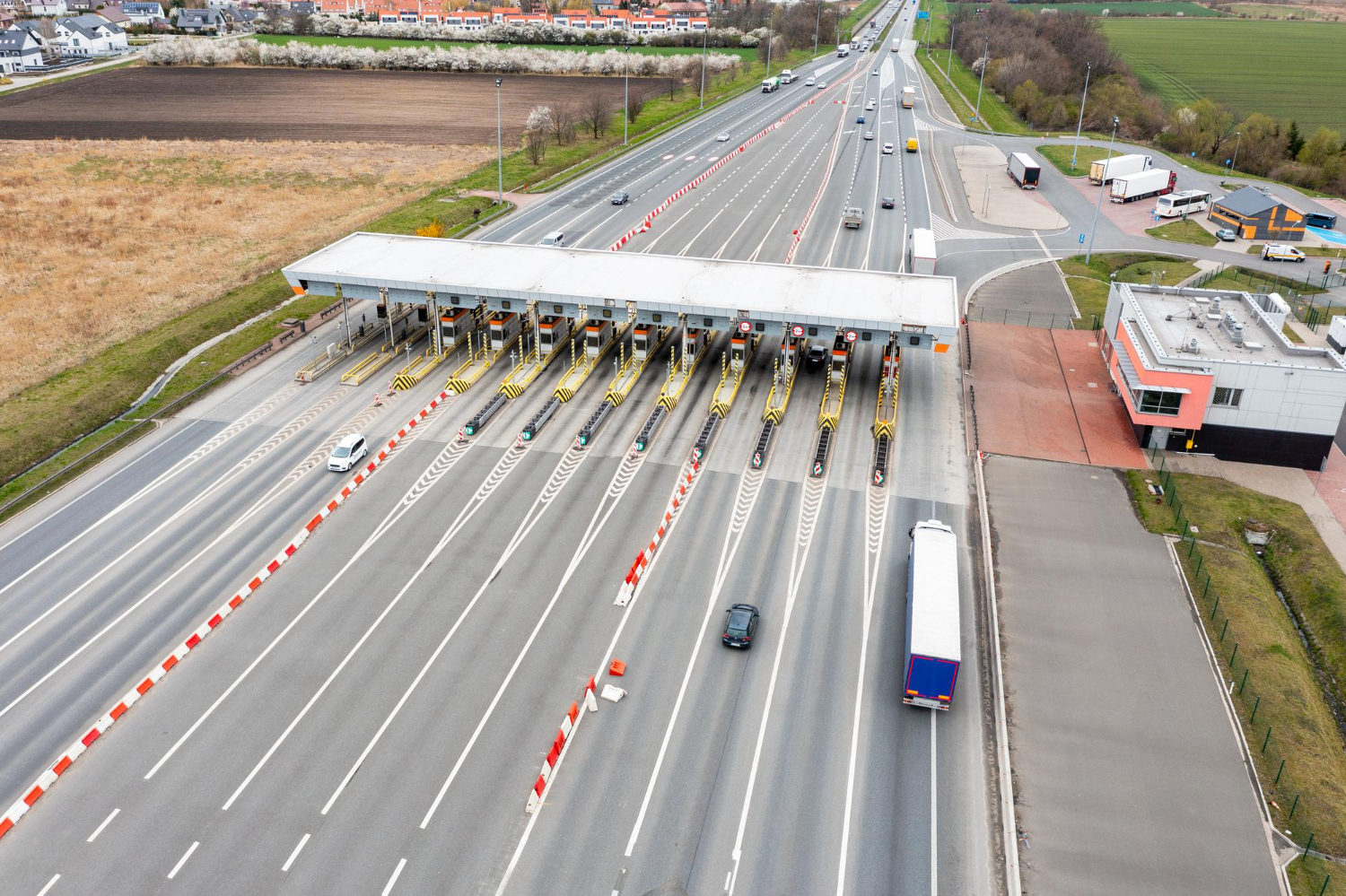
The long list of costs for running a transport business has been joined by toll increases imposed by the European Union. All EU countries were required to include CO2 emission costs in their road tolls by March 1, 2024. The scale of these increases depends on the country, with Germany opting for the highest increase so far, where tolls are estimated to rise by about 86 percent for vehicles in the highest emission class.
– Mandatory increases have come into effect based on the EU’s Eurovignette Directive. It obliges member states to implement a road toll, the amount of which will depend on CO2 emissions into the atmosphere – explains Jakub Gwiazdowski, Head of Partnership and Relations at Transcash.eu. – The toll calculation is to be based on emission classes, where the lowest (first) represents vehicles emitting the most carbon dioxide into the atmosphere, and the highest represents electric and hydrogen-powered vehicles. The goal of the directive is clear – to reduce harmful gas emissions in line with the “Fit for 55” package, which aims to reduce air pollution by 55 percent by 2030.
Price shock in Germany is the exception, not the rule
The directive was adopted in 2022 and gave EU countries two years to incorporate the new toll into their road pricing systems. One of the few countries that decided to do this in 2023 was Germany. The amount of the toll shook the Polish transport market because it nearly doubled the rate even for vehicles with the highest emission class. Road tolls also increased significantly in Hungary – according to estimates by the mobility service provider for the European TSL industry, Easytrip Transport Services, the local toll increased by an average of 30 percent, and by 50 percent for vehicles with 5 or more axles.
– Fortunately for drivers, in other EU countries, the scale of increases is, so far, much lower. In Belgium, they range from 5 to 17 percent, in Austria – 8.5 percent, in Spain no more than 7 percent, in France – 3.5 percent, and in Italy or Portugal they range from 1.5 to 2 percent. So far, we do not know where Poland will fall on this scale, as the rate has not yet been set – says Jakub Gwiazdowski from Transcash.eu.
How will these numbers translate into real toll costs in individual countries?
Hungary
Although it was the German toll increases that upset the Polish public, the Hungarians were just as radical in this respect, starting a cycle of increases back in October 2023. Currently, the local toll is among the highest in Europe. Drivers must also remember that the Hungarian toll is multi-component. Its final amount consists of the number of kilometers, a base infrastructure fee, and an external fee aimed at covering the costs of air pollution, noise, and carbon dioxide emissions related to road transport. The fee also depends on the zone – suburban or intercity.
Additionally, the infrastructure fee rates depend on the type of road, i.e., expressway or national, and only these are uniform. The external fee is variable depending on the emission class and the nature of the area and can be equal to or higher than the infrastructure fee. Currently, its amount for the heaviest vehicles with 5 or more axles is 40 euro cents per km.
Germany
Germany also implemented increases back in 2023. On December 1, road tolls in this country increased by 86 percent compared to the existing rate for Euro VI class trucks. It is calculated not only based on EURO classification but also on the vehicle’s total weight and number of axles. After the changes, the maximum toll rate applied to vehicles over 18 tons in the Euro 1 class, which emits the most pollutants, exceeded 50 euro cents per km, whereas before the increase it was 35.4 euro cents, i.e., over 16 euro cents less. In the case of Euro VI class vehicles, the highest toll rate after the changes (vehicle over 18 tons, 5 axles) is nearly 35 cents per km.
From July 1, 2024, drivers transporting goods with vehicles or combinations of vehicles with a GVW of over 3.5 tons must also expect higher road tolls in Germany. Previously, they were exempt from tolls, which applied only to vehicles intended for the transport of goods with a total weight exceeding 7.5 tons.
Czech Republic
On March 1, 2024, the Czech toll also increased, and the restrictive emission classification method in this country ensures that the vast majority of transport companies will feel it. According to information provided by CzechToll, all internal combustion vehicles registered before July 1, 2019, were automatically assigned to the first, lowest emission class with no possibility of changing this status. The increases will not be drastic, however – the Czech government estimates them at 10-15 percent compared to the situation before March 2024.
Austria
At the beginning of 2024, Austria also implemented increases, raising road tolls by 3.87 euro cents per km for vehicles emitting the most pollutants. The current increase, although small, will not remain at this level for long, as it is the first in a series – further toll increases are expected in 2025 and 2026. The Austrian government estimates that next year the increase will be about 6.5 cents, and in the following year, about 9 euro cents.
Lithuania
In Lithuania, the toll also increased significantly compared to 2023. The cost of purchasing a seven-day vignette for an N2 category truck (3.5-12 tons) currently ranges from 31-67 euros (3 axles) and 54-153 euros for 4 and more axles. N3 type vehicles (over 12 tons) must pay 41-91 euros or 68-153 euros, respectively. According to data from the website autostrady.com.pl, in February 2023, the fees for the same period (without distinction by axles) were 26-37 euros for N2 type vehicles and 37-52 euros for N3. So, we are talking about a several-fold increase in rates compared to the situation a year ago.
Poland
The obligation to increase toll rates also applies to Poland. In our country, they are regularly updated in accordance with the inflation rate, which resulted in a 15 percent increase at the beginning of 2024. However, this increase does not take into account the CO2 emission fee imposed by the EU, which means the toll must be raised as soon as possible. In theory, we should have done this by March 25, 2024, and the changes must be made by the Sejm. However, its work calendar shows that Parliament will not manage to address this topic before October 2024.
Source: Transcash