








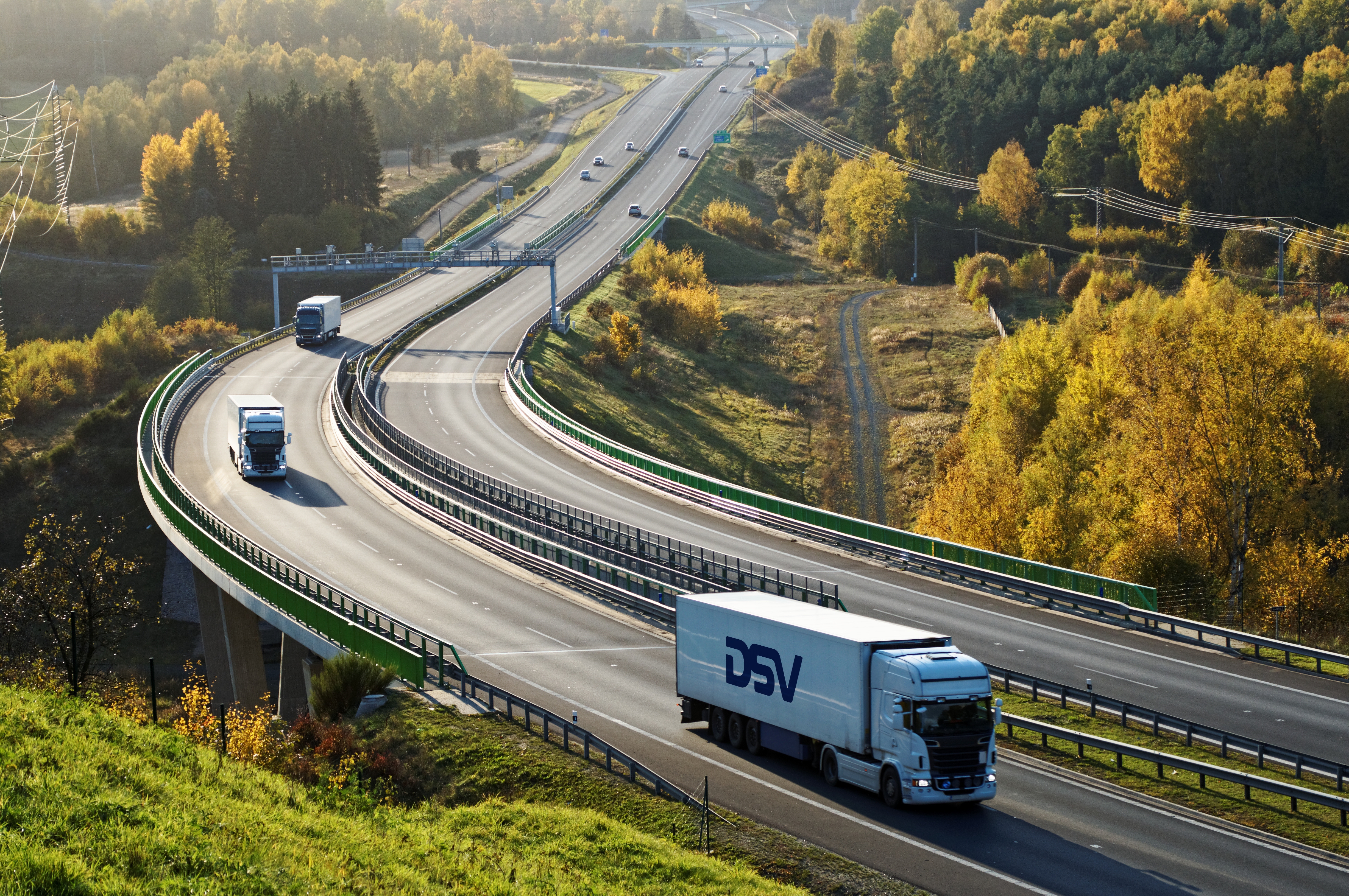
Monitoring and forecasting external conditions is fundamental in logistics. Experts from DSV – Global Transport and Logistics have analyzed the factors that will have a key impact on global, European, and national supply chains, as well as the direction of the industry’s development. The situation in logistics will reflect on the situation in other sectors of the economy, including trade and product prices. All consumers and entrepreneurs will therefore feel the changes taking place in the TSL market, which is why it is worth taking a closer look at them.
Road transport
In road transport, we are currently observing a decline in the available fleet. Comparing data from the second and third quarters of 2023 to the same period in 2024, it can be noted that the availability of heavy goods vehicles has decreased by 7%. This is related to carriers limiting their operations, and thus the size of their fleets, due to the unfavorable economic situation. A clear slowdown in activity and a decrease in the number of orders are visible primarily in the Eurozone.
Rising operating costs are also a challenge for the TSL industry. Higher financial outlays will be allocated next year to leasing and vehicle maintenance, including insurance, the prices of which, according to the report “Cost developments in road transport including intermodal transport 2024-2025,” will increase by 5.9% in 2025. The report also shows that transport companies will pay more to employees – driver wages will be 5.42% higher.
TSL companies will also have to face rising road tolls. The EU Eurovignette Directive imposes an obligation on countries to introduce charges dependent on a vehicle’s CO2 emissions. Consequently, from January 1, 2025, tolls will be collected in Denmark for vehicles with a GVW of over 12 tons on 10.9 thousand km of roads. In Poland, on the other hand, the network of national roads subject to electronic toll collection (e-toll) was expanded from 3,620 to 5,200 km on November 1, 2024.
At the same time, the road transport sector will continue to seek higher operational efficiency. According to Eurostat, in the first half of 2024, empty runs of heavy goods vehicles accounted for as much as 20% of vehicle-kilometers.
– To maximize cargo space and reduce the number of empty kilometers, DSV is developing regular export and import groupage lines, where vehicles travel on a fixed route, fully utilizing the vehicle’s transport capabilities. An example is the Poland – Sweden – Poland line, on which double-deck vehicles using ecological HVO fuel operate. Thanks to such solutions, as well as close cooperation between logistics operators and customers in planning and implementing the supply chain, it is possible to increase the level of efficiency in road transport – says Paweł Ledwoń, Senior Key Account Manager, DSV.
Achieving sustainable development goals will also be important for the industry. Among the tools enabling this, one should primarily mention fleet electrification and the popularization of the use of biofuels. Investing in such solutions will allow for the reduction of CO2 emissions, and in the long term, also limit operating costs. Some of these will depend precisely on the amount of greenhouse gases emitted, according to the principle: he who emits, pays.
Warehouse logistics
In warehouse processes, the fourth quarter is the absolute peak season. The number of orders reaches record levels due to preparations for Christmas and the days of great promotions that are now common all over the world – such as Black Friday or Cyber Monday.
– Due to the multitude of orders, at DSV we diversify our courier subcontractors. Thanks to the fact that shipments are distributed among different companies, they can quickly reach their destination. Furthermore, diversification ensures that even if problems occur with any of the subcontractors, most of the packages – distributed by the other entities – will be delivered without delay – says Oskar Błaszkowski, Distribution Manager, DSV.
Currently, a significant increase in the transported volume is visible in the courier services market. This will translate into an increase in the price for delivering shipments. Some courier companies are already establishing a fee for excess cargo weight. Some companies will likely introduce a so-called capacity surcharge, i.e., fees for the space occupied by shipments, while others may raise their rates.
Forecasts for the coming year also indicate the continuation of many ESG-related activities. Solutions that may dominate the market include reusable shipping packaging. Their use will significantly limit waste production. Emission-free vehicles will also be used on a wider scale, although this does not only refer to electric cars, but also to drones, robots, bicycles, or scooters. The latter two types of vehicles, in particular, will support couriers in delivering shipments as part of the same-day delivery service – i.e., delivering a package on the same day it was ordered.
Source: DSV – Global Transport and Logistics