











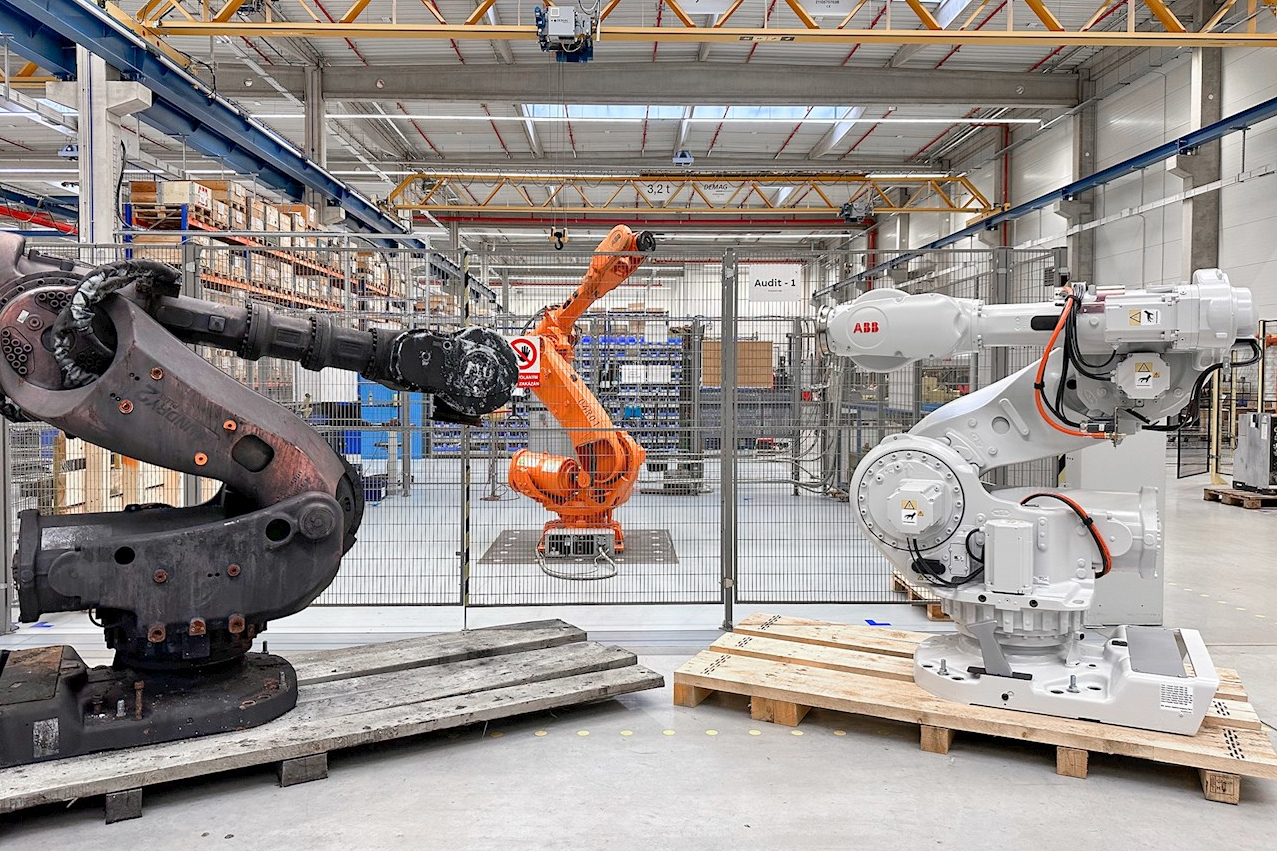
Should you buy new or invest in refurbishing a used one? Owners of production plants using industrial robots face dilemmas similar to those of drivers. So-called robot regeneration has ceased to be a market curiosity in Poland and has become a standard service provided by the industry’s biggest players. Giving a robot a second life is usually a time-saver, in many cases also a money-saver, and incidentally, it also means less CO2 in the atmosphere.
At the Frosta plant in Bydgoszcz, two robotic lines were in operation, where manipulators assisted in the process of packing frozen food into boxes. Wishing to standardize their offering, the well-known fish finger producer decided to expand one line at the expense of the other. The problem was that the decommissioned line featured two solid, older-type manipulators that are now very difficult to find on the market. Frosta did not want to “adapt” new devices to a complex process, so they decided to regenerate the old ones, which had proven themselves well in packing frozen food.
The manipulators were sent to the ABB robotics center. “First, they underwent an audit to determine whether the device qualifies for regeneration, and if so, what scope of work would be required for us to provide a warranty for the refurbished unit. We then return to the customer with this information. The assumption is that the functionality and expected service life of a robot that has undergone regeneration should be the same as that of a new unit,” says Bogumił Matuła from the ABB Robotics business in Poland.
There are many advantages to regenerating used robots. Refurbished equipment reaches the customer’s production line faster. The renovation time can be up to twice as short as manufacturing a unit from scratch. It happens that customers need a machine “immediately,” but it is not available. In this situation, they can wait for the robot to leave the manufacturer’s factory or refurbish a device they already own. There is also a third option, when long waiting times are not an option and the old unit cannot be refurbished for some reason – buying a ready-made, refurbished robot “off the shelf.”
New old strength
This solution was chosen by Vitkovice Milmet from Sosnowiec, a manufacturer of, among other things, technical steel cylinders. A large ABB IRB 7600 industrial robot worked in their foundry, operating a press for several years in very difficult environmental conditions. Its complete regeneration was not possible, so the company decided to buy the same model, but one that had already been refurbished. The new unit was delivered within a week, which is a very good time in the industry. It currently operates at such a level of efficiency that it is impossible to tell at first glance whether it was used before or if it arrived straight from the robot factory.
In many cases, it is not just time that counts, but also lower costs. As the ABB expert points out, a refurbished robot can be up to 25 percent cheaper to purchase than a new unit, although this is, of course, not a rule. “The more advanced the robot, the more profitable it becomes to refurbish it. You don’t have to make new castings, for example, or many other components that are suitable for reuse,” emphasizes Adam Majewski from ABB.
Naturally, such regeneration is also more ecological than production. According to ABB’s own data, CO2 emissions into the atmosphere are 1.7 tons lower than during the production of a new unit.
Respect your robot
And what does such regeneration look like in practice? The robot is dismantled into parts. Then it is meticulously cleaned. The elements identified for replacement are replaced with new ones. Practically everything can be replaced, from the arm to the cable harnesses. The reassembled robot is painted to look exactly like the original. The effect is impressive – a wrapped device, looking like new, arrives at the customer, is installed, and is ready for work.
The ABB center has already regenerated machines from the 90s, which shows that a robot’s life can be long and its age does not matter that much. The key, apart from proper servicing or performing periodic inspections, is using the unit in accordance with the specifications. An improperly operated unit will be more difficult to regenerate.
“Even when a robot works in a clean environment, but carries elements weighing several dozen kilograms more than its maximum lifting capacity, it will wear out faster than a robot working in difficult conditions, e.g., in a foundry, but where operators follow the recommendations. One will work continuously for several years, the other even for twenty. Working conditions are key,” explains Adam Majewski from ABB.
As Bogumił Matuła adds, it is not yet possible to speak of a “refurbishment” trend for robots in the Polish industry. Plant owners are aware of such a service and the benefits it brings, but it is still not widespread. This does not change the fact that the market will stand on two legs. The right, stronger one will, of course, still be represented by new robots.
Source: ABB