











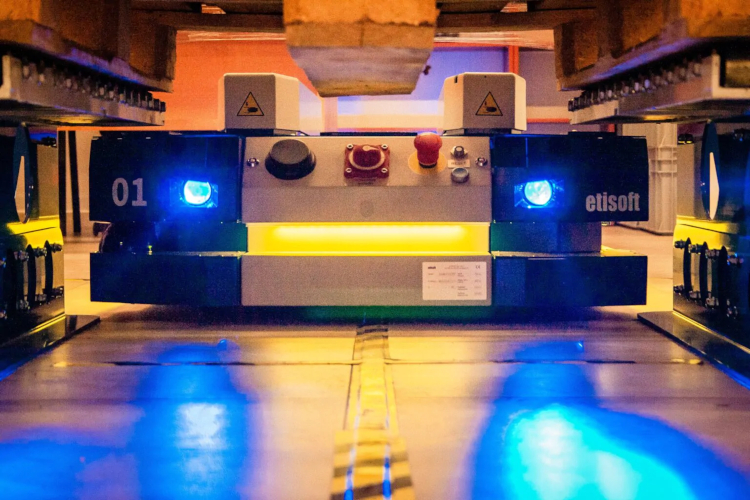
Modern factories use a large fleet of robots to carry out processes of varying degrees of complexity. To improve control and organize the flow of exchanged data, it is necessary to implement advanced software that supports the management of intralogistics processes.
What key functionalities should software in an intralogistics system have? Robot fleet management involves defining challenges composed of many smaller missions. The system supervising the operation of the devices connects groups of robots performing various tasks related to a single operation.
– Modern software architectures allow for breaking down the entire field of internal logistics management into smaller processes. This helps avoid organizational chaos and better manage the fleet of autonomous mobile robots. At Etisoft Smart Solutions, we followed this path by dividing the main systems into several smaller subsystems – explains Dominik Ługowski, Software Development Manager at Etisoft Smart Solutions.
In this way, the system enables the optimization of time, energy, and costs of mission execution. It also allows for avoiding congestion that could lead to chaos in the supervised space. Software in an intralogistics system acts as a kind of traffic code for robots, thanks to which they move efficiently and safely. Here are 5 key functionalities that software in an intralogistics system should offer.
1. Robot management system
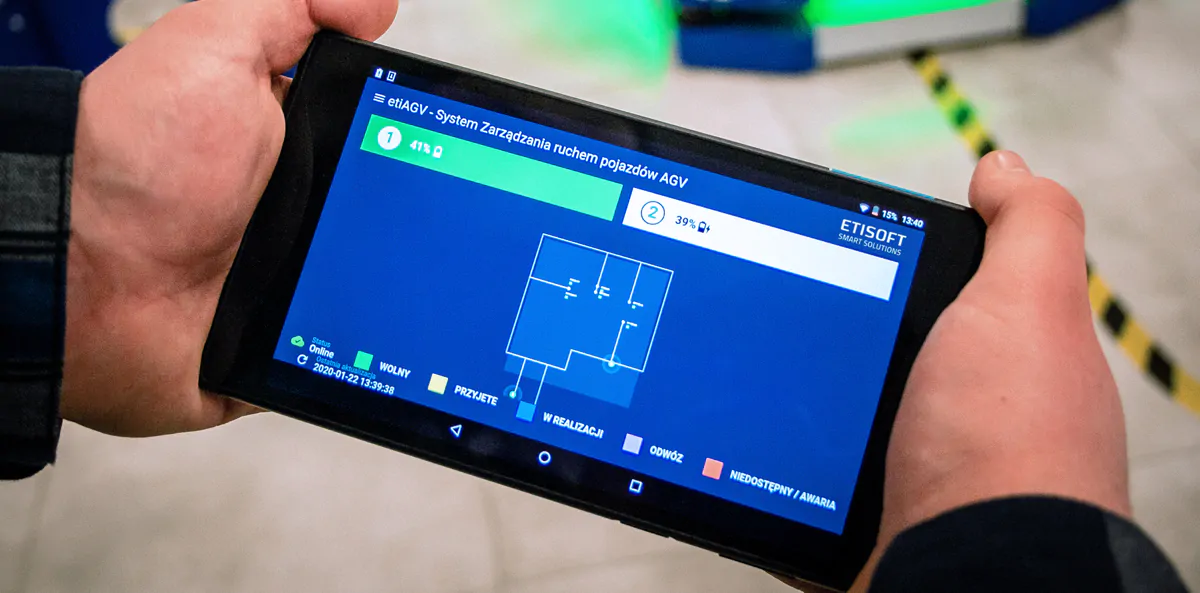
One of the most important functionalities of software in an intralogistics system is the robot management system. It is responsible for managing missions, eliminating problems related to vehicle priority, or updating the mission plan after a failure occurs. The system minimizes the risk of stopping the transport process and the occurrence of bottlenecks.
– At Etisoft, such a system is IntraFleet, which is a robot manager that handles their business logic. The software accumulates robot actions into missions that meet customer requirements. Furthermore, the IntraFleet system manages and monitors robot traffic, queues orders, and organizes robots into functional groups intended to perform a specific operation – the expert lists.
2. Mission generation methods
Generating missions, i.e., orders regarding the need to use a robot, is possible using several methods. One of the simplest is to use a dedicated module in the aforementioned robot management system, where an appropriate operator panel can be generated as a website. This method works well in cases where the process only requires a call, and the robots themselves do not interact with the employee. If, however, this interaction is necessary, for example, for the operator to signal that the robot can depart, it is possible to connect dedicated operator panels with a larger number of implemented functions. For systems of the highest complexity, a tool such as an order manager is used. It does not deal with transport itself, but with the preparation of appropriate plans for missions.
3. Integration with existing robot management systems
Implementing intralogistics software in a partially automated plant requires the ability to integrate with other systems such as ERP, MES, or WMS. Free data exchange allows for better management of intralogistics processes. Integration performed using special adapters usually needs to be tailored to a specific client, which is why it can affect the extension of the implementation time.
4. Process visualization and reporting
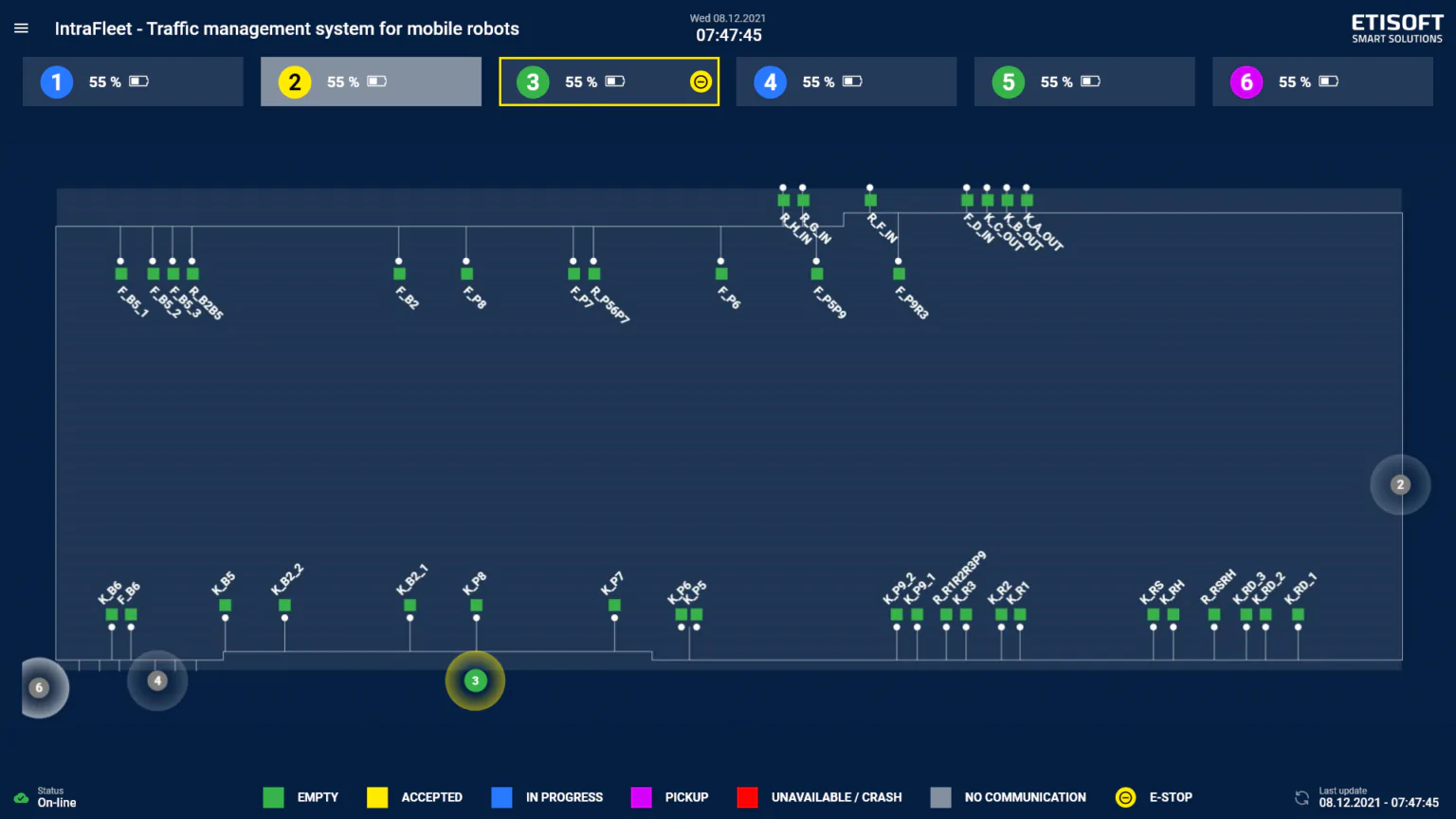
A good transport system should also allow for inference and provide data necessary for seeking further ways to optimize processes. Reporting modules, as well as panels and dashboards enabling clear data presentation, are a good way to precisely deliver information and avoid information noise.
5. Dedicated functions
Every industrial plant has different needs and capabilities, which is why there is sometimes a need to create a new, personalized solution or expand the basic offer with dedicated software. Such a solution may affect the extension of the implementation time, but it gives companies the certainty that they will receive a system that meets all requirements. Therefore, a key element is the possibility of expanding the software with additional modules adapted to the needs of a specific plant.
Source: Etisoft.