









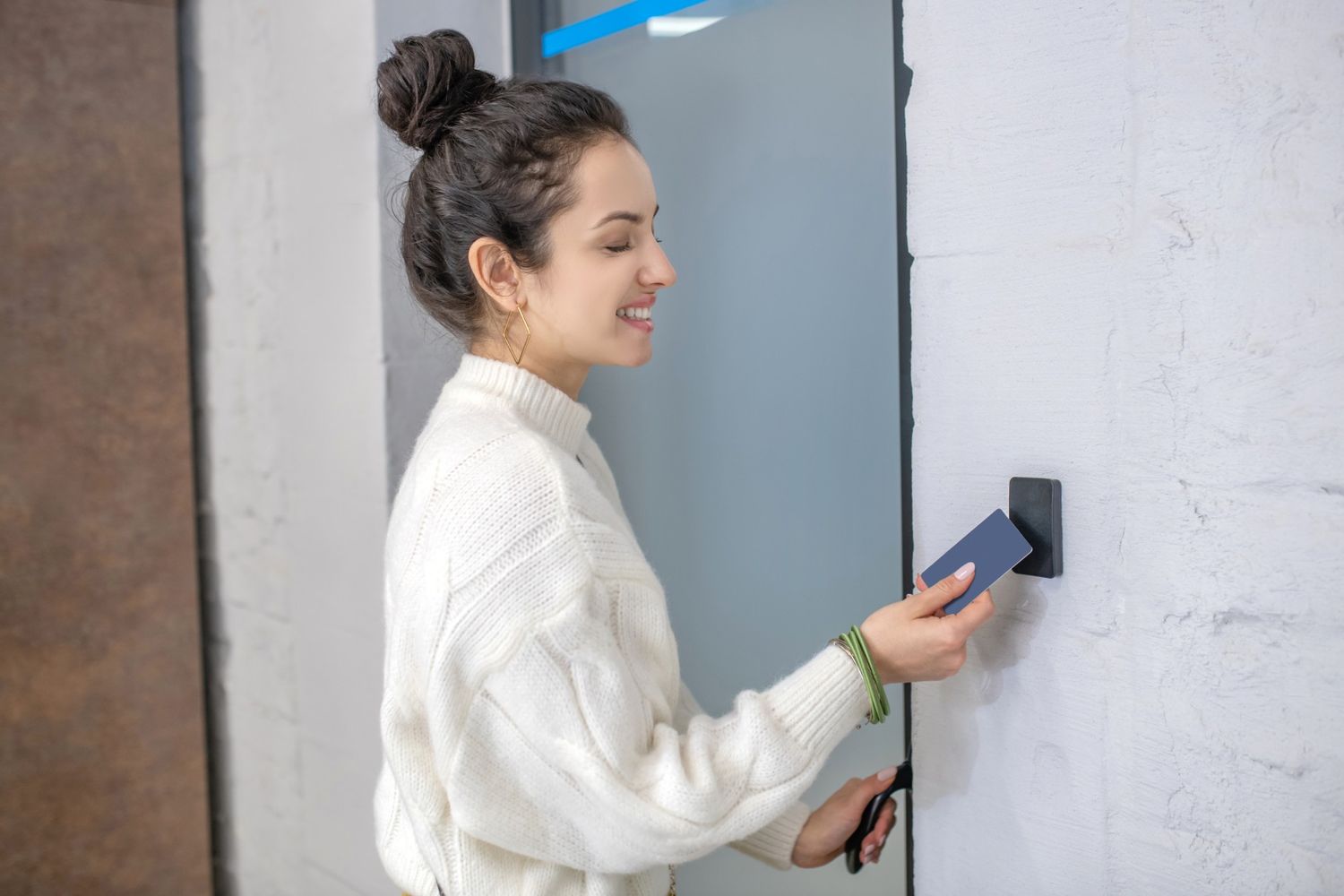
Choosing the right RFID proximity reader technology is a decision that directly impacts security and the convenience of daily use. Analyzing what to invest in most often comes down to choosing between the two dominant frequencies on the market. Understanding the differences between them is crucial for anyone who designs, manages, or modernizes systems in office buildings, residential complexes, or industrial facilities.
What exactly is an RFID proximity card and how does it communicate with a reader?
The acronym RFID stands for Radio-Frequency Identification. From a physical point of view, a proximity card is a simple device. Inside the laminated plastic, a miniature integrated circuit, commonly called a chip, is embedded along with a copper antenna connected to it. The vast majority of these carriers are completely passive devices. This means they do not have their own power source in the form of a battery and remain completely dormant without an external stimulus.
The communication process is always initiated by edge devices. A reader mounted, for example, at a door, constantly generates an electromagnetic field at a specific frequency. When we bring the carrier close to this reader, the antenna integrated inside the plastic “collects” energy from the emitted field and immediately converts it into a weak electric current. This fraction of a second is enough to wake up the integrated circuit. The chip instantly processes the request and wirelessly sends back to the proximity reader a data packet stored in its memory, most often containing a unique ID number that is then verified by the door controller.
What are the differences between 125 kHz and 13.56 MHz frequencies?
The main division is between two generations of equipment. The 125 kHz frequency, referred to in technical documentation as LF (Low Frequency), is an older and simpler technology. Identifiers of this type can usually only transmit their fixed serial number (UID) on demand. The biggest disadvantage of cards such as Unique or EM4100 is the complete lack of advanced encryption, which makes them extremely easy to clone. However, they have an advantage resulting directly from the physics of wave propagation. A longer electromagnetic wave shows slightly better resistance to interference generated by the presence of metal and liquids in the immediate vicinity of the reader.
In turn, 13.56 MHz, often referred to as HF (High Frequency), is a much more modern technology. Above all, it allows for reading, but also for two-way data writing in the chip’s memory. Carriers operating in this band have built-in memory that is divided into separate sectors managed by cryptographic keys. The biggest advantage of high frequency is the support for advanced encryption algorithms, which, in the right configuration, makes such cards extremely difficult to copy without authorization. One must only be aware that the physical reading range of HF cards is generally slightly shorter than that of their older low-frequency counterparts.
What standards does 13.56 MHz cover?
The 13.56 MHz designation only defines the physical carrier frequency of the system. The actual level of security and functionality of the system depends directly on the communication standard and the built-in chip used on the card. Historically, the most popular solution in this group is Mifare Classic. Unfortunately, this is an obsolete standard, and its basic cryptography was broken many years ago. Currently, it is only suitable for systems with very low security requirements.
A much higher level of protection is provided by Mifare DESFire, currently available in EV1, EV2, and EV3 generations. It uses encryption algorithms such as AES and DES. As a result, this solution is today’s market standard in modern access control systems and complex implementations supporting micropayments.
Competitive options are also offered by HID, which has its proprietary iCLASS technology. Although older versions of iCLASS offered better parameters than Mifare Classic, they are now being slowly replaced by much more modern innovations. The pinnacle of this manufacturer’s offer is Seos technology. This latest and most secure standard is completely resistant to modern cryptographic attacks.
Which frequency fits a specific scenario?
Older solutions operating at 125 kHz should only be chosen if low implementation cost is the priority and the potential cloning of the identifier does not pose a real threat. They will work well for simple apartment building intercoms, local fitness clubs, or opening barriers in residential parking lots. Due to the aforementioned resistance to interference, they can be successfully used in harsh industrial environments with large amounts of metal and water, as well as in older hotels awaiting comprehensive modernization.
The possibility of using the 13.56 MHz band is different. This solution should absolutely be used by modern office buildings, corporate facilities, as well as government and military zones with increased security requirements. They should be used wherever the most important requirement is the security of property, data, and the greatest possible protection against unauthorized copying of cards by unauthorized entities.
The importance of choice and implementation
The decision between the 125 kHz and 13.56 MHz bands is a choice that sets the boundaries of a facility’s security for many years to come. Low frequencies remain a typically budget-friendly solution that is only functional in open or industrial environments without the risk of sabotage. Modern systems in the HF band are the foundation for business, offering advanced data encryption and highly convenient integration of many company services on a single carrier. However, one cannot forget that the potential of even the most expensive card will be reduced to zero if integrators ignore its security features and treat it only as a more expensive carrier of an open serial number.