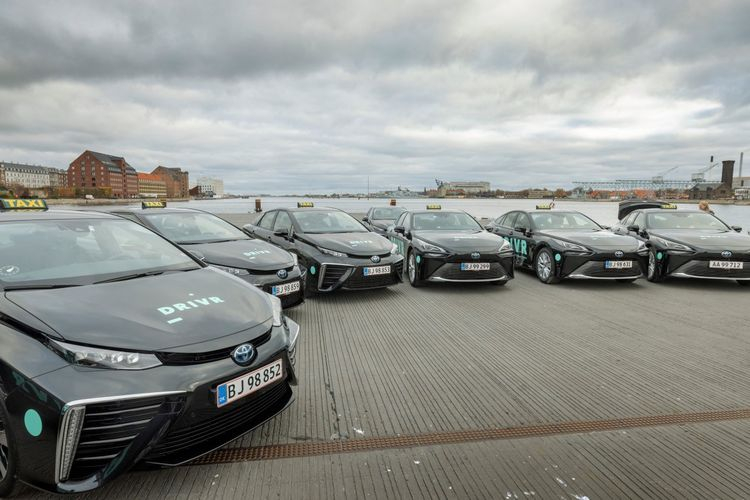
Toyota and the taxi company DRIVR have introduced 100 hydrogen taxis to the streets of Copenhagen. The new taxis in the Danish capital are second-generation Toyota Mirai models with electric fuel cell propulsion. This eco-friendly initiative aligns with the Copenhagen authorities’ goal for all taxis in the city to be zero-emission by 2030. The taxi industry is seen as key to the green transformation of cities.
The green transformation of taxi services in European cities is gaining momentum. According to the Danish government’s strategy, from 2025, taxi companies will only be able to purchase zero-emission cars, and by 2030, no taxi on Danish roads will be allowed to emit a single gram of exhaust fumes. At the beginning of November this year, Toyota and the company DRIVR introduced 100 hydrogen taxis to the streets of Copenhagen, supporting public authorities’ efforts to achieve zero-emission passenger transport.
The app-based taxi service DRIVR is one of the leaders of the green transformation in the industry. Customers have long had the option to choose between hybrids, battery electric vehicles, and hydrogen cars. Now, the company is significantly increasing the number of hydrogen taxis in its fleet. All 100 new cars are Toyota Mirai models with electric fuel cell propulsion (FCEV), which emit only pure water while driving.
– The taxi industry is crucial for the green transformation. Taxis are constantly on the move and cover huge distances every day in congested cities. Switching from internal combustion engines, especially diesels, to zero-emission cars that take only a few minutes to refuel will allow us to rid cities of harmful air pollution while maintaining the same practicality and flexibility of the vehicle fleet – emphasizes Tejs Laustsen Jensen, CEO of the Hydrogen Denmark association. – A large fleet of new taxis will help create a suitable customer base for refueling stations, which is essential for the development of green hydrogen infrastructure. Furthermore, this will give many people the opportunity to encounter fuel cell technology. In Denmark, we have one of the world’s strongest hydrogen supply chains and a large base of subcontractors.
The purchase of 100 Mirai cars for Copenhagen is the result of one of the largest public tenders for taxi services in Denmark. The capital’s authorities selected DRIVR to operate the entire system of social taxi services in the city. This system is used to transport children with disabilities, people with intellectual disabilities, and patients requiring transport to the hospital. It can also be used by city officials and public authority representatives for business travel. All eligible users will now travel in completely zero-emission hydrogen Toyota cars.
– We are very proud that DRIVR has received such an important task of supporting those in need and that we will be able to contribute to the green transformation of Copenhagen. We are also very pleased with the cooperation with Toyota, which has enabled us to introduce a large fleet of new hydrogen cars to the streets of the Danish capital – emphasized Haydar Shaiwandi, CEO of DRIVR.
Toyota, which supplied DRIVR with 100 electric Mirai cars, notes the growing interest in hydrogen cars in the taxi market.
– It was a great pleasure to hand over the first 100 hydrogen taxis to DRIVR drivers, and we are ready to deliver more cars as soon as the need arises. We fully support the company’s ambition to become the most eco-friendly taxi operator in Denmark – added Alar Metsson, CEO of Toyota Denmark.
The second-generation Toyota Mirai debuted on European markets earlier this year. The car is also available in Poland. The large premium sedan was designed using the TNGA architecture and is equipped with the latest electric drive powered by fuel cell technology. The new-generation Toyota Mirai powertrain is smaller, lighter, more efficient, and cheaper to produce than its predecessor. The Mirai is powered by an electric motor with 182 hp and 300 Nm of torque. This unit is powered by fuel cells that produce electricity on the fly through the reaction of hydrogen with oxygen. The hydrogen Toyota does not emit any exhaust fumes while driving, and the only byproduct of the fuel cell operation is water vapor.
Expanding the DRIVR fleet with 100 hydrogen cars is part of the European projects for the development of hydrogen transport Hydrogen Mobility Europe 2 (H2ME2) and Zero Emission Fleet vehicles For European Rollout (ZEFER), implemented by The Hydrogen And Fuel Cell Joint Undertaking (FCH JU). Partners of this European organization include both Toyota and the City of Copenhagen. Its goal is to popularize hydrogen transport and other hydrogen-based technologies in the European Union. FCH JU has provided support to Denmark several times in expanding its fleet of fuel cell vehicles and hydrogen refueling infrastructure.
Source: Toyota