











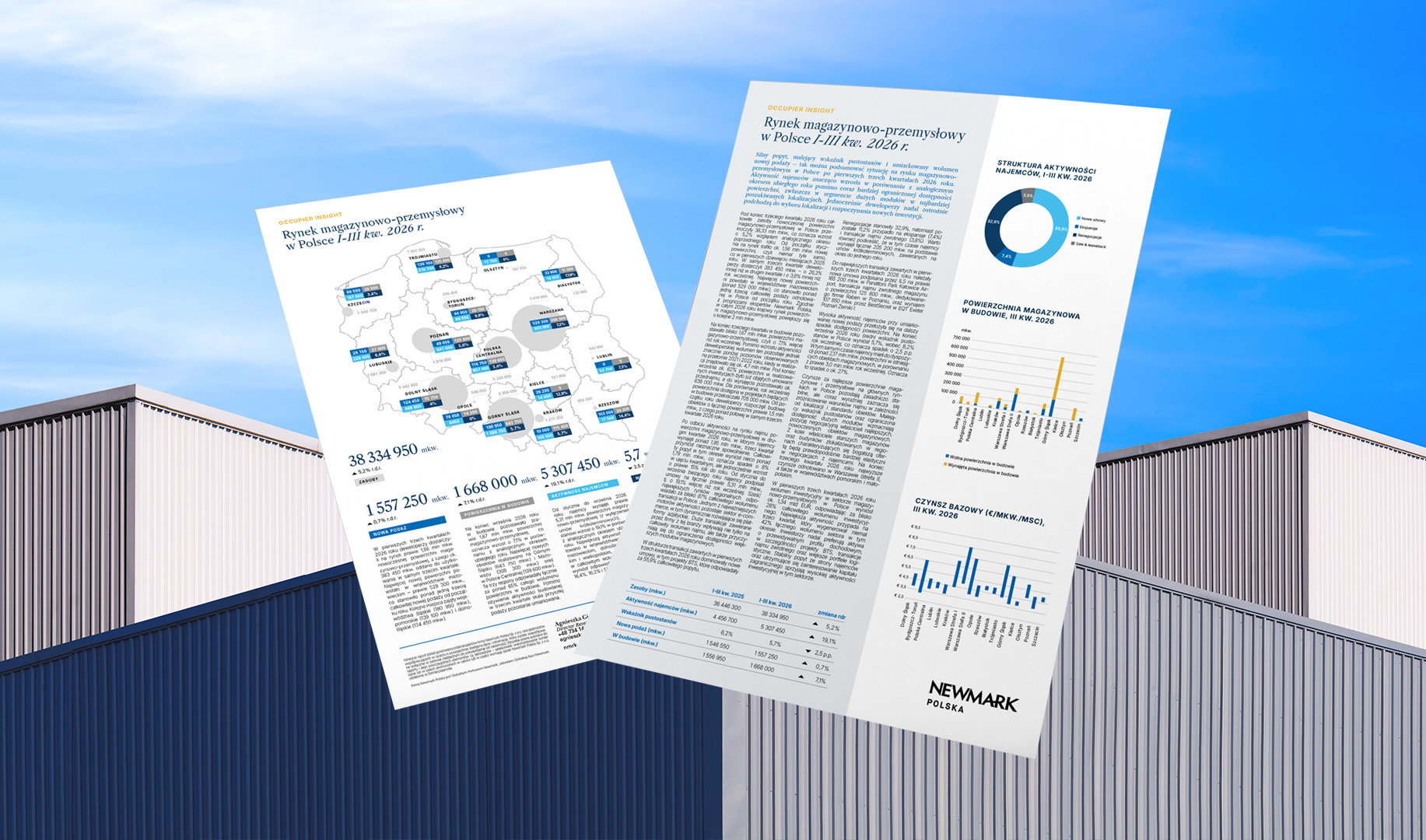
According to the latest report “Warehouse and Industrial Market in Poland”, published by the advisory firm Newmark Polska, strong demand, a declining vacancy rate, and a moderate volume of new supply are the key trends defining the warehouse and industrial market in Poland after the first three quarters of 2026. Tenant activity has increased significantly compared to the same period last year, despite increasingly limited space availability, particularly in the segment of large units in the most sought-after locations. At the same time, developers continue to take a cautious approach to selecting locations and launching new investments.
By the end of the third quarter of 2026, the total stock of modern warehouse and industrial space in Poland exceeded 38.33 million sqm, representing a 5.2% increase compared to the same period last year.
Since the beginning of January, approximately 1.56 million sqm of new space has entered the market, which is almost the same amount as in the first nine months of 2025. In the third quarter alone, developers delivered 383,450 sqm – 26.3% less than in the second quarter and 3.8% less than a year earlier. The largest amount of new space was completed in the Mazowieckie region (over 529,000 sqm), accounting for more than one-third of the total supply recorded in Poland since the beginning of the year. According to our forecasts, the national warehouse and industrial space market will expand by another 2 million sqm throughout 2026.
– says Jakub Kurek, Head of Industrial and Warehouse Department at the advisory firm Newmark Polska.
Space under construction
At the end of the third quarter, nearly 1.67 million sqm of warehouse and industrial space remained under construction, which is 7.1% more than a year earlier. Despite the increase in developer activity, this volume remains significantly below the levels observed at the turn of 2021 and 2022, when approximately 4.7 million sqm were under development. By the end of September, approximately 62% of the space in ongoing projects was already covered by pre-let agreements, with about 638,000 sqm remaining available for lease.
The majority of new facilities were being developed in Upper Silesia (643,750 sqm), the Mazowieckie region (308,300 sqm), and Central Poland (139,600 sqm). These three regions together accounted for more than 65% of the total volume of space under construction. Despite the recovery in construction activity in the third quarter, the scale of future supply will remain moderate.
– adds Jakub Kurek.
Tenant activity in the Polish warehouse and industrial market
From January to September 2026, tenants leased almost 5.31 million sqm of warehouse and industrial space (excluding short-term contracts), representing a 19.1% increase compared to the same period last year. The highest activity was recorded in the Silesian, Mazowieckie, Lower Silesian, Łódzkie, and Greater Poland regions.
The six largest regional markets accounted for nearly 87% of the total transaction volume in Poland. One of the most important drivers of activity remains the e-commerce sector, including rapidly expanding Asian platforms. Large transactions concluded by companies in this industry affect not only the total leasing volume but also contribute to limiting the availability of larger warehouse modules.
– says Jakub Kurek from Newmark Polska.
In the structure of transactions concluded in the first three quarters of 2026, new leases dominated, including BTS projects, which accounted for 55.9% of total demand. Renegotiations accounted for 32.9%, while the remaining 11.2% went to expansions (7.4%) and sale-leaseback transactions (3.8%). It is also worth noting that during this time, tenants leased a total of 205,200 sqm under short-term contracts concluded for a period of up to one year. Among the largest transactions concluded in the first three quarters of 2026 were a new lease signed by ILS for nearly 165,200 sqm at Panattoni Park Katowice Airport, a sale-leaseback transaction for a 125,800 sqm warehouse dedicated to Raben in Poznań, and the lease of 107,850 sqm by BestSecret at EQT Exeter Poznań Żerniki I.
Investment market
In the first three quarters of 2026, the investment volume in the warehouse and industrial sector in Poland amounted to approximately EUR 1.34 billion, accounting for nearly 28% of the total investment volume. The highest activity occurred in the third quarter, which generated almost 42% of the sector’s total volume for that period.
Investors continue to prefer assets with a predictable income profile, in particular BTS projects, sale-leaseback transactions, and larger logistics portfolios. Stable tenant demand and continued interest from foreign capital favor high investment activity in this sector.
– says Søren Rodian Olsen, Executive Director and Head of Capital Markets at Newmark Polska.
Warehouses for rent
High tenant activity combined with moderate new supply led to a further decline in space availability. At the end of September 2026, the average vacancy rate in Poland was 5.7%, compared to 8.2% a year earlier, representing a 2.5 percentage point decrease. During the same period, tenants had over 2.17 million sqm of space available in existing warehouse facilities, compared to almost 3.0 million sqm a year earlier. This represents a decline of approximately 27%.
The highest vacancy levels were recorded in the Podlaskie (17.9%), Podkarpackie (14.4%), and Świętokrzyskie (12.9%) regions. Conversely, the lowest vacancy rates were observed in the Opolskie and Warmian-Masurian regions (no available space), as well as the West Pomeranian and Łódzkie regions (3.4% each).
Rents
Rents for prime warehouse and industrial space in major markets in Poland remain essentially stable, but the differentiation of lease terms based on location and facility standard is becoming increasingly pronounced.
The declining vacancy rate and limited availability of large modules strengthen the bargaining position of owners of the best, modern warehouse facilities. In contrast, owners of older warehouses and buildings located in regions with a more abundant supply will likely be more flexible in negotiations with tenants. At the end of the third quarter of 2026, the highest rents were recorded in Warsaw (Zone I), as well as in the Pomeranian and Lesser Poland regions.
– concludes Agnieszka Giermakowska, Director of Research & Advisory, ESG Lead, Newmark Polska.
The full report is available at: https://www.polskamagazyny.pl.
Source: Newmark Polska