











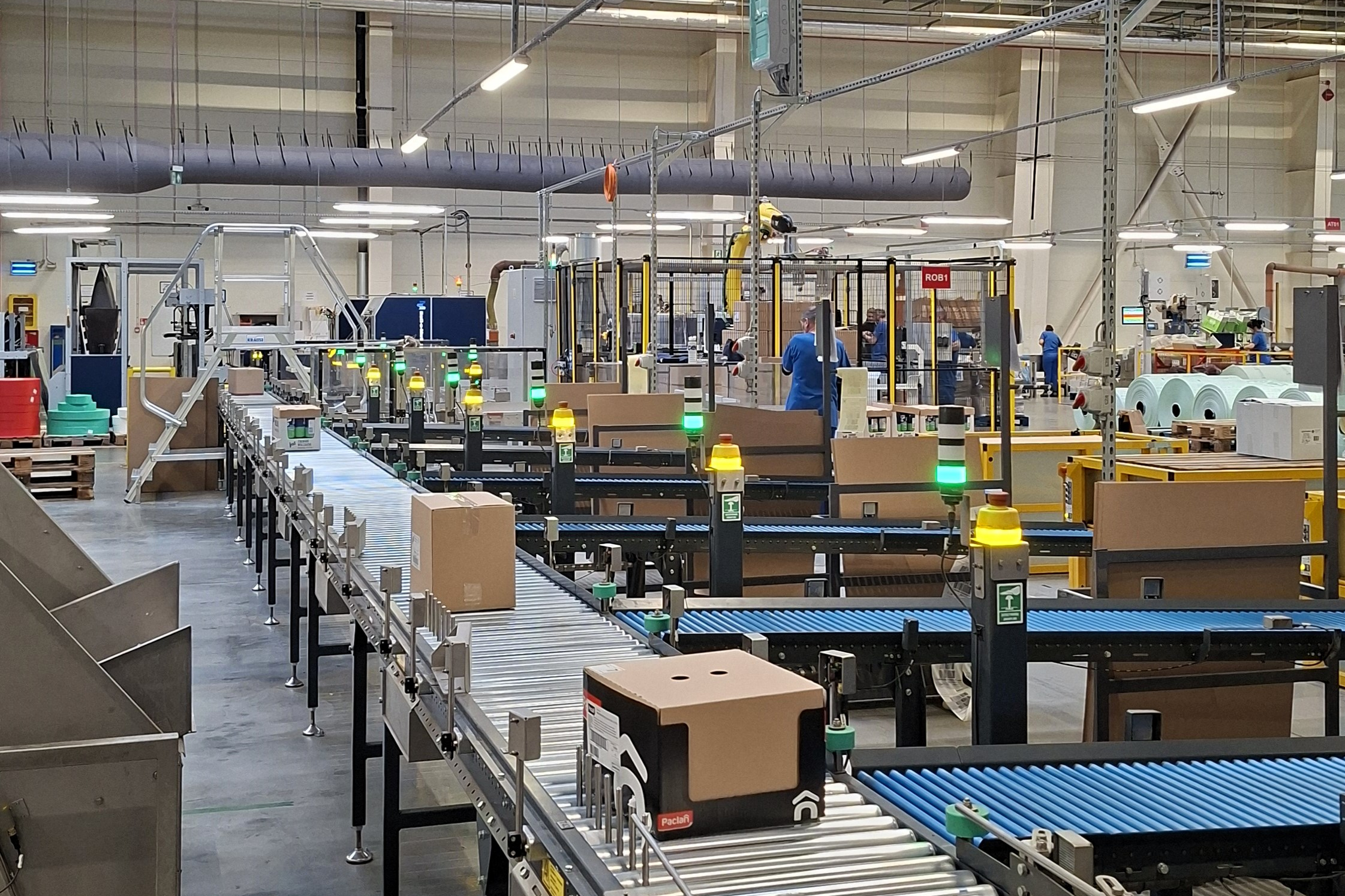
Folding boxes, transporting them, and placing them on pallets can take up a significant portion of the work involved in operating a production line. These operations can be combined into a single system. Centralizing packing stations also opens up the possibility of automating and robotizing subsequent stages of the process. However, this approach requires proper design of material flow, integration of transport systems and packing stations, as well as standardization of packaging designs. Mateusz Jelonek, Automation Leader at Cedo, explains what to pay attention to when planning such a change.
From individual lines to a joint system
When planning the centralization of the packing process, it is crucial to analyze the entire material flow in the production area. The existing layout, adapted for independent operation of individual lines, may require reorganization. The placement of lines and operator stations, as well as the available space, determine how the solution is designed. Centralizing operations therefore requires separating common process zones and integrating them with other elements of the system.
In one of our production areas, where we manufacture items such as waste bags, we implemented a project to centralize packing stations and automate selected process operations for several conversion lines. Previously, each line was operated independently, and operations related to forming boxes, packing, and palletizing were carried out directly at the individual lines. As part of the project, we separated some of these operations from the operator stations and moved them to common, dedicated zones, connected by a transport system that ensures smooth material flow between individual process nodes. We also implemented automatic box forming and labeling – a vision system identifies data on the label, based on which finished product boxes are directed to the appropriate palletizing zones. The actual process of packing the product into boxes remains a manual operation at this stage, but the operator stations have been equipped with a finished product weight control system. Automating the packing of products into bulk packaging is currently one of the key areas of automation we want to focus on in future projects.
– explains Mateusz Jelonek.
It is also necessary to ensure information exchange between system elements and its integration with the plant’s infrastructure.
A significant element of the project was also connecting the automation layer with the ERP system and using product data directly in the production process. Thanks to this, we implemented automatic control of selected quality parameters, as well as their ongoing monitoring and visualization. As a result, the project connected not only devices and subsequent process stages, but also automation, digitalization, and production data.
– adds the expert.
Packaging standardization vs. customer requirements
Centralizing the packing process for several lines does not mean full standardization of all products. Individual items may require different packaging formats, labeling methods, or palletizing schemes, resulting from product specifications and individual customer requirements. Therefore, it is crucial to consider the required diversity and ensure appropriate flexibility of the solution at the automation system design stage.
We handle various product codes, and consequently, several box formats and palletizing schemes. The system must account for this diversity, but during design, we also check which elements can be standardized. At the implementation stage, we had to adapt the box design for automatic forming. In the case of manual palletizing, the operator can continuously correct the arrangement of boxes on the pallet and react to small deviations, whereas a robotic process requires greater packaging repeatability and stable conditions. Therefore, the choice of technology must go hand in hand with an assessment of the boxes themselves and a potential change in their construction. Such changes require cooperation with teams responsible for the product and servicing individual markets. On one hand, we have the technical requirements of the equipment, and on the other, the expectations of customers, which must be reconciled. Automating such a process is an interdisciplinary project that goes beyond just machine integration. It requires combining many areas: from automation, IT, and production data, to product, market, and customer requirements. Only the cooperation of these areas allows for creating a stable, scalable solution adapted to the real needs of production.
– says the Automation Leader at Cedo.
System expansion starts at the design stage
From an automation perspective, it is important to think about the possibility of further expansion and integration of subsequent processes at the design stage. It is worth treating automation as a gradual transformation of the entire production process, rather than a collection of individual, independent projects.
The first stage of the project is already functioning and has brought about a reduction in manual operations as well as greater repeatability and stability of the process. Devices have taken over some of the tasks related to forming and labeling boxes, their transport, and palletizing. Thanks to the integration of automation with ERP, we can also automatically control selected quality parameters and continuously monitor and visualize results. In the second stage, we are implementing three more robotic stations for box forming for subsequent conversion lines. After their launch, we will achieve full automation of box forming in the production area covered by the project. The next direction for us is automating the packing of products into bulk packaging and further integration of production with internal logistics.
– summarizes Mateusz Jelonek from Cedo.
Source: Cedo sp. z o.o.