











In the second quarter of 2026, Slovenia’s GDP grew by 4.8 percent year-on-year – the second-highest result in the European Union after Malta, according to Eurostat data. Investment expenditure grew nearly four times faster than household consumption. In a country where the export of goods and services accounts for about four-fifths of GDP, such growth quickly translates into cargo flows. At SUUS, we have been operating in Slovenia since 2019, with branches in Koper and Brnik near Ljubljana, and we see this in our daily operations. The market’s potential is based on two pillars: the production of advanced goods, including pharmaceuticals and components for the automotive and electronics industries, and the country’s role as a transit gateway for the entire region.
Slovenia specializes in advanced semi-finished products and components. According to the SPIRIT Slovenia agency, the automotive sector alone accounts for about 20 percent of Slovenian exports. Local suppliers produce, among other things, tires, rims, lighting, seats, and electric powertrain systems for plants in Germany, France, Italy, and Austria. Alongside the automotive industry, the pharmaceutical and biotechnology base is growing in the country, as is the production of electronics: printed circuit boards, sensors, optoelectronic components, and laser devices.
For logistics, this means high-value cargo that is often sensitive to delivery deadlines. Components go straight to assembly lines abroad, so any delay means a production stoppage at the plant, while pharmaceuticals and electronics require controlled conditions and full shipment visibility throughout the entire chain. Therefore, Slovenian producers are increasingly expecting modern logistics based on precise delivery windows and temperature-controlled transport, combining sea and rail transport so that the cargo does not remain dependent on a single route.
Koper serves markets far beyond Slovenia
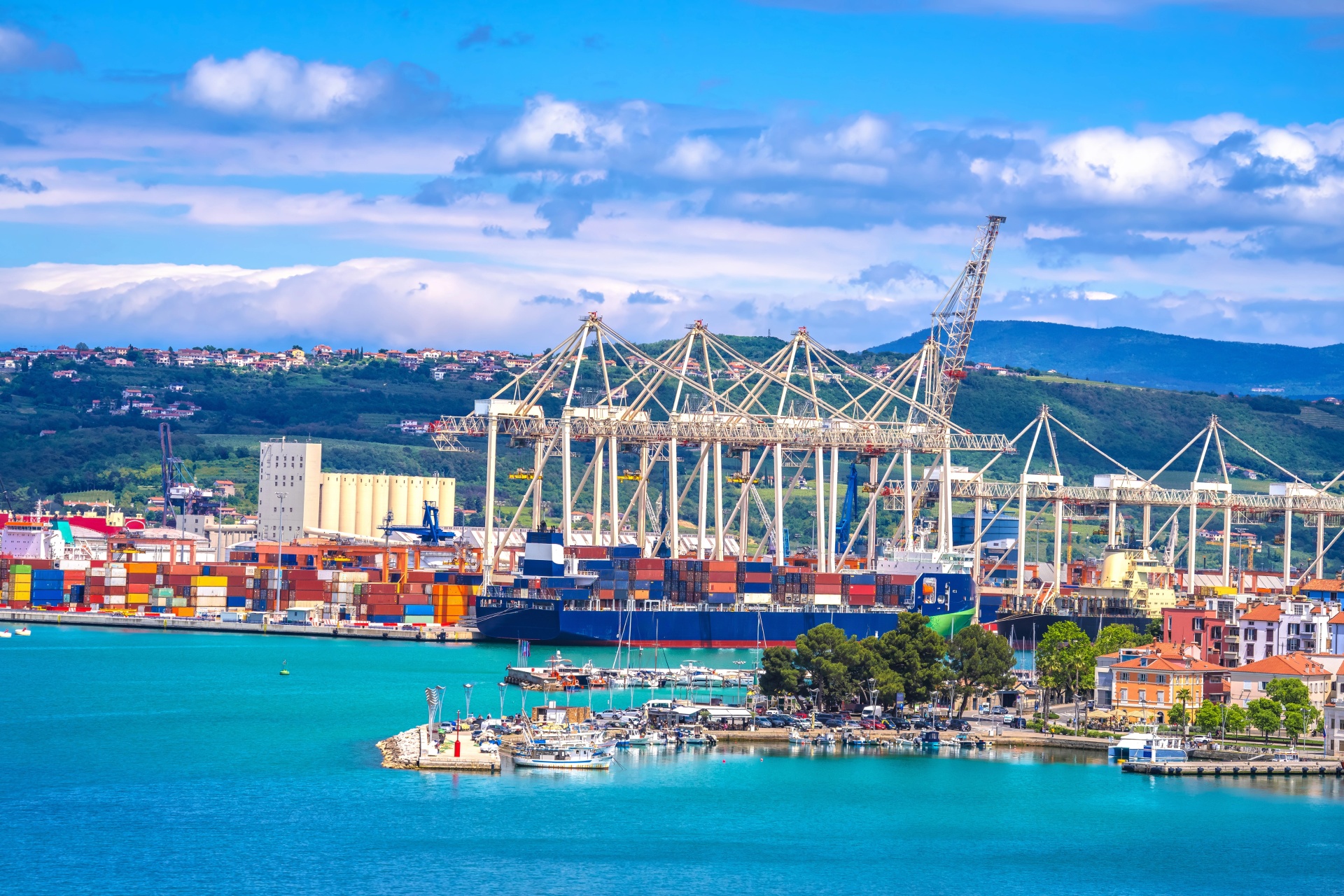
Transit is the second important pillar of the Slovenian economy. According to the Centre for Eastern Studies, more than 70 percent of cargo handled at the port of Koper comes from or is destined for foreign markets. Data from the Luka Koper company show that Austria and Hungary are larger container markets for the port than Slovenia itself, and Slovakia, the Czech Republic, and Poland are also among the top destinations. Trade with the Western Balkans also passes through Koper. For importers from Central Europe, the Adriatic port offers a shorter route from Asia and the Mediterranean basin than the North Sea ports – by up to seven days on selected routes. We are observing a growing demand for the transport of components for electromobility, including batteries for electric cars, solutions for IT and biotechnology, as well as equipment for renewable energy, i.e., energy storage and photovoltaic panels heading mainly towards Hungary and Austria.
Equally demanding is the transport of fresh fruit. The cold storage terminal in Koper handles, among other things, bananas from South America and citrus fruits from Egypt, which are directed from there to Germany, the Netherlands, and even Great Britain. With short-shelf-life cargo, every day saved at sea has measurable commercial value.
Second rail track will increase corridor capacity
The region’s ability to handle cargo depends on infrastructure. In 2025, rail already carried more than half of all inland transport to and from the port. The construction of the second track on the Divača–Koper section is in the final phase, and the special-purpose company 2TDK expects to obtain operating and usage permits at the end of the first quarter of 2027. According to the investor, the line’s capacity will increase from about 90 to 212 trains per day. For customers, this means more predictable delivery times to the heart of Europe and more opportunities to combine sea and rail transport.
Companies that plan supply chains based on new routes will gain an advantage
A large portion of the cargo arriving in Koper comes from outside the EU, which is why customs handling is becoming an operational competency here: from port clearance and temporary storage to reporting under CBAM, and from December 30, 2026, also obligations resulting from the EU Deforestation Regulation (EUDR). Companies that plan their supply chains now, taking into account Slovenian routes and regulatory requirements, will gain an advantage, as they will better utilize the increased capacity once the second track begins operation. At SUUS, we combine sea, air, rail, and road freight with transshipment and customs services in a single structure, and we design special solutions for demanding cargo such as pharmaceuticals and fruit. We treat Central and Eastern Europe as one integrated business unit, where operational decisions are made locally.
The prospects are good: in September, the Slovenian Institute of Macroeconomic Analysis and Development raised its GDP growth forecast for this year to 3.8 percent, pointing to new production capacities in the pharmaceutical and automotive industries. If exports maintain their pace, the demand for cargo handling through Koper will continue to grow.
Source: Rohlig SUUS Logistics