








The European Commission has today announced a proposal for a compromise solution regarding the amendment of the CO2 emission reduction target for passenger cars and vans from 2035. Instead of a 100% reduction, manufacturers will be required to limit emissions by 90%. Interim targets for 2030 are set to remain without critical changes. As assessed by the Polish Alternative Fuels Association (PSNM), the Commission’s draft will not decisively affect the development of electromobility in the European Union, where nearly 8 million new electric cars will continue to be registered annually by 2035, despite the lowering of the target emission reduction level. Reducing emission ambitions will also not solve the problems of the European automotive industry. Global electromobility development will continue regardless of this decision, and the European automotive sector will continue to face growing technological and price pressure from manufacturers in other parts of the world.
The European Commission today presented a package of initiatives for the automotive industry, including a proposal to amend emission regulations resulting from Regulation 2019/631. According to the new rules, from 2035, manufacturers will reduce CO2 emissions of new passenger cars and vans by 90% instead of 100%. The requirement for zero emissions will also not appear in 2040. The final shape of the new regulations remains an open issue – subsequently, the announced draft will be subject to trilogue negotiations between the Commission, the European Parliament, and the EU Council.
The Commission’s proposal constitutes a softening of the regulations adopted under the “Fit for 55” package. Consequently, not all cars leaving showrooms in 10 years will be zero-emission. It is difficult to assess this change positively, especially since it means a correction of previously adopted rules, which were followed by specific investment decisions. However, let us remember that a 90% CO2 emission reduction is still an extremely ambitious goal, which means staying the course for dynamic fleet electrification. Space for fossil fuel-based technologies will remain very limited. In practice, the proposed changes will not have a critical impact on the development of electromobility in member states.
– comments Maciej Mazur, CEO of the Polish Alternative Fuels Association (PSNM).
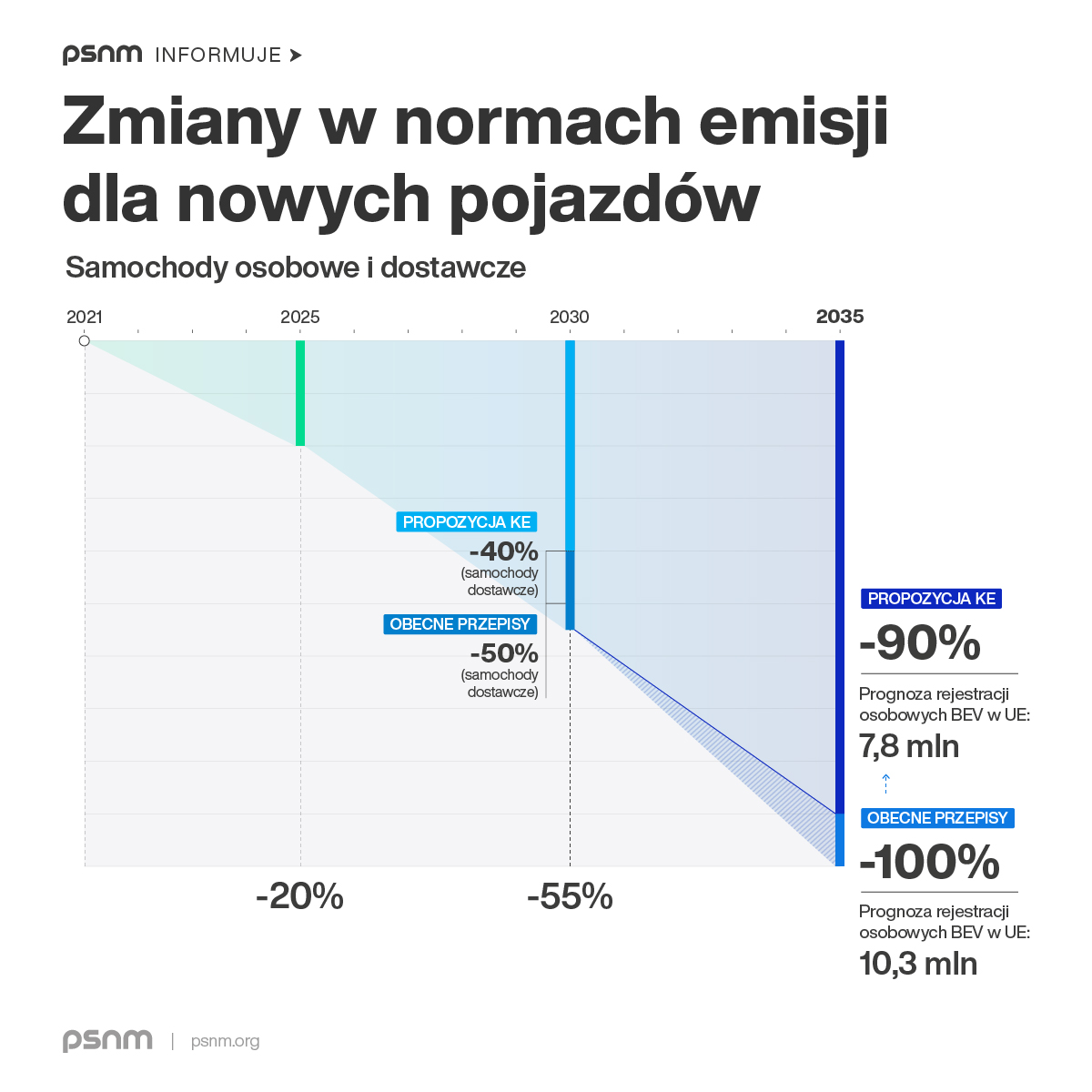
Emission reduction targets stem from the Regulation of the European Parliament and of the Council (EU) 2019/631. The currently applicable version of the regulation provides that compared to 2021, the average annual CO2 emission level of the EU’s passenger car and van fleet should be reduced by 15% from 2025, by 55% (50% in the case of “vans”) from 2030, and ultimately by 100% from 2035. As a result, the regulation motivates automotive groups to provide customers with an increasing number of low- and zero-emission cars, primarily electric ones. Currently applicable law also means in practice that from 2035, the sale of new passenger cars and vans with internal combustion engines will end in all EU member states. The plans announced today, however, mean that the previously planned “ban” will most likely not come into force. Besides regulatory changes relating to 2035, the Commission’s proposal also provides for a slight modification of the targets set for 2030 for vans (40% instead of the current 50% reduction). The level of interim targets for passenger cars (55% reduction) will remain unchanged, but the method of their implementation will be modified – an average of three consecutive years is to be taken into account. A similar mechanism was introduced in 2025 for currently applicable targets, and yet the European e-mobility market is recording record growth.
Taking into account the differences in detailed provisions, the new shape of regulations for passenger cars and vans can be compared to the current targets for heavy-duty vehicles, defined in another regulation (2019/1242). In this case, the target emission reduction level is also 90%, albeit from 2040. And from the moment these regulations were announced, the industry focused on almost full electrification of the HDV sector. A similar course will be maintained for passenger cars and vans, but changing the applicable regulations will mean that in 10 years, the number of new passenger BEV registrations in the EU may be even more than 20% lower compared to the forecast under current legal status. We estimate that in 2035, instead of 10.3 million BEVs, about 7.8 million such vehicles will leave European showrooms. This will still be the vast majority of newly registered cars in the member states.
– says Jan Wiśniewski, Director of the PSNM Research and Analysis Center.
The Commission’s project also contains other proposals, such as introducing a pooling system, which will allow groups not meeting emission targets to buy credits from companies that exceed them. Such a solution will provide a massive financial injection for manufacturers investing in electric cars, further reducing the competitiveness of OEMs losing the technological race. The Commission also proposed, among other things, regulations intended to stimulate the sale of small, affordable electric cars (as part of the Small Affordable Cars initiative). Before 2035, OEMs producing such vehicles will be able to use “super-credits” included in CO2 emission standards. Consequently, they could count on a factor of 1.3 in emission target calculations, which means that if a manufacturer sells 10 small electric vehicles, they will receive emission credits worth 13 cars. The Commission has also proposed obligations regarding the electrification of corporate fleets. The required share of zero-emission passenger cars and vans used by large enterprises is to vary depending on the member state. In 2030, it is to range from 17% (Bulgaria) to 100% (Ireland and Luxembourg). Requirements for Poland were set at 24% (2030) and 45% (2035). The Commission also intends to create a sustainable battery ecosystem in Europe and increase the cost competitiveness of production in the EU through a dedicated program (“Battery Booster”) worth EUR 1.8 billion. Furthermore, thanks to new vehicle labeling regulations, consumers are to be informed before purchasing new and used passenger cars and vans about fuel efficiency and CO2 emissions, as well as whether the car was produced in the EU.
PSNM emphasizes that the governments of some member states opting for softening emission targets seem not to notice that it is not electrification and EU regulations that are the main cause of the deteriorating position of the European automotive industry, the increasingly frequent closing of plants, and mass layoffs.
There is no chance that any change in regulations will stop the global development of electromobility and restore the market situation from two or three decades ago. Our industry is losing competitiveness not so much due to EU regulations, but primarily because it cannot handle the technological and price pressure from manufacturers in other parts of the world. It cannot be otherwise, since the USA spends more than twice as much on research and development than the European Union. In China, already in 2024, 2/3 of electric cars were offered at prices lower than internal combustion vehicles, even without taking into account subsidies. We hope that decision-makers, both at the EU and national levels, will treat the change in emission targets as a warning signal and intensify work on a coherent and ambitious strategy for the transformation of the European automotive industry. The support instruments proposed today by the Commission, parallel to the project to weaken emission targets, will not be enough to make up for the distance lost so far.
– points out Aleksander Rajch, Board Member of PSNM.
Source: PSNM