








In 2025, the freight transport market entered a new phase. While the currently recorded transport volume is growing, it is doing so at a slower rate than in 2024. According to analysts, this trend will continue in the coming years. Data from Eurostat shows that in 2024, over 13.1 billion tons of goods were transported on the roads of the European Union, which corresponds to 1,867 billion ton-kilometers. However, these are superficial data. Geopolitical changes observed by logistics industry experts indicate that the market is entering a period of uncertainty, and the key to success is the ability to analyze the business environment and make balanced and informed decisions.
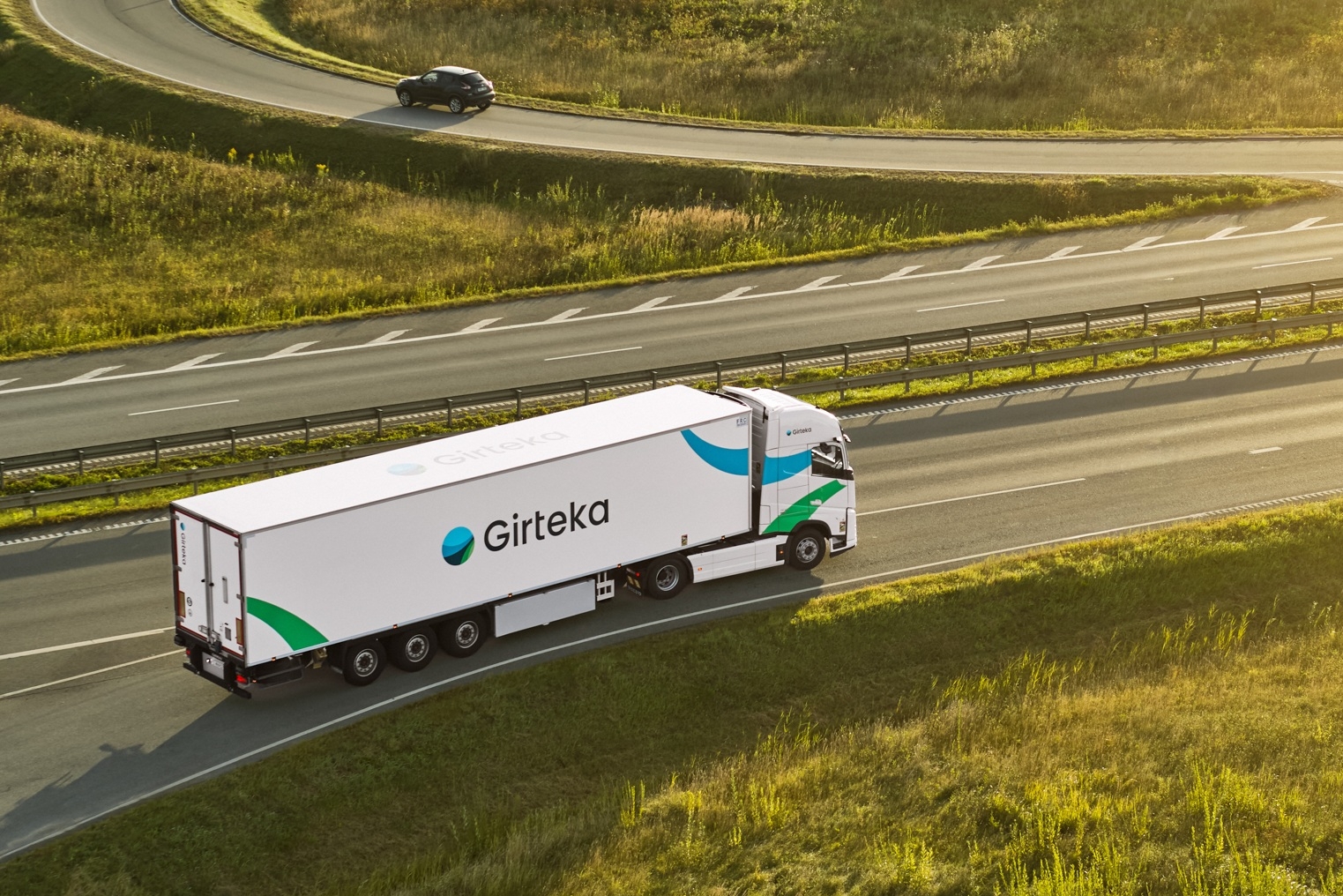
What does the situation look like in the road transport market and what will be important for its future? Girteka, Europe’s largest asset-based transport company, comments.
The market is heating up
Virtually all measurable indicators point to the European freight transport market heating up. As Tomas Šilinikas, Head of Regional Sales and Pricing at Girteka, explains, the most telling signal is the number of spot transport inquiries directed at carriers. Currently, there are almost twice as many as in the same period last year.
This shows that demand is growing, which is also confirmed by rising spot transport prices — services purchased not under long-term contracts, but to meet current needs. At the same time, we see that our contract clients are maintaining high transport volumes. For example, during a slowdown, if we had a contract for 100 transports per month, we might only fulfill 50. When the situation improved, the number increased to 70 or more. Now we are operating close to maximum transport capacity.
– says Tomas Šilinikas.
The expert attributes this growth to several factors. First and foremost, it stems from the post-pandemic recession, when production and consumption in Europe were limited. Many transport companies went bankrupt, others reduced their fleets, and many lost employees. According to the ECB, the number of bankruptcies in the transport and warehousing sector has increased by 180% compared to 2016. The effects are still felt today, making it difficult for carriers to keep up with growing demand.
Another important factor is the increase in exports from Germany and the Benelux countries to the United States. This was largely due to changes in tariff policies introduced by Donald Trump, which created uncertainty and prompted companies to act quickly. This trend is reflected, for example, in the noticeably higher production of German factories. In other words, market dynamics are shaped more by geopolitical factors than by domestic consumption.
– says Tomas Šilinikas.
Fragile economic recovery in Europe
Freight transport can be treated as a barometer of economic activity. Trends in logistics often indicate the direction other sectors are heading. As Šilinikas explains, this is because carriers react directly to changes in consumption and production. Currently, these are mainly shaped by one factor: weak economic growth in Europe, especially in Germany and France. Although the EU economy shows some signs of recovery, it is still performing below potential, and forecasts for individual countries vary.
After adjusting the tariffs, exports fell slightly and have since returned to more normal levels. Whether they will continue to decrease year-on-year is difficult to determine for now. At the same time, we are seeing signs of a recovery in consumption in Europe. The PMI indicator reached 51 points — which means a growth zone and is the highest result in 38 months. This suggests that if exports have weakened after an earlier increase caused by inventory buildup in the USA, but production is still growing, then the driving force for growth is domestic consumption. And rising consumption, combined with the ongoing driver shortage and the three-year-long transport capacity crisis, inevitably leads to a lack of available transport capacity.
– explains Tomas Šilinikas.
If US tariffs on goods from China turn out to be significantly higher than before, European producers may become more attractive to American buyers, as the price gap between European and Asian products will decrease. Conversely, if tariffs remain only slightly changed, European companies will face even fiercer competition. For the European Union, an economy largely based on exports, this would pose a major challenge.
Nevertheless, Šilinikas predicts that the United States will remain a key trading partner for Europe. A recently concluded trade agreement suggests that the worst-case scenario has been avoided. Even if trade volumes fall, a sharp collapse is not expected. Other geopolitical risks are a greater cause for concern.
At the same time, we are increasingly falling behind China, which completely dominates green technology and electric vehicle production. This is a serious challenge for Europe’s competitiveness, especially in the automotive and chemical industries.
– notes the Head of Regional Sales and Pricing at Girteka.
In response, the EU initiated the “Green Deal” and recently introduced targeted tariffs on imports of Chinese electric vehicles. This is not a uniform policy, but a deliberate step aimed at leveling the playing field against what the EU perceives as subsidized competition. However, this introduces uncertainty into the logistics sector, with a direct impact on trade flows and volumes.
If tariffs effectively restrict imports from China, it could lead to an increase in domestic production, changing the demand for transport. On the other hand, strong pressure from cheaper Chinese electric vehicles could force European manufacturers to reduce production, triggering a domino effect that would shake the entire supply chain – the primary customer for transport companies.
– says Šilinikas.
Stable contracts or the profitability of spot orders?
A heated market has also led to an increase in demand for spot orders, i.e., transport carried out based on market conditions rather than long-term contracts. Such orders are usually more profitable for carriers, but carry greater risk due to unpredictability. Some companies focus almost exclusively on spot transport, achieving higher profits during periods of boom but struggling when the market shrinks or it is necessary to maintain a constant fleet.
Our approach assumes that long-term contractual obligations should ensure stability, while spot orders help smooth out fluctuations or maximize profit. Contracts remain the backbone of a sustainable business as they guarantee that trucks will not stand idle. Spot orders should be handled by resources kept in reserve.
– explains Tomas Šilinikas.
However, this does not mean that contracts are a guarantee of success. They provide stability but can also lead to missed opportunities. Since contracts are usually signed for a year, companies must forecast the economic situation, cost dynamics (roads, tunnels, maintenance, costs of recruiting and retaining drivers), and other factors as accurately as possible.
Will the economy grow, generating more orders? Or will conditions worsen, making it necessary to secure as many contracts as possible because demand for spot transport will fall? That is why monitoring geopolitical factors is not just a matter of curiosity — it is the only way to make informed decisions.
– emphasizes the Girteka expert.
A large logistics company might have 70–80% of its fleet covered by long-term contracts (which provides a stable base) and allocate the remaining 20–30% to spot transport, allowing it to capitalize on periods of market growth and optimize profits. Such a strategy limits risk while ensuring flexibility.
In search of balance
Another factor that is having an increasing impact on the transport industry is climate change. Seasonal changes are already noticeable; for example, heat waves have disrupted fruit exports from Spain.
From a logistics operator’s perspective, this means a need for greater focus on cargo storage conditions, which affects fuel consumption. It is the same with flooding — you just have to bypass them, which involves extra kilometers. So far, these phenomena are difficult to measure precisely and rely mainly on expert judgment. However, in the future, this problem will gain more and more importance.
– says Šilinikas.
In other words, weather conditions and forecasts are becoming another variable that logistics companies must take into account. According to the expert, success in this industry depends on the ability to predict what will happen in the 6 to 12-month horizon. Only in this way can one understand economic dynamics and avoid mistakes with serious, long-term consequences.
Maintaining a balance between long-term contracts and spot opportunities is crucial today – you must ensure stability while remaining flexible enough to take advantage of attractive offers. To put it another way, one should take advantage of the current situation while keeping the future in mind, because there is no guarantee that current conditions will persist.
– summarizes the Head of Regional Sales and Pricing at Girteka.
Source: Girteka Group